
































Complete Sour Beer Styles Word Search | Adults ELA

Paste this activity's link or code into your existing LMS (Google Classroom, Canvas, Teams, Schoology, Moodle, etc.).
Students can open and work on the activity right away, with no student login required.
You'll still be able to track student progress and results from your teacher account.
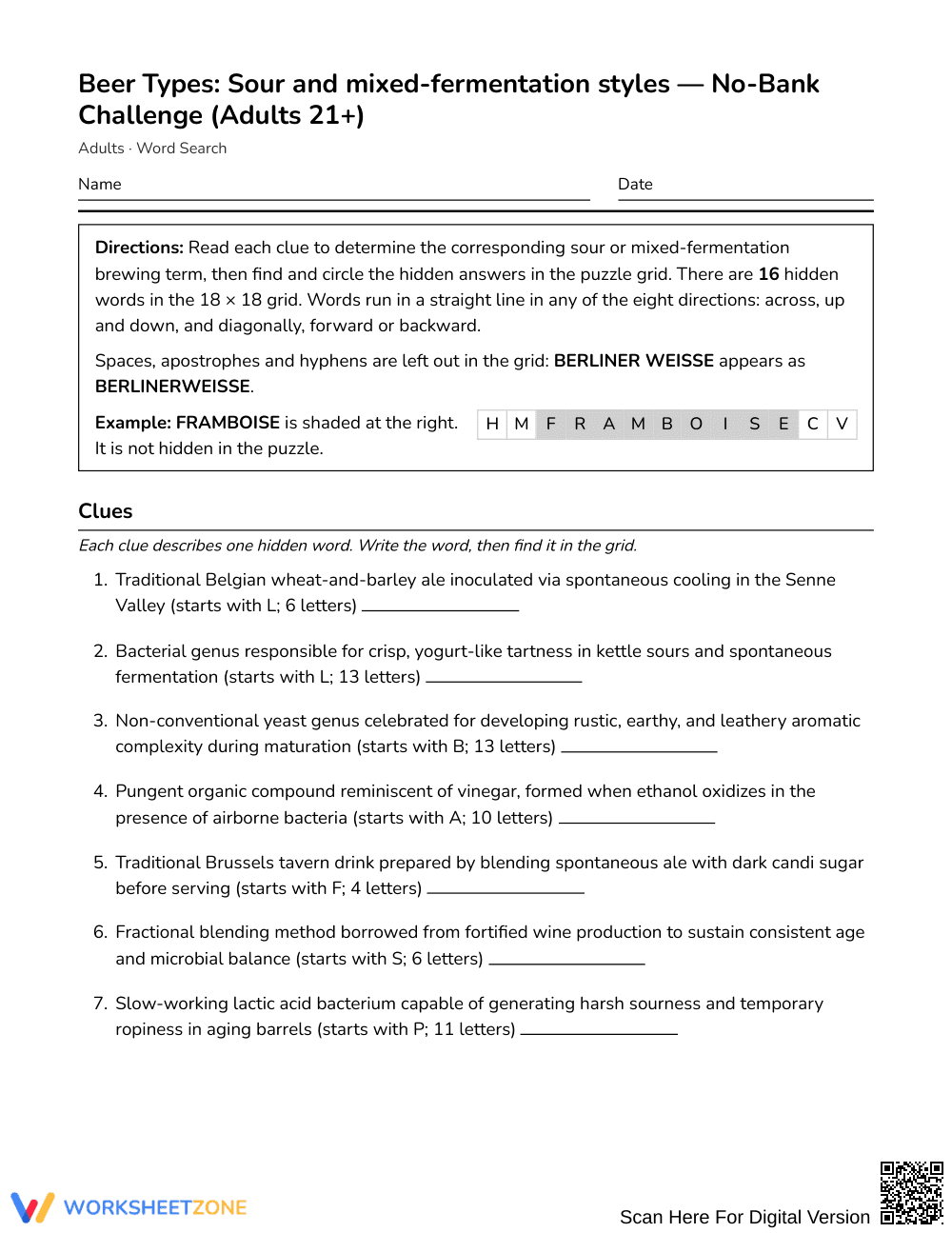
This adult-level word search builds specialized brewing and fermentation vocabulary through targeted retrieval practice. Adult learners actively reinforce their knowledge of sour and mixed-fermentation beer styles, wild microbes, and traditional brewing vessels by identifying 16 key terms hidden across the puzzle. The clue-driven format ensures conceptual recall rather than passive letter matching.
At a Glance
- Grade: Adults · Subject: English Language Arts (ELA)
- Standard: Not standards-assessed — vocabulary enrichment
- Skill Focus: Sour and mixed-fermentation brewing styles
- Format: 3 pages · 16 hidden words · Full answer key included · Printable PDF
- Best For: Adult beverage education, hospitality training, and specialized vocabulary mastery
- Time: 25–35 total minutes
What's Inside
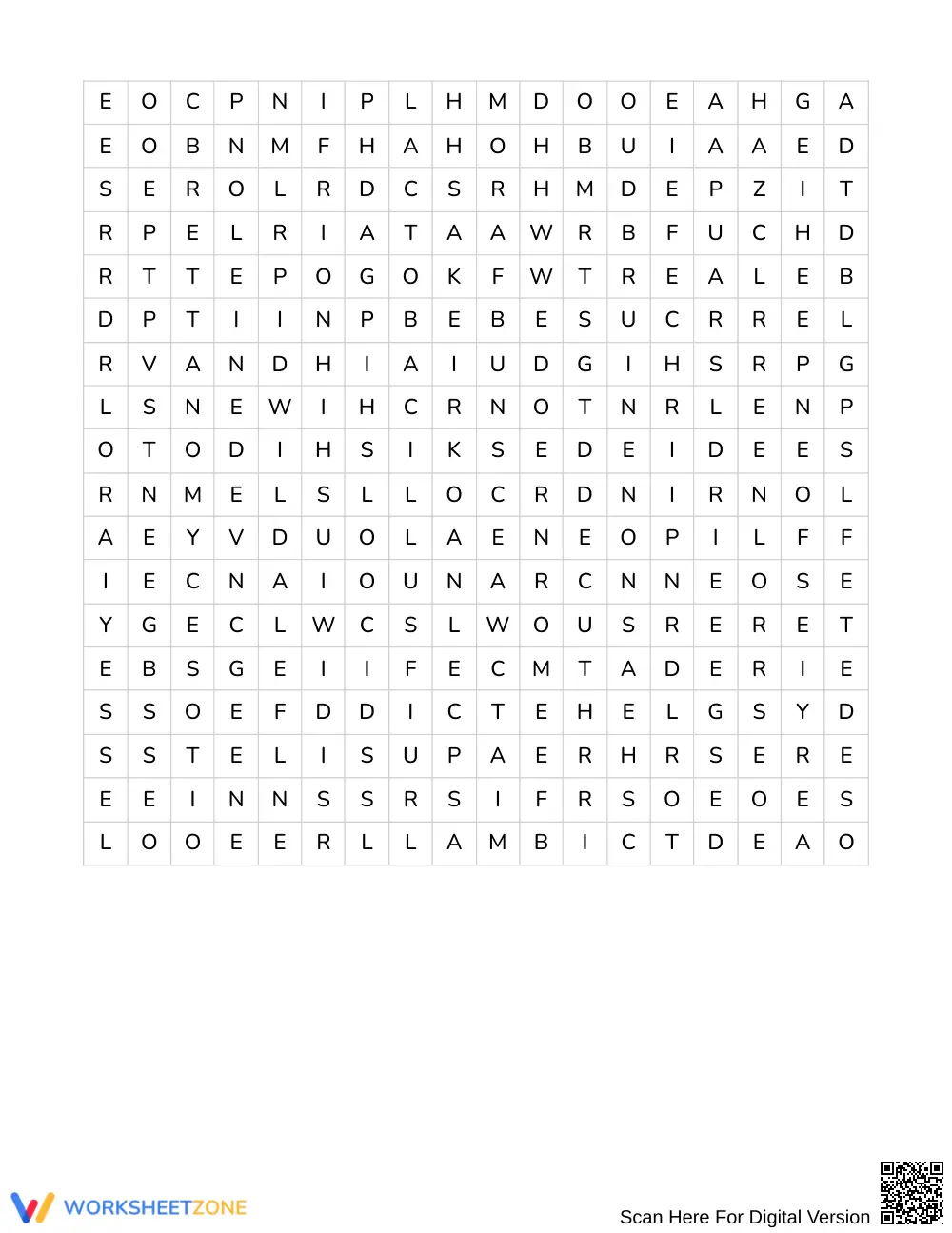
The 3-page printable document features an advanced word puzzle accompanied by detailed, definition-style clues. Instead of a standard list of target terms, learners receive 16 comprehensive descriptions covering spontaneous fermentation, historic regional styles, wood aging, and microflora. The resource includes a complete answer key highlighting exact coordinate locations across all 16 hidden terms for quick verification.
Puzzle Mechanics
This no-bank challenge operates on an 18 × 18 letter grid designed to engage analytical reasoning. Words are oriented in all eight possible directions: north, northeast, east, southeast, south, southwest, west, and northwest. Without a visible word bank, adult learners must read each technical clue, deduce the corresponding brewing terminology, and scan the dense grid systematically to locate the answers.
Standards Alignment
This resource focuses exclusively on specialized vocabulary enrichment and is not aligned to K–12 academic standards. It serves adult education courses, hospitality training programs, and beverage industry certificate preparation by developing technical lexicon and style identification skills.
How to Use It
Deploy this activity during or after direct instruction on fermentation science and European brewing traditions. In classroom or workshop settings, instructors can use the puzzle as an independent review session to consolidate terminology following a lecture on spontaneous fermentation. Alternatively, facilitators can assign it as a collaborative partner challenge to spark discussion around style profiles and microbial actions. Formatively observe whether learners struggle with microbe nomenclature versus style names to identify areas needing conceptual reinforcement. Expected completion time spans 25 to 35 minutes.
Who It's For
This activity is designed for adult learners, including sensory analysis trainees, culinary arts cohorts, and hospitality staff expanding their craft beverage knowledge. For learners requiring extra support, educators can provide a reference sheet detailing Belgian and German brewing traditions. Pair this puzzle with an informational tasting guide or a sensory evaluation lecture to anchor technical definitions in real-world tasting notes.
Domain-specific vocabulary acquisition relies on deliberate cognitive retrieval pathways that strengthen long-term memory networks. According to Fisher & Frey (2014), intentional word-learning tasks that require adult learners to analyze contextual definitions before locating target terms foster significantly deeper orthographic and semantic retention than passive rote memorization. This adult word search challenges learners to decode 16 rigorous clues spanning spontaneous fermentation, regional traditions, and microbiology without relying on a passive word bank. By integrating bidirectional scanning across an 18 by 18 matrix with deductive problem-solving, adult learners systematically consolidate specialized brewing terminology. The activity effectively bridges conceptual comprehension and technical literacy, validating domain knowledge through active puzzle completion. Fisher & Frey (2014) emphasize that engaging adult learners with complex informational prompts accelerates technical fluency, enhances cognitive engagement, and supports sustained recall across specialized professional disciplines.


