
































Complete Solving Inequalities Worksheet | Grade 7 Math

Paste this activity's link or code into your existing LMS (Google Classroom, Canvas, Teams, Schoology, Moodle, etc.).
Students can open and work on the activity right away, with no student login required.
You'll still be able to track student progress and results from your teacher account.
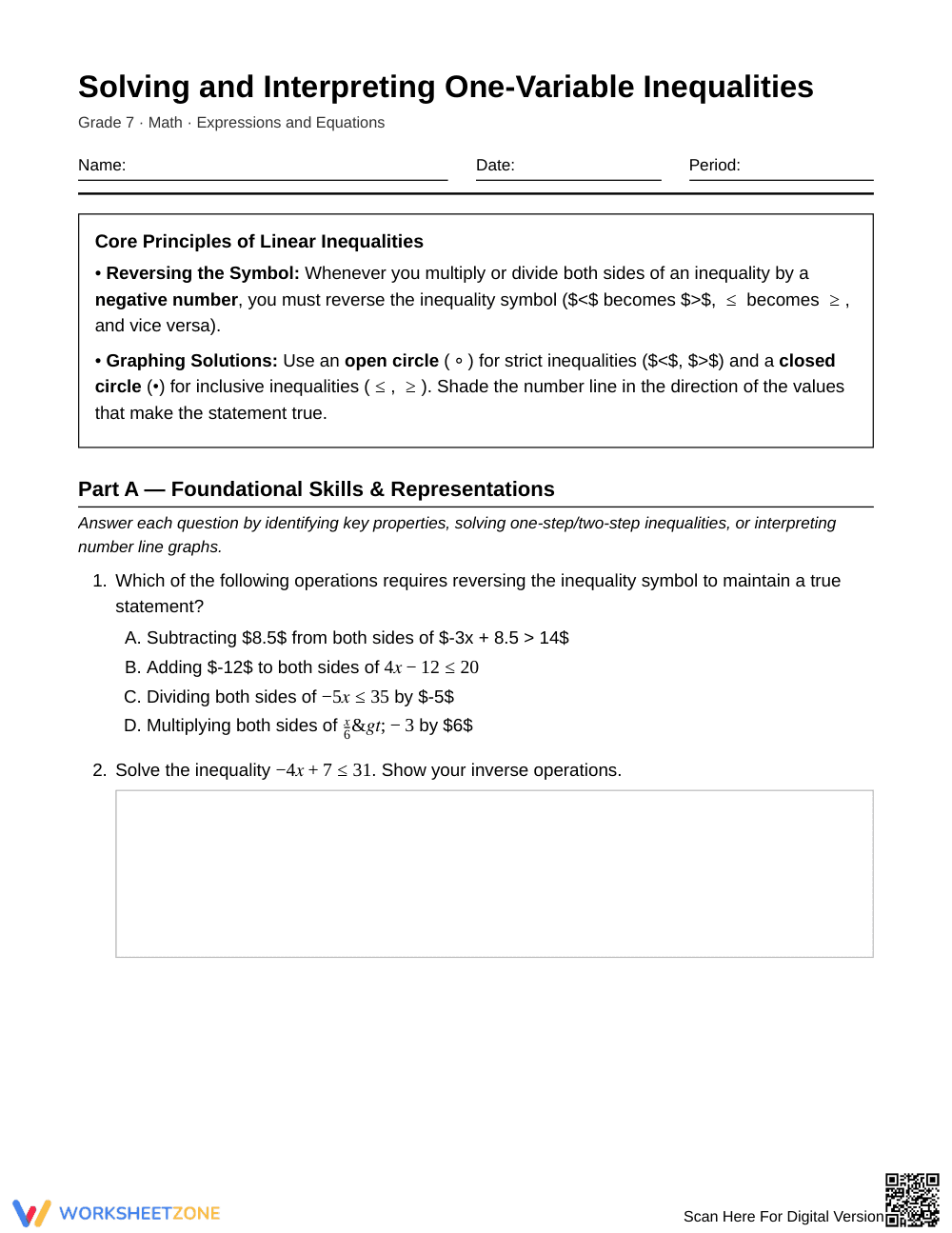
This Grade 7 math worksheet develops student proficiency in solving, graphing, and interpreting one-variable linear inequalities. Learners master sign reversal rules, isolate variables across rational coefficients, and translate authentic constraints into algebraic models, ensuring solid preparation for high school algebra concepts.
At a Glance
- Grade: 7 · Subject: Math
- Standard:
7.EE.B.4— Solve multi-step linear inequalities and graph contextual solution sets- Skill Focus: Mix Inequality Solving and Interpretation
- Format: 5 pages · 16 problems · Answer key included · PDF
- Best For: Skill consolidation and contextual problem solving
- Time: 45–60 minutes
What's Inside
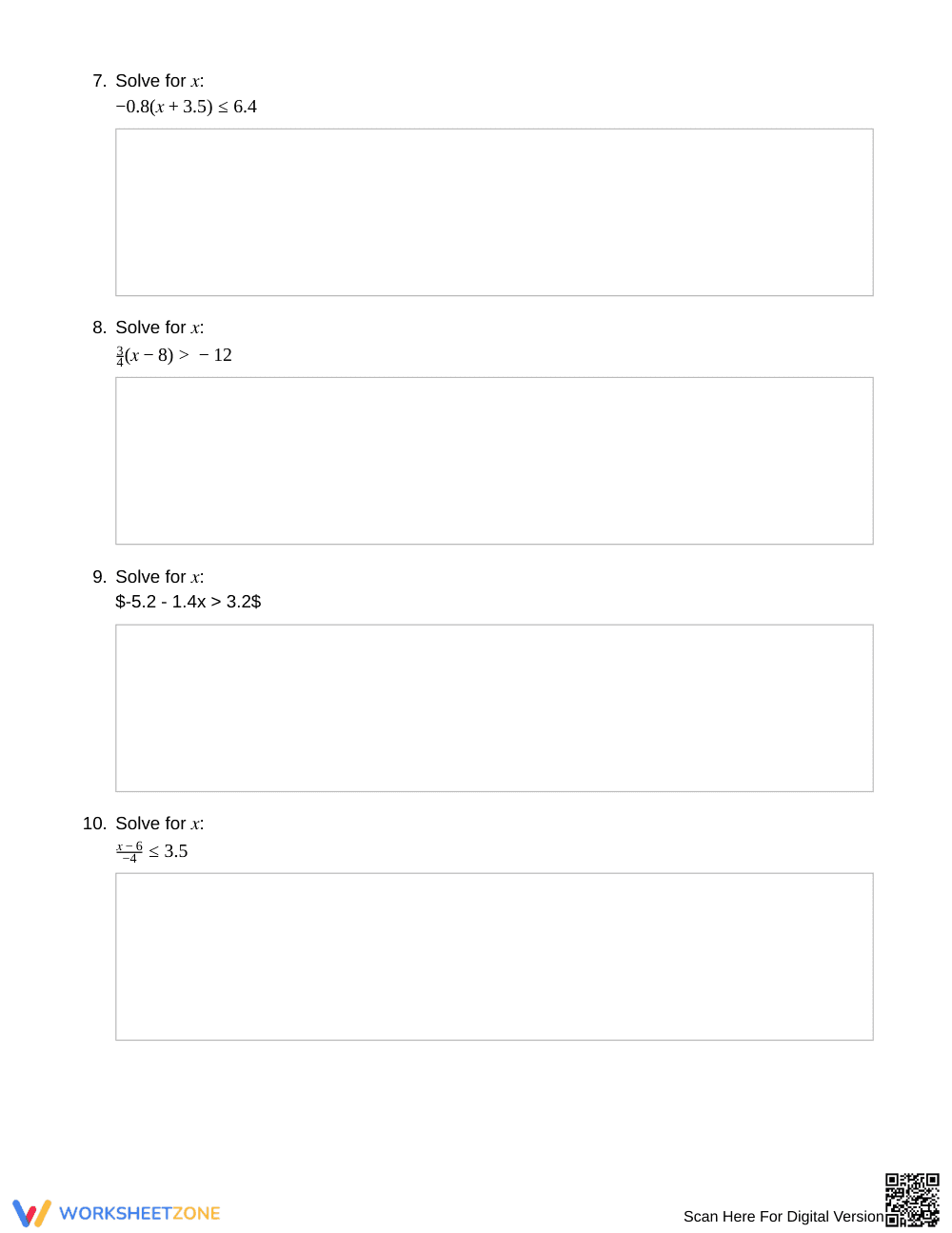
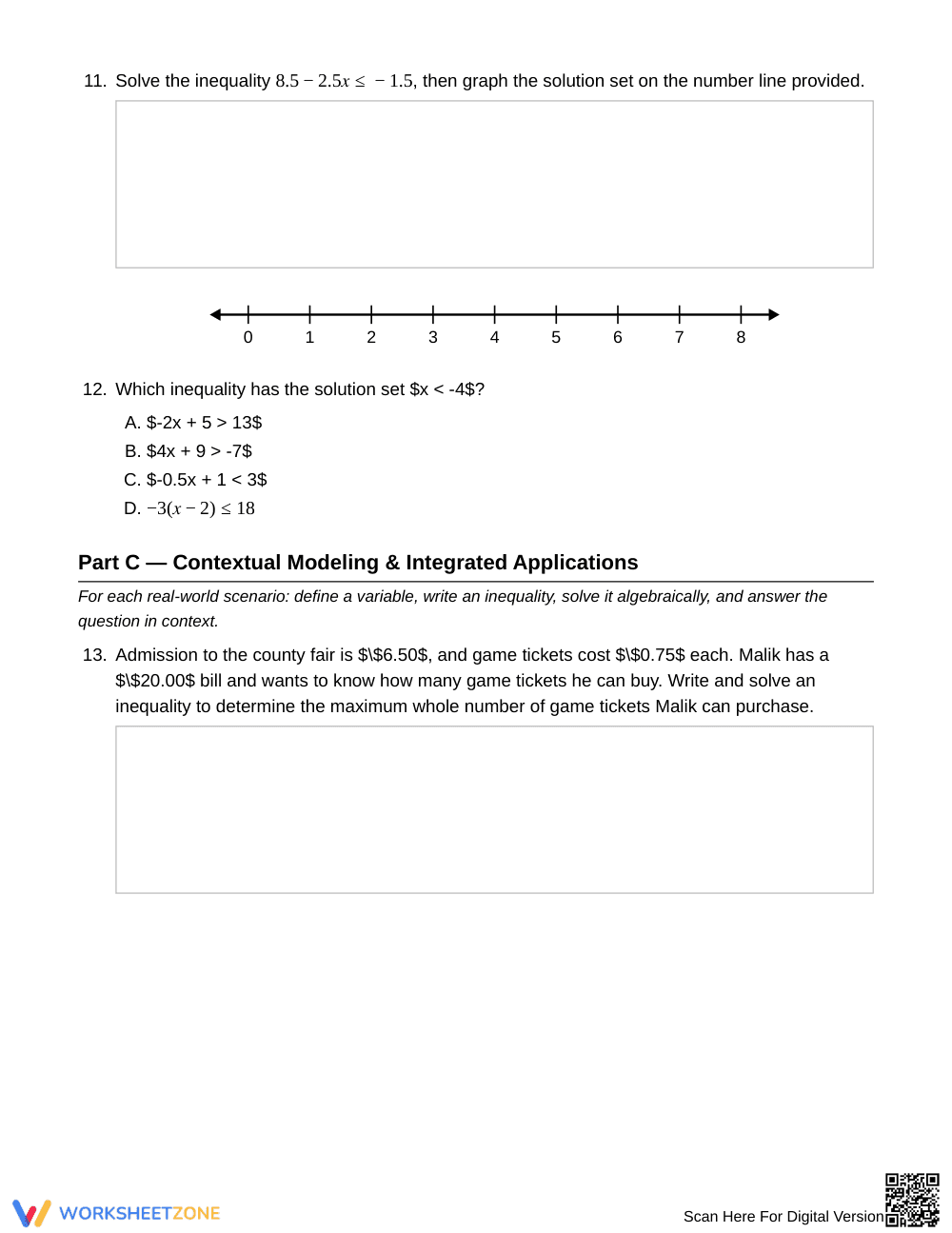
This 5-page printable resource includes 16 multi-step math problems divided into three structured sections. It features a foundational rule reference box highlighting sign reversal and number-line graphing protocols, followed by algebraic calculation items with fractions and decimals, and real-world modeling scenarios. A comprehensive 4-page answer key provides step-by-step arithmetic and completed graphical solutions.
Skill Progression
- Guided Practice (Part A, 4 problems): Students review core inequality theorems, evaluate inverse operations, interpret graphed solution sets, and test solution boundaries with low scaffolded difficulty.
- Supported Practice (Part B, 8 problems): Learners solve complex linear inequalities containing rational coefficients, negative multipliers, parentheses, and fractional terms while graphing results on number lines.
- Independent Practice (Part C, 4 problems): Students define variables, construct algebraic inequalities from situational word problems, compute exact boundary values, and interpret solutions in practical context.
This structured progression reflects the gradual release of responsibility model, guiding students smoothly from foundational concept verification to autonomous contextual problem-solving.
Standards Alignment
This resource aligns directly with standard `7.EE.B.4`, which requires students to use variables to represent quantities in real-world or mathematical problems and construct simple equations and inequalities to solve problems. It also supports `7.EE.B.4.b` by focusing on graphing solution sets and interpreting them in context. Both standard codes can be copied directly into lesson plans, IEP goals, or district curriculum mapping tools.
How to Use It
Deploy this worksheet immediately after direct instruction on multi-step inequalities or as targeted mid-unit review. During classwork, conduct formative observation by monitoring whether students remember to reverse inequality symbols when dividing by negative rational coefficients in Part B. The complete 16-task sequence requires approximately 45 to 60 minutes of focused instructional time.
Who It's For
Designed for Grade 7 general mathematics classrooms, accelerated Grade 6 cohorts, and Grade 8 remedial intervention groups. The visual rules support English language learners and students with IEP accommodations. Pair this worksheet directly with a teacher-led mini-lesson on inverse operations or a visual number-line anchor chart.
According to research highlighted in Fisher & Frey (2014), instructional frameworks that move systematically from conceptual modeling to targeted independent application significantly improve algebraic fluency and problem-solving retention in middle school mathematics. Standard 7.EE.B.4 emphasizes that Grade 7 students must not only manipulate symbolic expressions mechanically, but also interpret what inequality constraints mean within real-world situations. By integrating foundational property identification, multi-step calculation involving positive and negative rational numbers, number line representations, and word problem modeling, this worksheet directly addresses persistent misconceptions surrounding inverse operations and sign reversals when dividing by negative values. Teachers utilizing this resource gain actionable formative assessment data that pinpoints whether student errors stem from arithmetic errors or conceptual gaps in relational reasoning, establishing the rigorous mathematical foundation essential for linear modeling and functions in subsequent high school algebra coursework.


