































Complete Solubility Curves Worksheet | Grades 9-12 Science

Paste this activity's link or code into your existing LMS (Google Classroom, Canvas, Teams, Schoology, Moodle, etc.).
Students can open and work on the activity right away, with no student login required.
You'll still be able to track student progress and results from your teacher account.
Mastering solubility curves requires students to connect quantitative data with chemical principles. This 4-page worksheet provides high school science learners with 22 structured problems to interpret solubility tables, classify unsaturated, saturated, and supersaturated solutions, and calculate recrystallized mass across temperature changes.
At a Glance
- Grade: Grades 9–12 · Subject: Science
- Standard: Analyze thermal data to predict solubility patterns, classify chemical mixtures, and determine dissolved solute masses
- Skill Focus: Classification & Relationships
- Format: 4 pages · 22 problems · Full answer key · PDF
- Best For: High school chemistry and physical science practice
- Time: 45–60 minutes
What's Inside
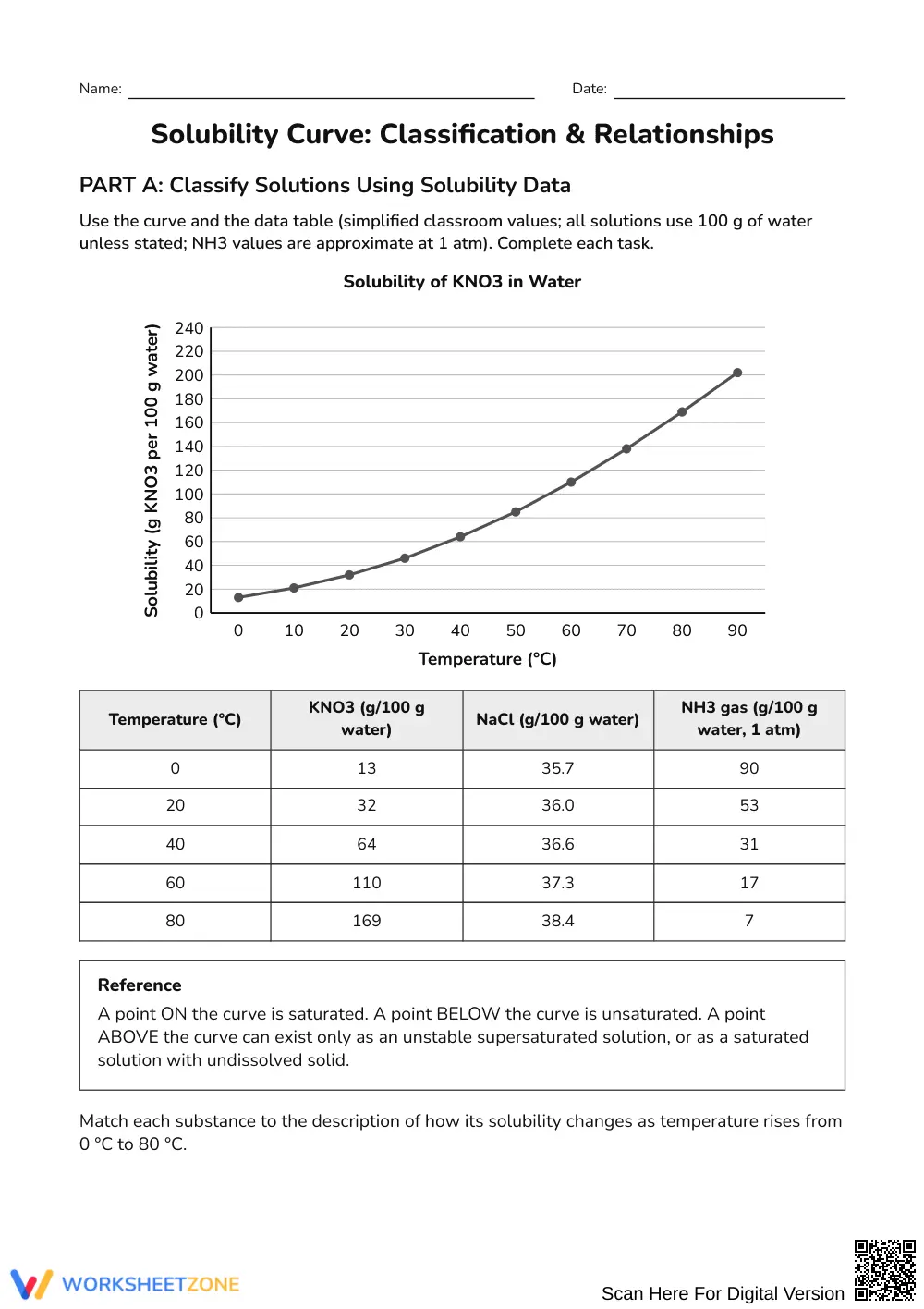
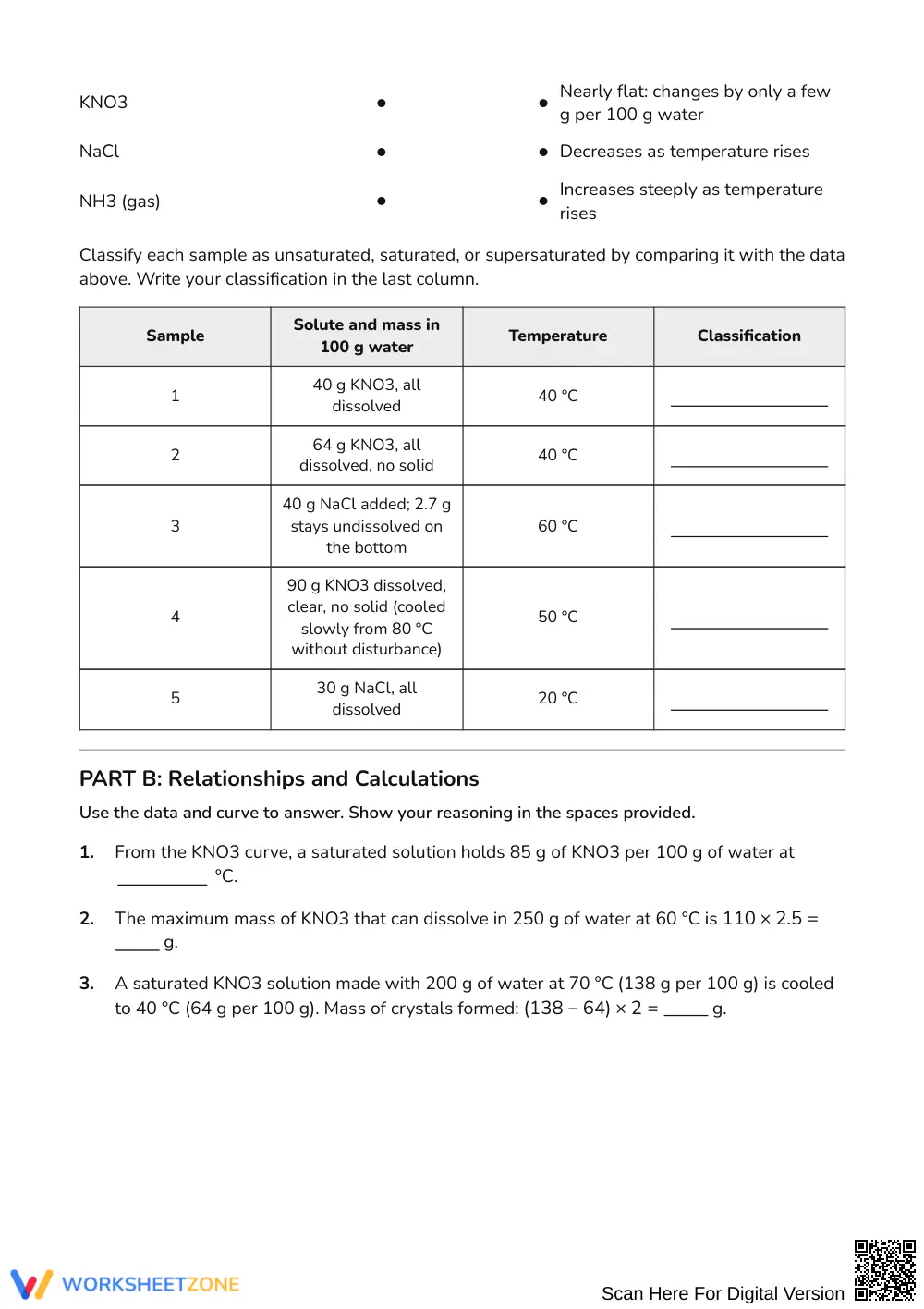
This 4-page worksheet includes 22 rigorous problems and a complete 4-page answer key. It features reference definitions for saturation states, tabular data sets for potassium nitrate, sodium chloride, and ammonia, matching tasks, proportional solvent calculations, crystal yield problems, and particle-level conceptual prompts.
Skill Progression
- Guided practice: Tasks 1–8 establish foundational knowledge through trend matching and classifying 5 solution samples using provided reference criteria.
- Supported practice: Tasks 9–15 prompt proportional calculations for varied solvent amounts, crystal yield analysis upon cooling, and claim evaluation using solubility data.
- Independent practice: Tasks 16–22 require students to differentiate dissolution rate from capacity, explain thermodynamic enthalpy, and analyze fractional crystallization.
This gradual-release structure moves learners systematically from basic data identification to advanced synthesis.
Standards Alignment
This worksheet aligns with high school physical science performance expectations focusing on matter interactions and chemical properties. Students analyze thermal solubility relationships, determine saturation thresholds, and apply energy principles to endothermic dissolving. Both standard codes can be copied directly into lesson plans, IEP goals, or district curriculum mapping tools.
How to Use It
Assign Part A during direct instruction to verify student understanding of saturation definitions before progressing. Use Part B as post-lab analysis following a solubility investigation. Check whether students accurately scale values for solvent volumes other than 100 g during formative checks. Expect completion in 45 to 60 minutes.
Who It's For
Designed for Grades 9–12 Chemistry and Physical Science classes, this resource supports diverse learners. Provide the reference definitions as an anchor chart for developing students, while assigning the thermodynamic items as extensions for advanced students. Pair directly with an interactive aqueous solutions lab.
High school science achievement in chemistry relies heavily on the ability to interpret multi-variable graphical data and connect mathematical models to particulate phenomena. According to Fisher & Frey (2014), structured instructional scaffolds that transition students from modeled classification to independent analytical reasoning foster deeper conceptual retention and transfer in secondary STEM classrooms. This 4-page solubility curves resource operationalizes those findings across 22 problems focused on classifying solutions, interpreting solubility trends, and calculating mass recovery. By engaging students in evaluating authentic temperature-dependent solubility tables and applying particulate models to endothermic dissolution, the worksheet provides systematic practice that bridges graphical fluency with thermodynamic principles. Educators can utilize the included 4-page answer key to evaluate student diagnostic data, address persistent misconceptions regarding saturation equilibrium, and document progress toward high school physical science standards for quantitative solution chemistry.


