































Complete Six-Letter Reading Word Search | Grades 7–8 ELA

Paste this activity's link or code into your existing LMS (Google Classroom, Canvas, Teams, Schoology, Moodle, etc.).
Students can open and work on the activity right away, with no student login required.
You'll still be able to track student progress and results from your teacher account.
Reinforce essential literary and academic vocabulary with this focused word search for middle school readers. Students examine definitions to identify target terms before locating them within the grid, strengthening word recognition and concept retention across core English Language Arts units.
At a Glance
- Grade: Grades 7–8 · Subject: English Language Arts (ELA)
- Standard: Not standards-assessed — vocabulary enrichment and orthographic word retrieval
- Skill Focus: Six-letter reading and literary terms
- Format: 3 pages · 18 words · Complete answer key included · Printable PDF
- Best For: Cumulative reading unit review, morning work, or sub plans
- Time: 20–30 minutes
What's Inside
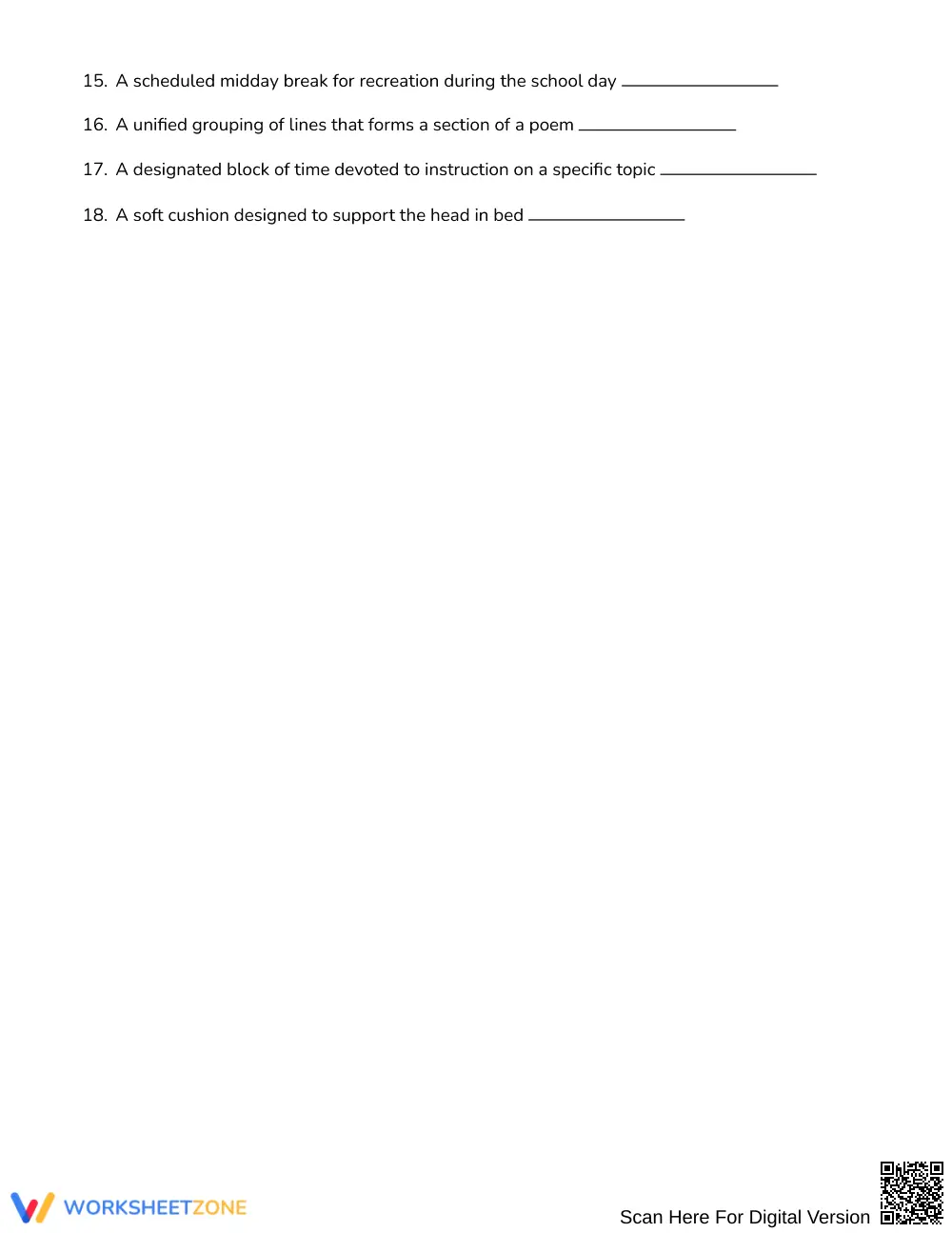
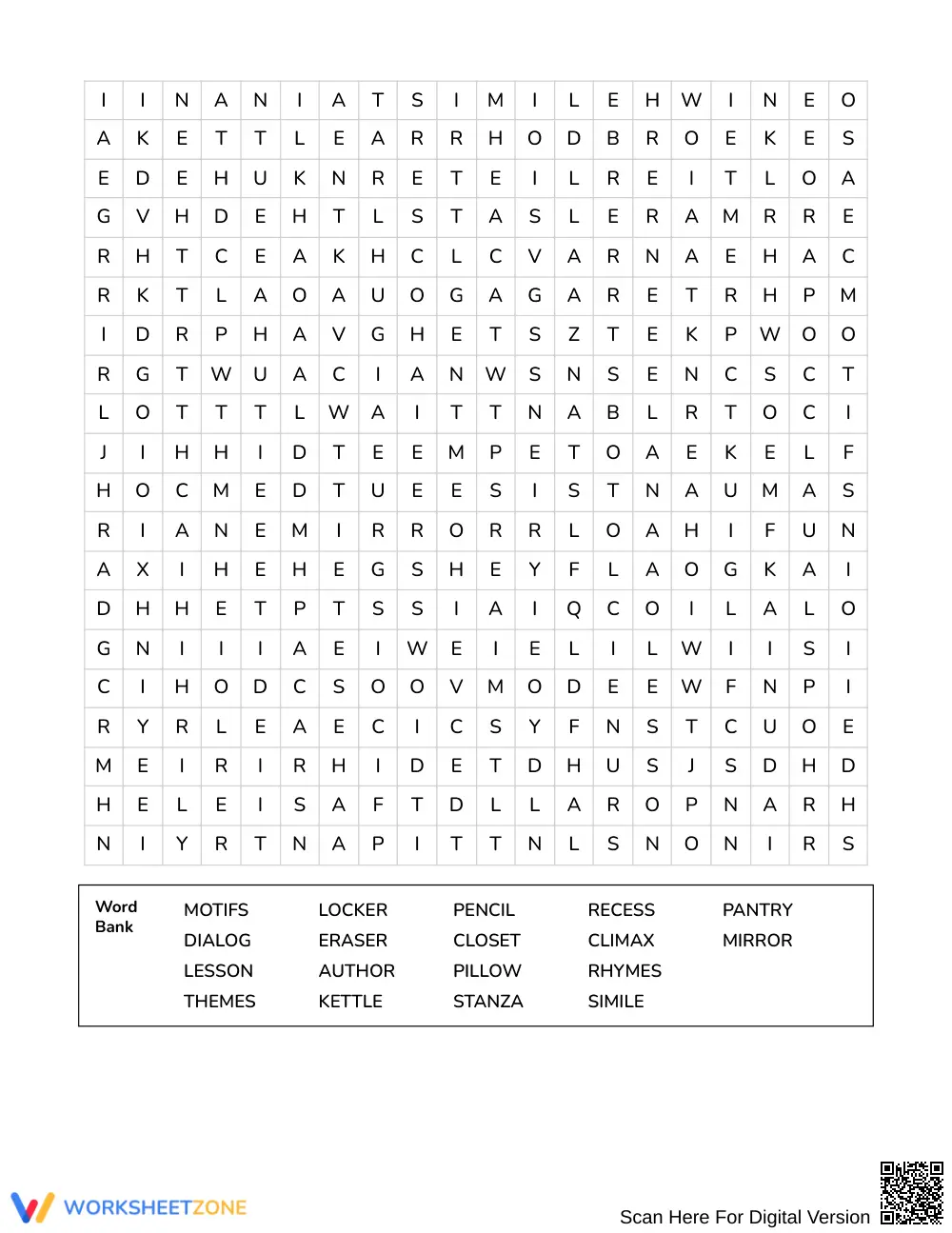
This 3-page printable activity features a full puzzle grid centered on 18 curated six-letter terms. The activity provides clues that prompt students to recall literary concepts—including climax, motif, and stanza—alongside school vocabulary. A 3-page answer key displays the orientation of every hidden word, enabling rapid grading.
Puzzle Mechanics and Structure
Students search across a dense 20 x 20 letter grid designed to reinforce visual scanning. All 18 vocabulary words run in eight directions: horizontally, vertically, and diagonally (N, NE, E, SE, S, SW, W, NW). A shuffled word bank pairs with definition clues, prompting learners to confirm spelling patterns.
Standards Alignment
This activity serves as dedicated vocabulary enrichment rather than a standard-assessed instrument. While it strengthens word retrieval and orthographic memory for terms commonly encountered in Grade 7 and Grade 8 literary analysis, it is not formally aligned to a specific Common Core standard code.
How to Use It
Deploy this word search during independent reading rotations or following a narrative poetry unit. For formative assessment, observe which students solve terms directly from semantic clues before consulting the word bank. The activity typically takes 20 to 30 minutes to complete.
Who It's For
This resource is designed for Grades 7–8 students needing vocabulary practice and spelling reinforcement. It provides accessible practice for striving readers who benefit from context clues. Pair this puzzle with a literary elements anchor chart or short story reading lesson.
Vocabulary enrichment activities that combine semantic retrieval with orthographic search patterns play a measurable role in intermediate reading development. According to research synthesized by Fisher & Frey (2014), intentional exposure to disciplinary vocabulary through multiple expressive modalities strengthens students' mental lexicon and improves reading comprehension across complex literary texts. When middle school learners in Grades 7–8 actively decipher definitions to identify 18 domain-specific and general academic words—such as climax, stanza, and simile—they reinforce conceptual meaning alongside correct letter sequencing. Spatial word searches utilizing a 20 x 20 grid demand sustained visual focus, which supports orthographic mapping and helps readers rapidly recognize multi-syllabic terms during independent reading. By pairing definition-based clues with bidirectional word hunting, this enrichment exercise builds cognitive connections between abstract literary definitions and orthographic patterns, fostering both vocabulary automaticity and reading fluency across secondary English Language Arts curricula.


