





























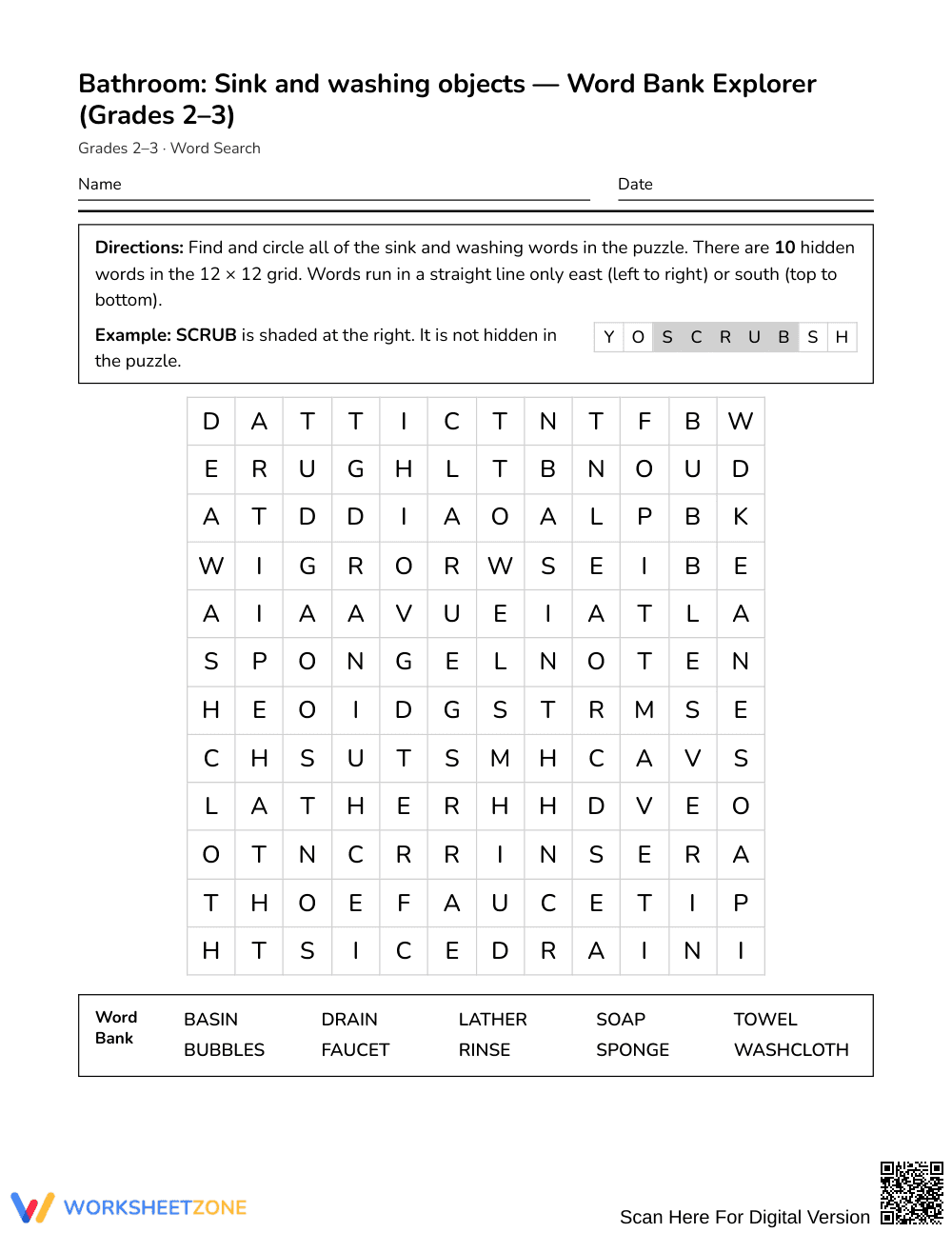


Complete Sink & Washing Word Search | Grades 2–3 ELA

Paste this activity's link or code into your existing LMS (Google Classroom, Canvas, Teams, Schoology, Moodle, etc.).
Students can open and work on the activity right away, with no student login required.
You'll still be able to track student progress and results from your teacher account.
This Grades 2–3 vocabulary word search introduces early elementary learners to practical sink and washing terminology. Students locate 10 foundational household nouns and action verbs, reinforcing spelling, letter pattern recognition, and everyday hygiene concepts. It delivers an engaging, independent activity designed to expand student functional vocabulary in primary literacy classrooms.
At a Glance
- Grade: Grades 2–3 · Subject: English Language Arts
- Standard: Not standards-assessed — vocabulary enrichment
- Skill Focus: Sink and washing objects
- Format: 1 pages · 10 words · Answer key included · PDF
- Best For: Vocabulary stations and independent practice
- Time: 15–20 minutes
What's Inside: A clean, 1-page student worksheet containing a target list of 10 vocabulary terms paired with contextual definitions, followed by a dedicated 2-page answer key showing completed word placements. The alphabetical bank organizes high-utility bathroom nouns and verbs like basin, faucet, lather, and washcloth.
Puzzle Structure and Mechanics
This puzzle is organized to support early elementary word hunters through an accessible, highly structured layout:
- Grid Dimensions: A compact 12 × 12 letter grid provides ample space for 10 terms without overwhelming developing readers.
- Word Placements: Hidden words run strictly East (horizontal left-to-right) and South (vertical top-to-bottom), avoiding backward or diagonal reversals that frustrate primary learners.
- Alphabetical Bank: Words are listed alphabetically alongside brief functional definitions, allowing students to verify word meanings as they search.
Standards Alignment
This resource serves as targeted vocabulary enrichment and is not aligned to a specific state or national content standard. It emphasizes practical language acquisition, orthographic awareness, and functional daily living concepts appropriate for primary elementary instruction.
How to Use It
Deploy this word search during independent literacy rotations following direct instruction on bathroom routines or health units. Alternatively, keep copies in a fast-finisher folder or substitute binder for immediate, zero-prep student engagement. As a formative check, circulate while students search and ask them to pronounce each found word and describe its function in the home. Most learners finish within 15 to 20 minutes.
Who It's For
This activity suits students in Grades 2–3 expanding their descriptive language skills, including English language learners acquiring daily life terminology. Pair this activity with an illustrated classroom anchor chart depicting bathroom fixtures or an early reading passage about personal hygiene habits.
Vocabulary acquisition research from Fisher & Frey (2014) highlights that structured exposure to domain-specific words across multiple authentic encounters strengthens both word recognition and reading automaticity. This 10-word puzzle supports orthographic mapping by requiring young readers to scan left-to-right and top-to-bottom sequences in a 12 × 12 grid, locating high-utility words such as basin, faucet, lather, and rinse. By combining alphabetical word lists with straightforward definitions, the printable provides purposeful lexical exposure without cognitive overload. It serves primary educators as an efficient, self-contained literacy enrichment tool that reinforces spelling patterns and functional household vocabulary during independent practice blocks.


