




























Views
Downloads



Complete Signed Integrals Worksheet | Grade 12 Calculus

Paste this activity's link or code into your existing LMS (Google Classroom, Canvas, Teams, Schoology, Moodle, etc.).
Students can open and work on the activity right away, with no student login required.
You'll still be able to track student progress and results from your teacher account.
This calculus worksheet helps Grade 12 students master the vital distinction between net signed area and total accumulation across definite integrals. Through 12 multi-part exercises, learners compute particle displacements, gross distances traveled, and fluid flux rates. Students establish conceptual fluency by contrasting directional cancellation with absolute accumulation across analytical, numerical, and verbal representations.
At a Glance
- Grade: 12 · Subject: Calculus
- Standard: Definite Integrals — Distinguish net signed accumulation from total absolute change across intervals
- Skill Focus: Compare Signed Integrals and Total Change
- Format: 5 pages · 12 multi-step problems · 2-page answer key included · Printable PDF
- Best For: Advanced placement calculus unit consolidation
- Time: 45–60 minutes of focused instruction
What's Inside
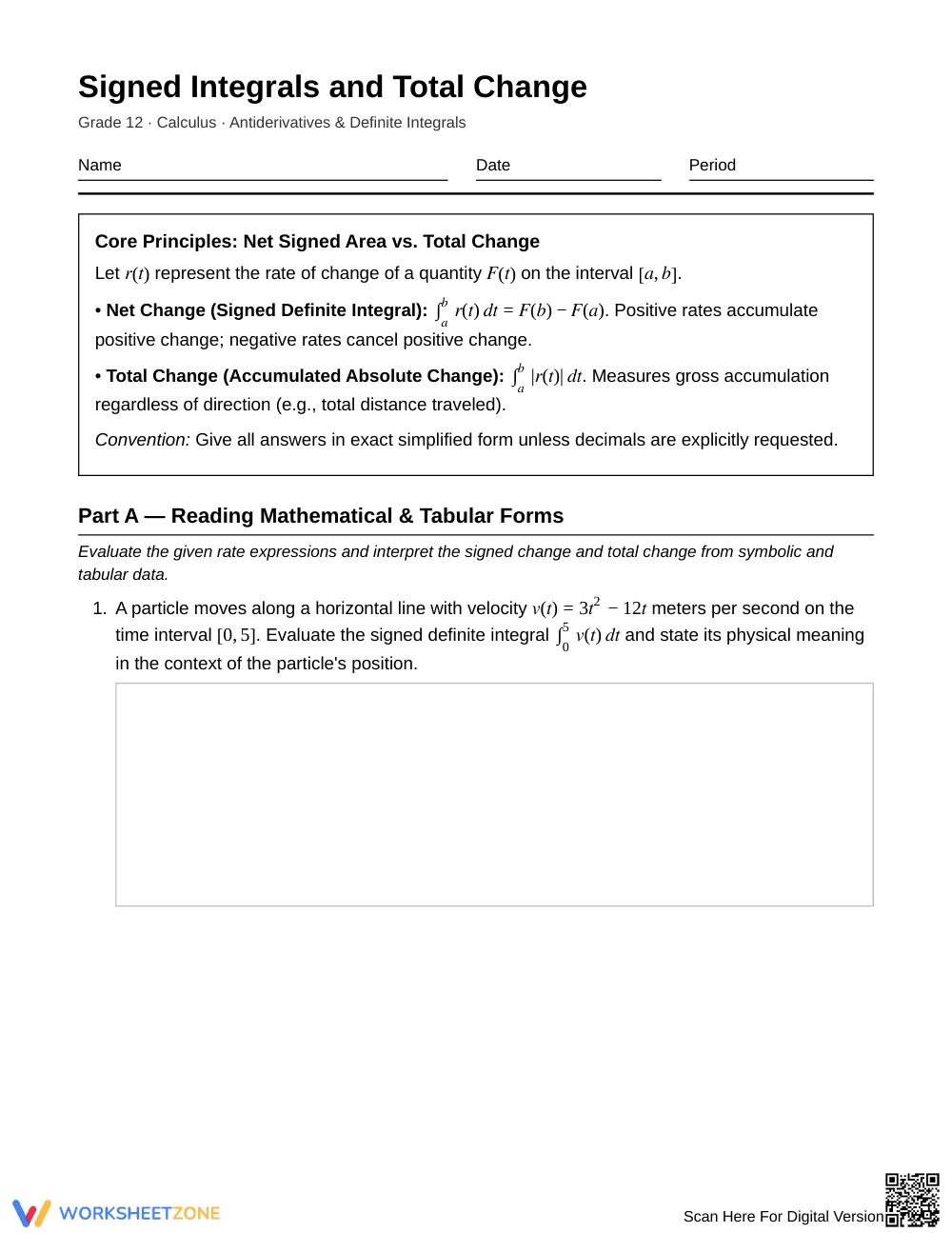
This 5-page printable packet delivers 12 comprehensive problems organized into three pedagogical sections, accompanied by a 2-page worked answer key. A foundational Core Principles reference box defines the mathematical distinction between signed integrals and absolute value integrands. The worksheet integrates diverse problem types, including algebraic polynomials, trigonometric expressions, discrete data tables evaluated via trapezoids, and piecewise flow functions.
Skill Progression
- Guided practice (Problems 1–3): Students read symbolic rates, boundary values of antiderivatives, and numerical tables with explicit scaffolded formulas to calculate net signed changes.
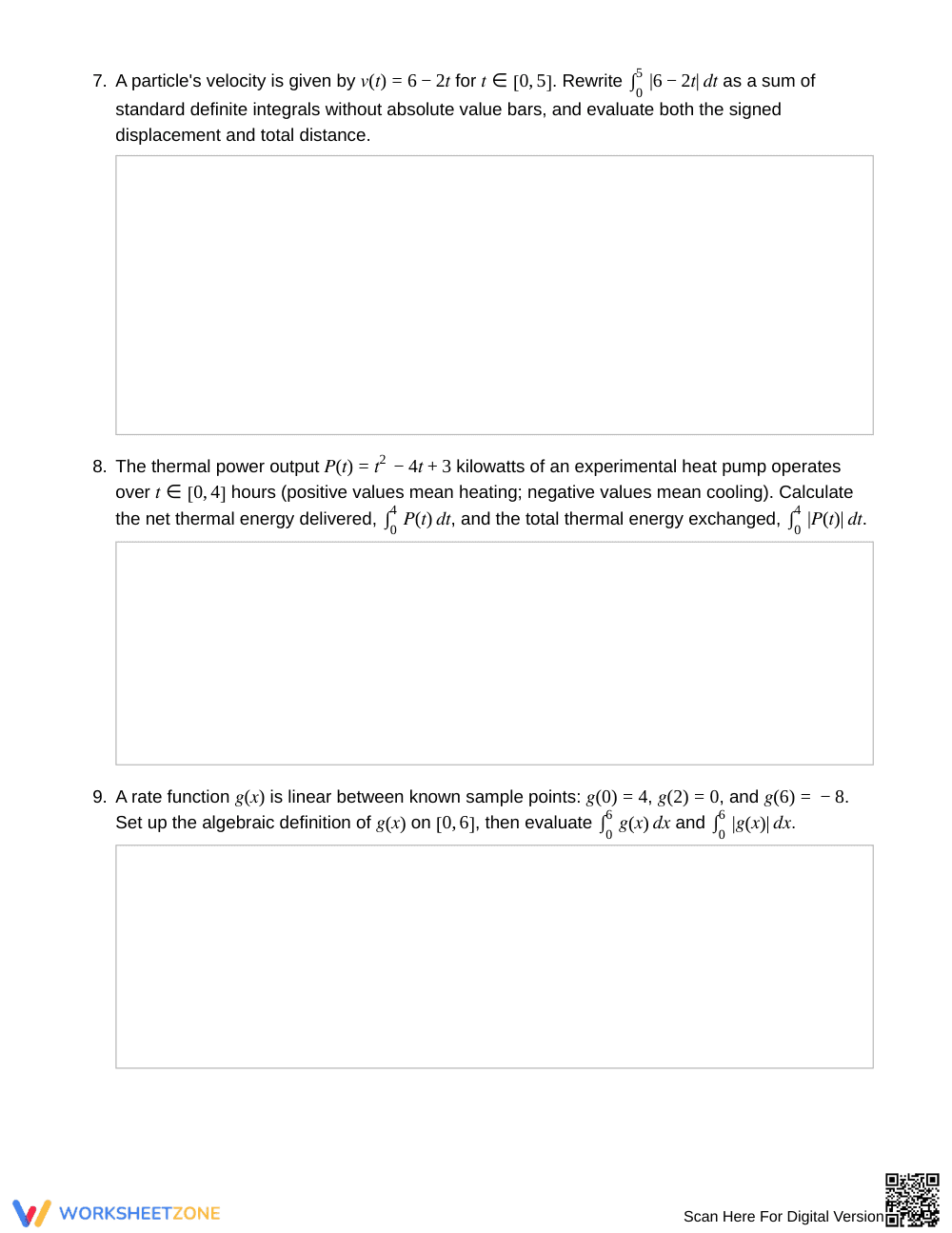
- Supported practice (Problems 4–9): Learners translate absolute value expressions into split piecewise integrals, evaluating and comparing displacement against total distance.
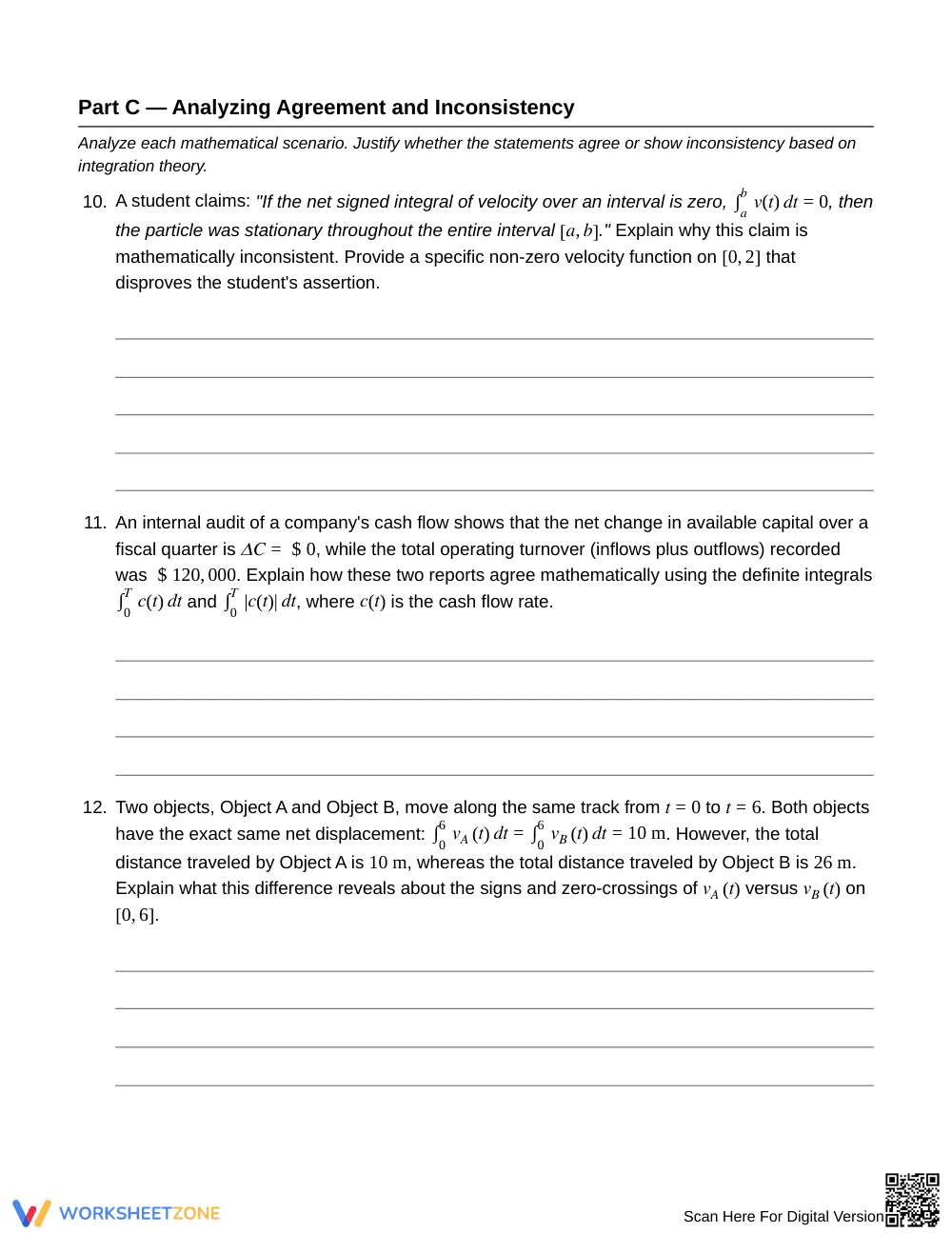
- Independent practice (Problems 10–12): Students analyze conceptual claims, resolve apparent inconsistencies in physical velocity and cash turnover, and mathematically justify when zero-crossings drive divergent integral values.
This intentional structure leverages gradual release, moving students from guided computation to independent conceptual justification.
Standards Alignment
This resource directly supports secondary calculus objectives addressing definite integrals and the Net Change Theorem, where integrating a rate yields net accumulation, while integrating its absolute value yields total change. Both standard codes can be copied directly into lesson plans, IEP goals, or district curriculum mapping tools.
How to Use It
Deploy this worksheet during consolidation after direct instruction on the Net Change Theorem, or utilize it as AP Calculus exam review. During practice, observe how students handle velocity sign changes in Part B; students frequently overlook roots where rates cross the t-axis. Expect completion within 45 to 60 minutes.
Who It's For
This resource is designed for Grade 12 students in AP Calculus or introductory college calculus. For struggling learners, provide a sign-chart template to identify interval roots before integrating. Advanced learners can explore non-polynomial piecewise curves. Pair this worksheet directly with a graphing calculator lab visualizing absolute value area.
Research from Fisher & Frey (2014) underscores that structured gradual release empowers learners to master high-level mathematical concepts by connecting procedural integration to authentic conceptual reasoning. In senior secondary calculus, distinguishing signed integrals from total change represents a notorious cognitive hurdle where students conflate directional displacement with gross accumulated distance. This 5-page resource addresses that challenge through 12 sequenced tasks that systematically guide students through tabular approximations, piecewise algebraic decompositions, and rigorous analytical justifications. By incorporating structured scaffolding and explicit reflection on sign reversals, the worksheet ensures that 12th-grade learners move beyond rote anti-differentiation to achieve genuine mathematical synthesis. Teachers can reliably utilize this curriculum-aligned resource to assess student readiness, diagnose persistent misconceptions regarding net cancellation, and reinforce the foundational underpinnings of the Fundamental Theorem of Calculus across both physics and engineering contexts.


