





























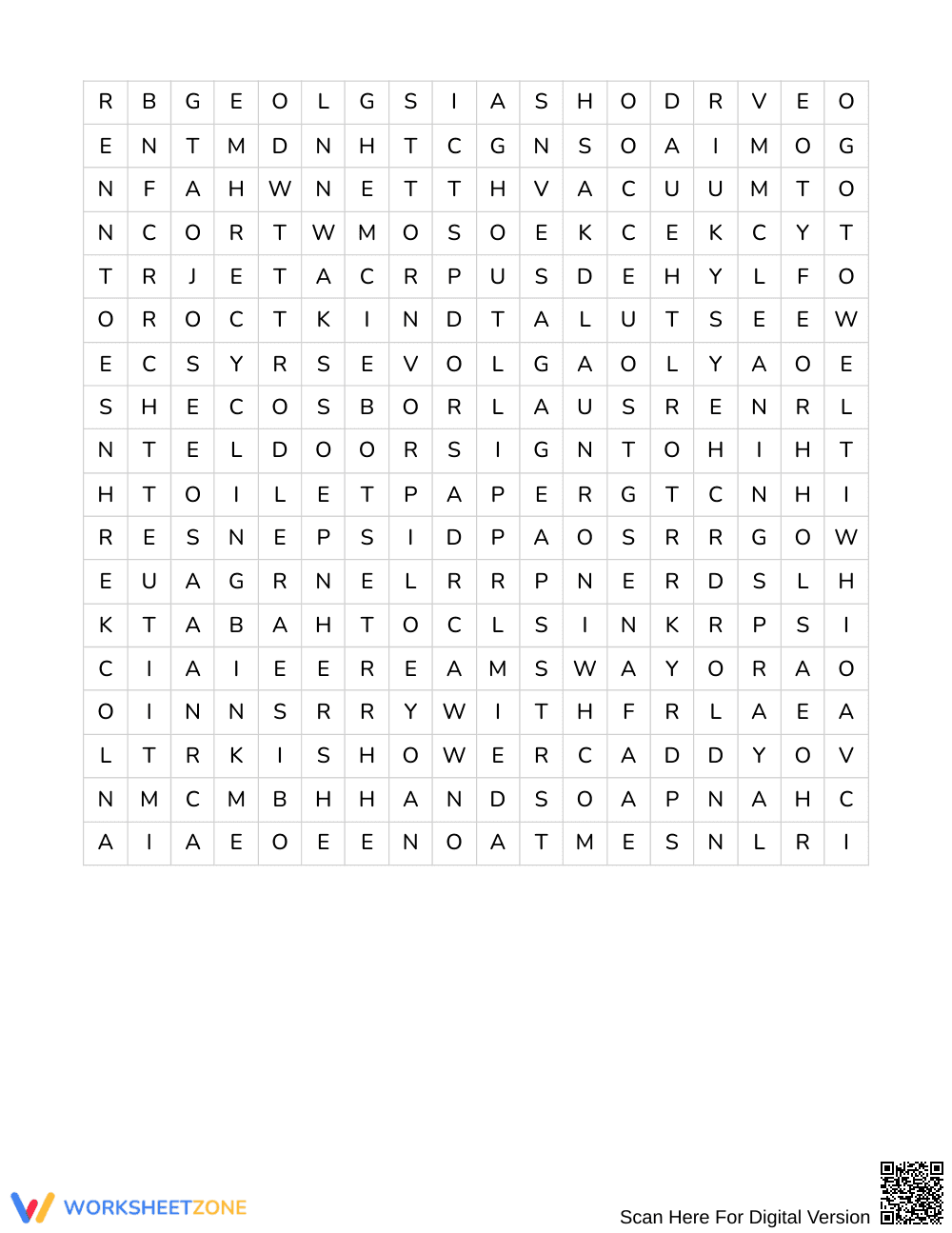


Complete Shared Spaces Word Search | Grades 6–7 ELA

Paste this activity's link or code into your existing LMS (Google Classroom, Canvas, Teams, Schoology, Moodle, etc.).
Students can open and work on the activity right away, with no student login required.
You'll still be able to track student progress and results from your teacher account.
This vocabulary word search reinforces life skills and community stewardship by challenging middle school learners to locate terminology connected to organizing shared spaces. Students read functional definitions to identify and locate target terms, building practical reading comprehension alongside domain-specific vocabulary retention without relying on a passive word bank.
At a Glance
- Grade: Grades 6–7 · Subject: ELA
- Standard: Not standards-assessed — vocabulary enrichment
- Skill Focus: Organizing shared spaces
- Format: 3 pages · 16 words · Answer key included · PDF
- Best For: Independent vocabulary review and life skills
- Time: 20–35 minutes
What's inside: This 3-page printable activity features an engaging no-bank design containing 16 hidden vocabulary words. Instead of checking off an alphabetized word list, learners solve practical descriptive clues—such as identifying a portable tray for toiletries or a wall-mounted liquid dispenser—to determine each term before searching the puzzle grid. A full-size 3-page solution key is included for immediate verification.
How the puzzle works: The activity utilizes an 18 x 18 grid designed to develop scanning, pattern recognition, and orthographic memory. Words run in all 8 compass directions: north, northeast, east, southeast, south, southwest, west, and northwest, including backwards and diagonal placements. Because students work from 16 functional clues rather than a visible word bank, they must actively recall spelling patterns and apply semantic understanding to complete the challenge.
Standards alignment: This resource serves as targeted vocabulary enrichment and life skills education rather than formal standards-assessed coursework. It strengthens domain-specific vocabulary acquisition, functional literacy, and text-based clue decoding for upper elementary and middle school learners.
How to use it: Introduce this activity after direct instruction on personal responsibility, communal living hygiene, or life skills routines. Alternatively, use it as a low-stress bell ringer, early finisher task, or substitute lesson plan. During work time, observe whether students write the identified word beside each clue before scanning the grid, which signals strong strategic planning. Expect completion within 20 to 35 minutes.
Who it's for: Designed primarily for general education students in Grades 6–7, this resource also supports English language learners and life skills classes working on community living terminology. Pair this activity with an informational reading passage on community sanitation or a classroom chore anchor chart.
Explicit vocabulary instruction that links definitions directly to contextual applications significantly strengthens orthographic processing and lexical retrieval among middle school students. According to Fisher & Frey (2014), purposeful word-learning tasks that require learners to process semantic clues prior to letter pattern recognition foster deeper lexical consolidation than rote memorization. This 3-page word search emphasizes 16 domain-specific terms centered on organizing shared spaces, eliminating passive word lists to encourage active retrieval. Operating across an 18 x 18 grid that spans 8 compass directions, the puzzle challenges learners in Grades 6–7 to combine functional literacy with visual scanning strategies. Although developed as supplemental vocabulary enrichment without alignment to a state assessment code, the activity reinforces essential life skills concepts and independent problem-solving habits suitable for general education, advisory periods, and differentiated academic support settings.


