































Complete Series Circuits Worksheet | Grade 8-12 Science

Paste this activity's link or code into your existing LMS (Google Classroom, Canvas, Teams, Schoology, Moodle, etc.).
Students can open and work on the activity right away, with no student login required.
You'll still be able to track student progress and results from your teacher account.
This series circuits worksheet provides secondary science students with systematic practice analyzing current, voltage, and electrical resistance. Learners evaluate loop structures, complete circuit calculation tables using Ohm's law, and explain physical mechanisms governing energy transfer in single-path arrangements. The resource develops conceptual fluency alongside quantitative problem-solving skills across physics and physical science curricula.
At a Glance
- Grade: 8–12 · Subject: Science
- Standard: High School Physical Science — Investigate electric circuit structures and energy transfer
- Skill Focus: Series circuit analysis and component relationships
- Format: 4 pages · 33 problems · Answer key included · PDF
- Best For: Guided practice and conceptual review
- Time: 45–60 minutes
What's Inside
The four-page document features four distinct sections containing 33 total items. Students classify circuit descriptions, match core quantitative principles, calculate electrical parameters within a multi-resistor data table, and apply conceptual models to solve novel scenario-based questions. A complete four-page answer key provides worked calculations and sample explanations for every written-response task.
Skill Progression
- Guided Practice (Part A): Students classify six operational descriptions as series or parallel circuits, then justify how single-path structures cause entire loops to open when one component fails.
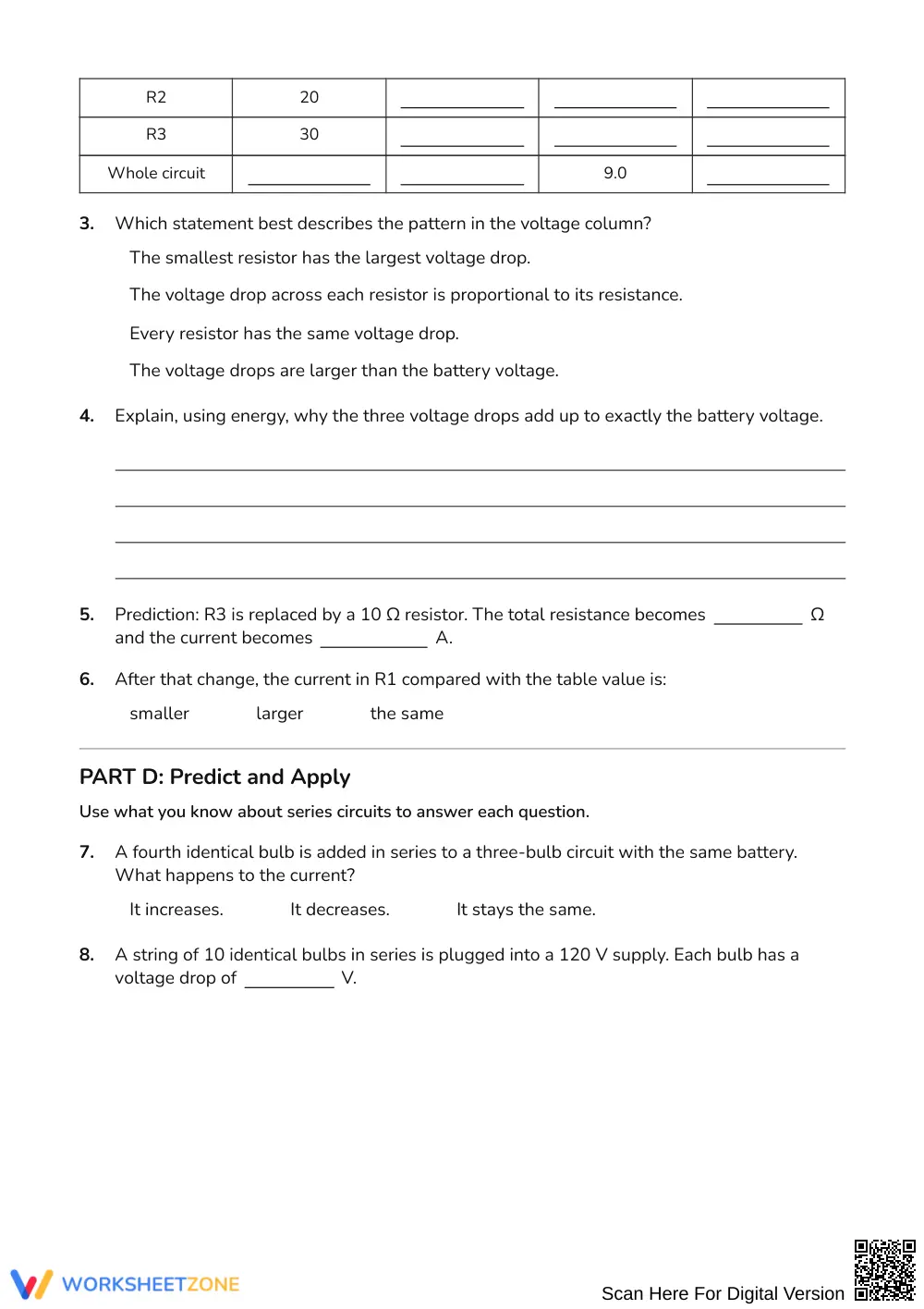
- Supported Practice (Parts B & C): Learners match fundamental circuit rules before calculating resistance, current, voltage drop, and electrical power across three resistors in a structured 9V circuit model.
- Independent Practice (Part D): Students independently predict the effects of adding components, explain parallel household wiring, and refute the common misconception that electric current is consumed by earlier resistors.
This sequence follows a gradual-release framework, transitioning students from foundational classification to independent conceptual critique.
Standards Alignment
This worksheet aligns with high school physical science performance expectations focusing on electric circuits, energy conservation, and quantitative relationships among voltage, current, and resistance. Students verify that electrical current remains uniform throughout a closed loop while voltage divides proportionally according to component resistance. Standard descriptions can be copied directly into lesson plans, IEP goals, or district curriculum mapping tools.
How to Use It
Deploy this resource during the mid-unit phase of an electricity unit after introducing Ohm's law and basic circuit schematics. Alternatively, use Part C as a collaborative station activity where student pairs verify calculations before moving to independent analysis. Formatively monitor whether students recognize that current values remain identical across every resistor in series rather than diminishing downstream. Typical completion requires 45 to 60 minutes.
Who It's For
This resource serves general science, physical science, and introductory physics classes in grades 8 through 12. Written prompts include scaffolding suitable for developing readers, while quantitative prediction tasks offer rigorous extensions for advanced learners. Pair this activity with a physical breadboard lab or virtual circuit simulation.
Structured circuit analysis activities reinforce mental models of electric potential and charge conservation in secondary science classrooms. Fisher & Frey (2014) highlight that structured gradual-release frameworks significantly increase student retention of complex scientific relationships by pairing scaffolded quantitative tables with written explanations. In this 4-page worksheet, students work through 33 focused tasks examining how series circuits function, calculating values for current, resistance, and voltage drop across multiple components. By requiring students to justify energy conservation principles and evaluate the persistent misconception that current gets consumed, the resource promotes authentic conceptual mastery. Teachers can readily verify individual student comprehension using the provided complete answer key, tracking mastery across basic classification, intermediate mathematical calculation, and higher-order diagnostic reasoning in high school physical science.


