































Complete Sentence Structure Worksheet | Grade 6 ELA

Paste this activity's link or code into your existing LMS (Google Classroom, Canvas, Teams, Schoology, Moodle, etc.).
Students can open and work on the activity right away, with no student login required.
You'll still be able to track student progress and results from your teacher account.
This worksheet builds Grade 6 students' ability to classify sentences as simple, compound, or complex by counting clause pairs and identifying conjunctions. Across 15 structured tasks, students move from guided clause-boundary identification to independent classification, developing grammatical reasoning aligned to standard L.7.1.b.
At a Glance
- Grade: 6 · Subject: ELA
- Standard:
L.7.1.b— Choose among simple, compound, complex, and compound-complex sentences to signal relationships- Skill Focus: Classifying sentence structures by clause analysis
- Format: 5 pages · 15 problems · Answer key included · PDF
- Best For: Guided practice after direct instruction
- Time: 25–35 minutes
What's Inside
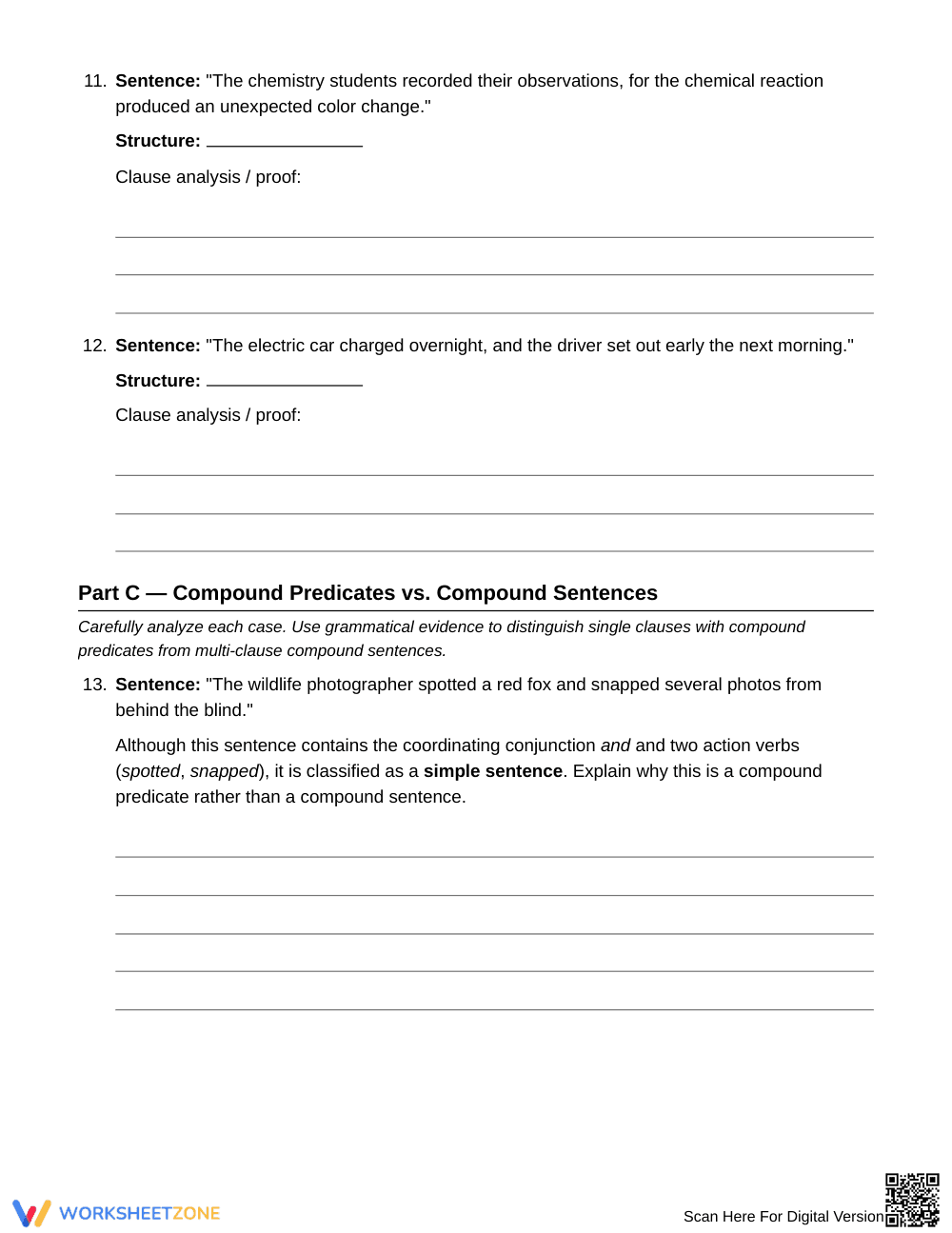
The worksheet opens with a Clause Count & Structure Reference Guide defining independent clauses, dependent clauses, and conjunctions. Students use this guide across three sections: Part A (clause-boundary identification, 4 items), Part B (sentence classification with written proof, 8 items), and Part C (compound-predicate versus compound-sentence analysis, 3 items). A 3-page answer key provides complete clause breakdowns.
Skill Progression
- Guided practice (Part A, 4 problems): Students identify clause boundaries and label conjunctions with explicit scaffolding.
- Supported practice (Part B, 8 problems): Students classify sentences as simple, compound, or complex and write a clause-analysis proof.
- Independent practice (Part C, 3 problems): Students distinguish compound predicates from compound sentences and rewrite simple sentences as compound sentences.
This gradual-release sequence mirrors the I Do, We Do, You Do model, building confidence before independent analysis.
Standards Alignment
The primary standard is L.7.1.b: Choose among simple, compound, complex, and compound-complex sentences to signal differing relationships among ideas. The worksheet also supports L.6.3.a on varying sentence patterns for meaning and style. Both standard codes can be copied directly into lesson plans or curriculum mapping tools.
How to Use It
Assign this resource after direct instruction on clause types. Complete Part A as a guided class activity, then release students to finish Parts B and C in pairs or independently. Use student proofs in Part B as a formative check before moving forward. Expected completion time is 25 to 35 minutes.
Who It's For
This resource is designed for Grade 6 ELA students studying sentence structure. Struggling learners benefit from the reference guide, while advanced learners engage with Part C's rewriting tasks. Pair this worksheet with a conjunction anchor chart for additional visual support.
This five-page worksheet aligned to L.7.1.b targets a foundational grammar skill: distinguishing simple, compound, and complex sentences through clause-level analysis. According to Fisher and Frey (2014), structured gradual-release tasks that require students to articulate grammatical reasoning rather than merely select multiple-choice answers produce significantly stronger transfer to authentic writing contexts. The resource provides 15 structured problems that progress from guided clause identification through independent sentence rewriting, supported by a built-in reference guide and a full answer key. Teachers can use student proof statements in Part B as immediate formative data to determine whether misconceptions stem from coordinating conjunction recognition or clause-boundary identification. The worksheet fits smoothly into a single class period of 25 to 35 minutes and requires zero preparation, making it practical for daily instruction, small-group intervention, or substitute plans in any Grade 6 ELA classroom.


