




























Views
Downloads



Complete Scientific Notation Worksheet | Grade 8 Math

Paste this activity's link or code into your existing LMS (Google Classroom, Canvas, Teams, Schoology, Moodle, etc.).
Students can open and work on the activity right away, with no student login required.
You'll still be able to track student progress and results from your teacher account.
This Grade 8 math worksheet helps students master scientific notation through systematic conversion, magnitude comparison, and multi-step computation. Learners transition from standard decimal conversions to real-world rate, area, and volume applications. By working through structured exercises, eighth graders build mathematical fluency and quantitative reasoning across astronomical and microscopic scientific contexts.
At a Glance
- Grade: 8 · Subject: Grade 8 Mathematics
- Standard: Perform conversions, magnitude comparisons, and multi-step arithmetic operations with scientific notation
- Skill Focus: Mixed Conversion, Comparison, and Four Operations
- Format: 5 total pages · 16 structured problems · Full answer key included · PDF
- Best For: Independent skills practice, test preparation, and review
- Time: 45–60 total minutes
What's Inside
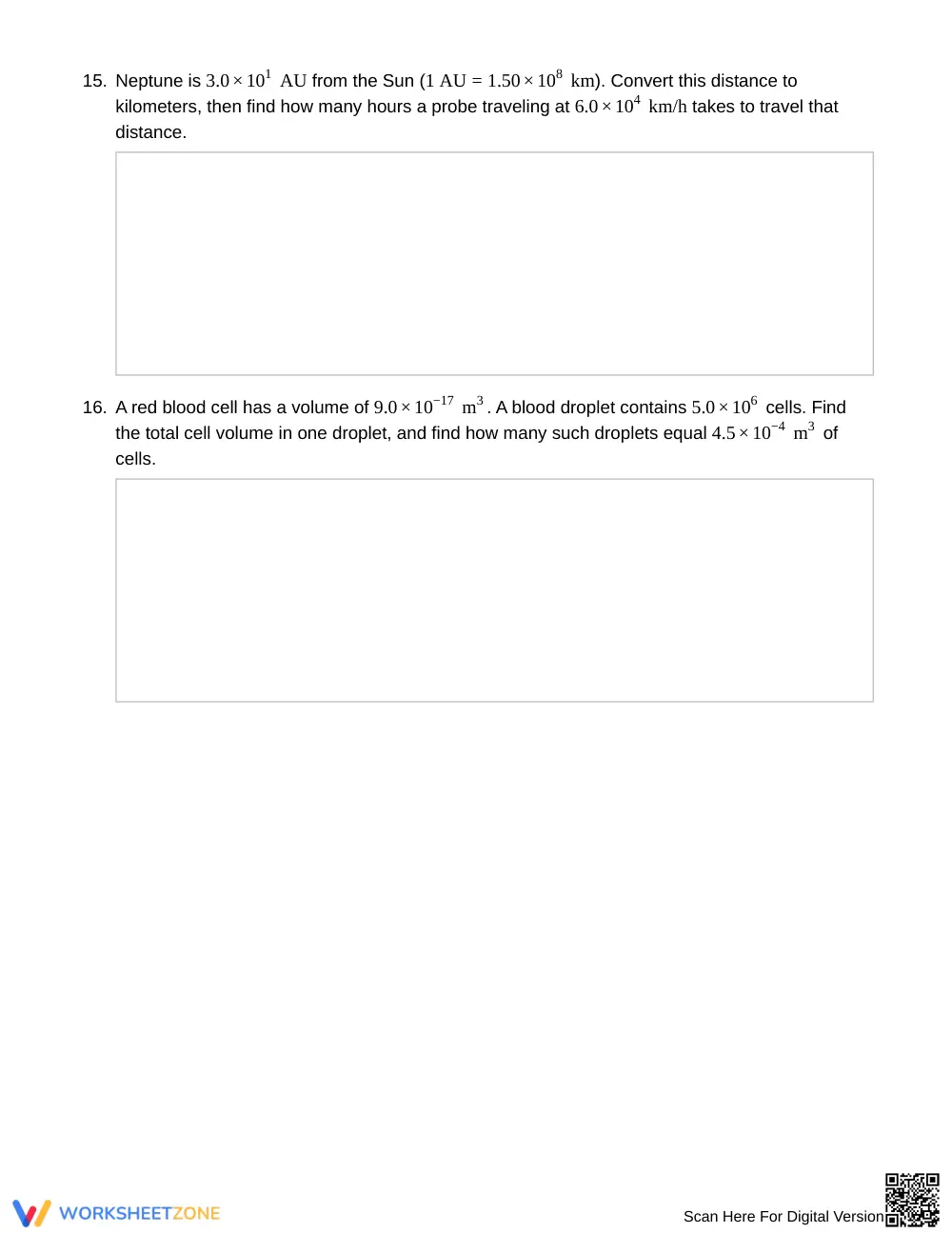
The 5-page worksheet provides 16 thoughtfully sequenced problems alongside a complete 2-page answer key with step-by-step solutions. Students begin with a Quick Reference guide that summarizes index laws and arithmetic rules before encountering standard conversions, magnitude orderings, four-operation arithmetic, and multi-step STEM scenarios involving planetary distances, cellular biology, and particulate filtration.
Skill Progression
- Guided practice (Part A, 4 problems): Students review core notation rules, convert values between scientific and decimal forms, identify valid representations, and order quantities using the Quick Reference box.
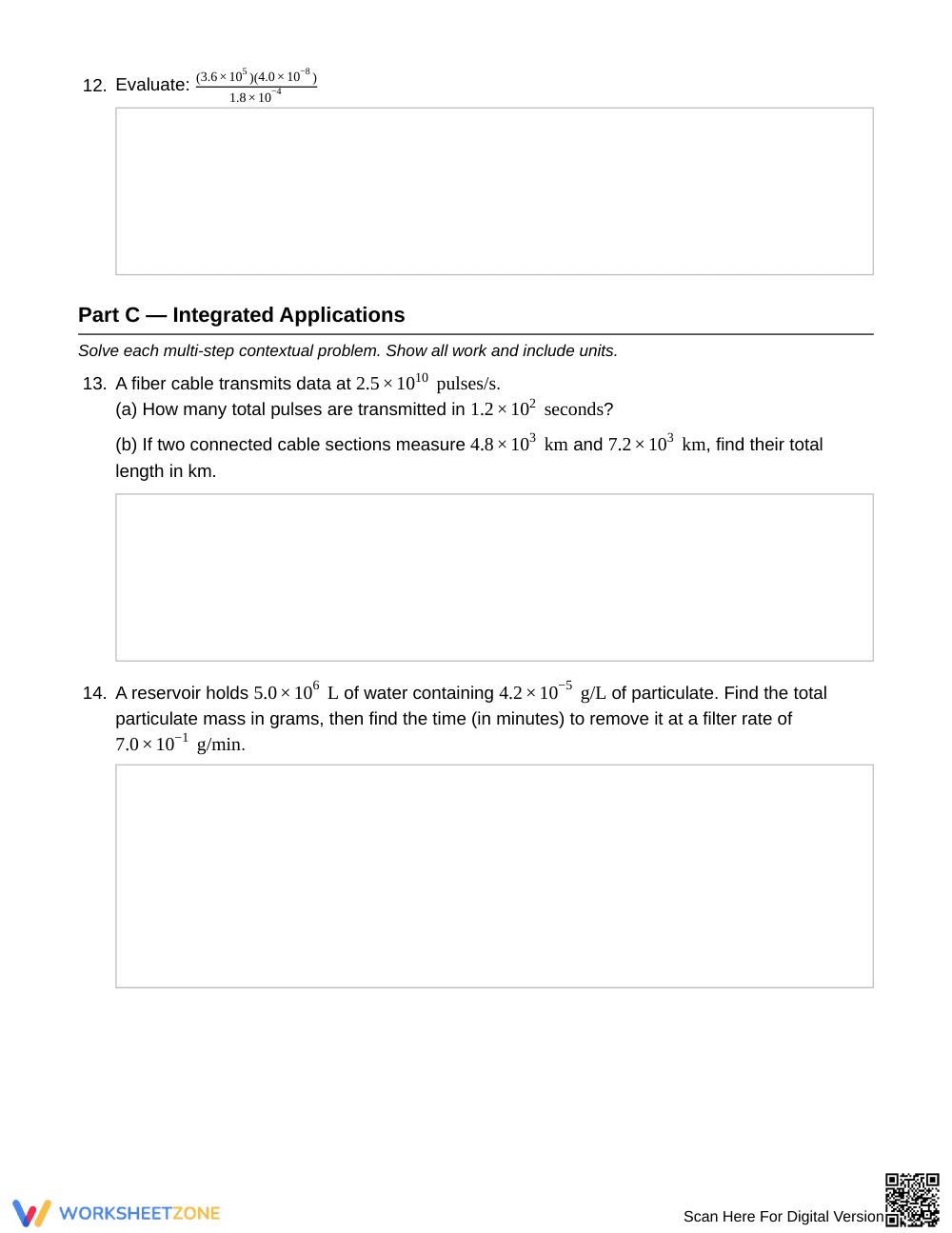
- Supported practice (Part B, 8 problems): Learners perform multiplication, division, addition, and subtraction, applying exponent rules to calculate light speed distance, cell division, and planetary masses.
- Independent practice (Part C, 4 problems): Students solve multi-step STEM scenarios involving particulate removal rates, space probe travel, and cell volume measurements without hints.
This structure follows the gradual-release model, transitioning students from foundational recall to independent mastery.
Standards Alignment
This resource aligns with middle school mathematics expectations for expressions and equations, requiring students to estimate very large or small quantities and calculate with scientific notation. Both standard codes can be copied directly into lesson plans, IEP goals, or district curriculum mapping tools.
How to Use It
Deploy this worksheet after direct instruction on exponent properties as an in-class consolidation activity or as a structured review before a unit exam. During work time, observe whether students properly adjust coefficients when adding numbers with unequal powers in Part B. Most learners will complete all 16 exercises within 45 to 60 minutes.
Who It's For
This resource is designed for eighth-grade general mathematics, pre-algebra, or physical science students requiring rigorous computation practice. Teachers can differentiate by assigning Part A for targeted intervention or Parts B and C for advanced learners, ideally paired with a physical science metric prefixes anchor chart.
According to Fisher & Frey (2014), structured instructional frameworks that shift cognitive responsibility from teacher modeling to independent application significantly improve mathematical retention and procedural competence. This Grade 8 scientific notation worksheet applies that principle by guiding students through 16 rigorous tasks focused on mixed conversions, direct magnitude comparisons, and four-operation arithmetic. Eighth-grade learners frequently struggle with non-matching exponents during addition and subtraction; this activity confronts that challenge directly by scaffolding intermediate steps between basic place-value recognition and multi-step real-world applications. By integrating authentic physical science contexts—such as astronomical distances, light speed, and cellular volumes—the material reinforces cross-disciplinary quantitative reasoning. The inclusion of an explicit reference guide and a comprehensive 2-page answer key ensures teachers can accurately gauge student mastery and provide targeted feedback during formative practice, supporting steady progress toward full standard proficiency across varied middle school learning environments.


