





























Complete Science Cycles Worksheet | Grades 9-12 Science
Paste this activity's link or code into your existing LMS (Google Classroom, Canvas, Teams, Schoology, Moodle, etc.).
Students can open and work on the activity right away, with no student login required.
You'll still be able to track student progress and results from your teacher account.
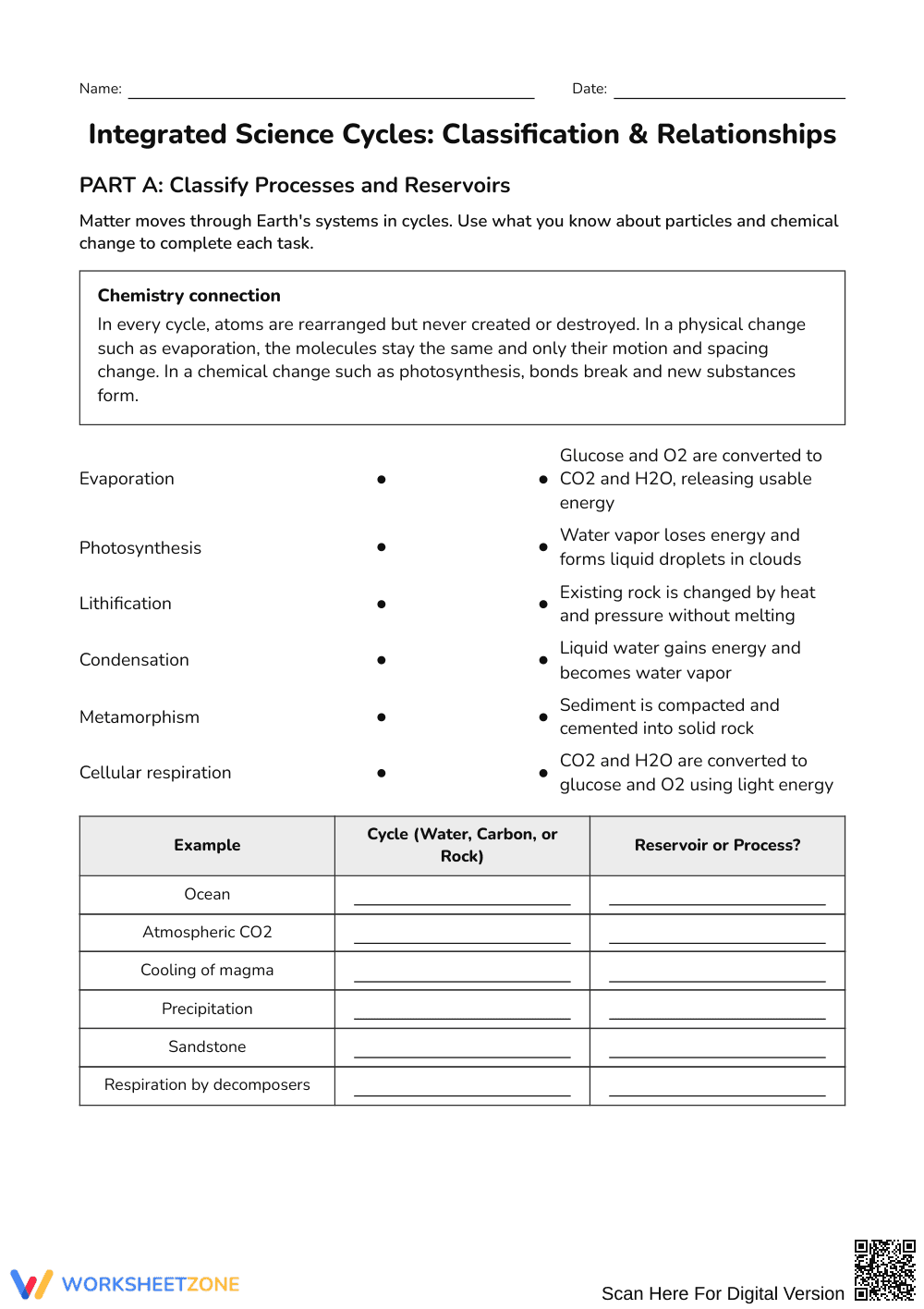
This 4-page science worksheet guides high school students through classifying matter, analyzing reservoirs, and tracing energy across Earth's cycles. Students examine water, carbon, and rock systems to explain how conservation of matter governs physical and chemical changes across 39 structured tasks.
At a Glance
- Grade: Grades 9–12 · Subject: Science
- Standard: High School Science — Classify cycle components and explain chemical conservation in Earth systems
- Skill Focus: Cycle classification, process analysis, and matter conservation
- Format: 4 pages · 39 problems · Answer key included · PDF
- Best For: Mid-unit practice or review
- Time: 45–60 minutes
What's Inside
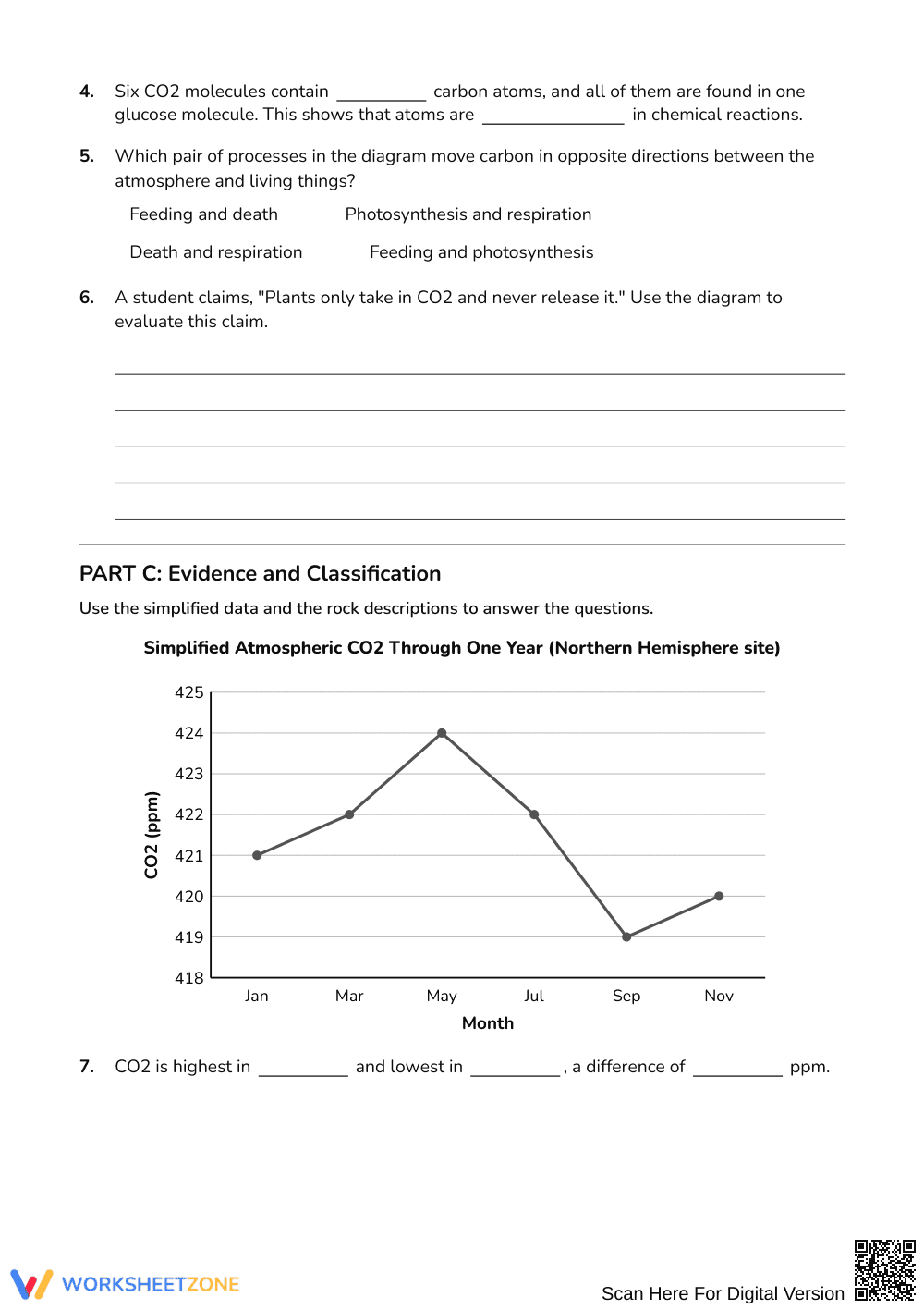
The worksheet contains 39 questions across four student pages organized into three parts. Students complete classification tables, evaluate scientific claims, balance chemical equations, and analyze real-world data. It features clear reference definitions for physical versus chemical processes, Northern Hemisphere atmospheric carbon data, and a full 4-page answer key.
Skill Progression
- Guided Practice (Part A, 16 tasks): Foundational classification where students categorize reservoirs and processes across three Earth cycles using structured definitions.
- Supported Practice (Part B, 11 tasks): Systems modeling where students balance the photosynthesis reaction and evaluate misconceptions about plant respiration using carbon pathways.
- Independent Practice (Part C, 12 tasks): Evidence-based synthesis where students interpret annual carbon dioxide trends and classify rock specimens by formation processes.
This sequence applies gradual release, moving students from guided vocabulary recognition to independent data synthesis.
Standards Alignment
This resource aligns with high school science standards requiring students to model matter conservation in Earth cycles. Learners show that atoms rearrange during physical and chemical changes while total mass is conserved. The tasks also develop skills in analyzing geoscience data to track carbon fluxes. Both standard codes can be copied directly into lesson plans, IEP goals, or district curriculum mapping tools.
How to Use It
Assign Parts A and B after direct instruction on biogeochemical cycles to reinforce matter cycling versus energy flow. During independent work, check Part B to address the common misconception that plants do not respire. Alternatively, complete all 39 tasks across 45 to 60 minutes as a collaborative station rotation.
Who It's For
This resource serves high school Earth science, biology, and physical science students. Clear process definitions support English language learners, while data tasks challenge advanced thinkers. Pair this packet directly with an interactive rock cycle lab or carbon cycle simulation.
According to research by Fisher & Frey (2014), structured gradual release instruction significantly enhances secondary students' ability to transfer abstract science concepts to data interpretation tasks. This 4-page worksheet develops cycle classification and systems modeling across 39 scaffolded problems. By examining how atoms rearrange during physical phase changes in the hydrologic cycle and chemical reactions in the carbon cycle, high school students master foundational conservation principles. Structured tables prompt learners to distinguish between stationary reservoirs and dynamic processes, while atmospheric carbon records require students to corroborate cycle mechanisms with empirical evidence. Fisher & Frey (2014) show that pairing visual cycle diagrams with claim evaluation dismantles persistent misconceptions regarding plant respiration. The included 4-page answer key provides reliable benchmarks for formative assessment, allowing secondary science educators to identify, track, and resolve student misconceptions efficiently.


