





























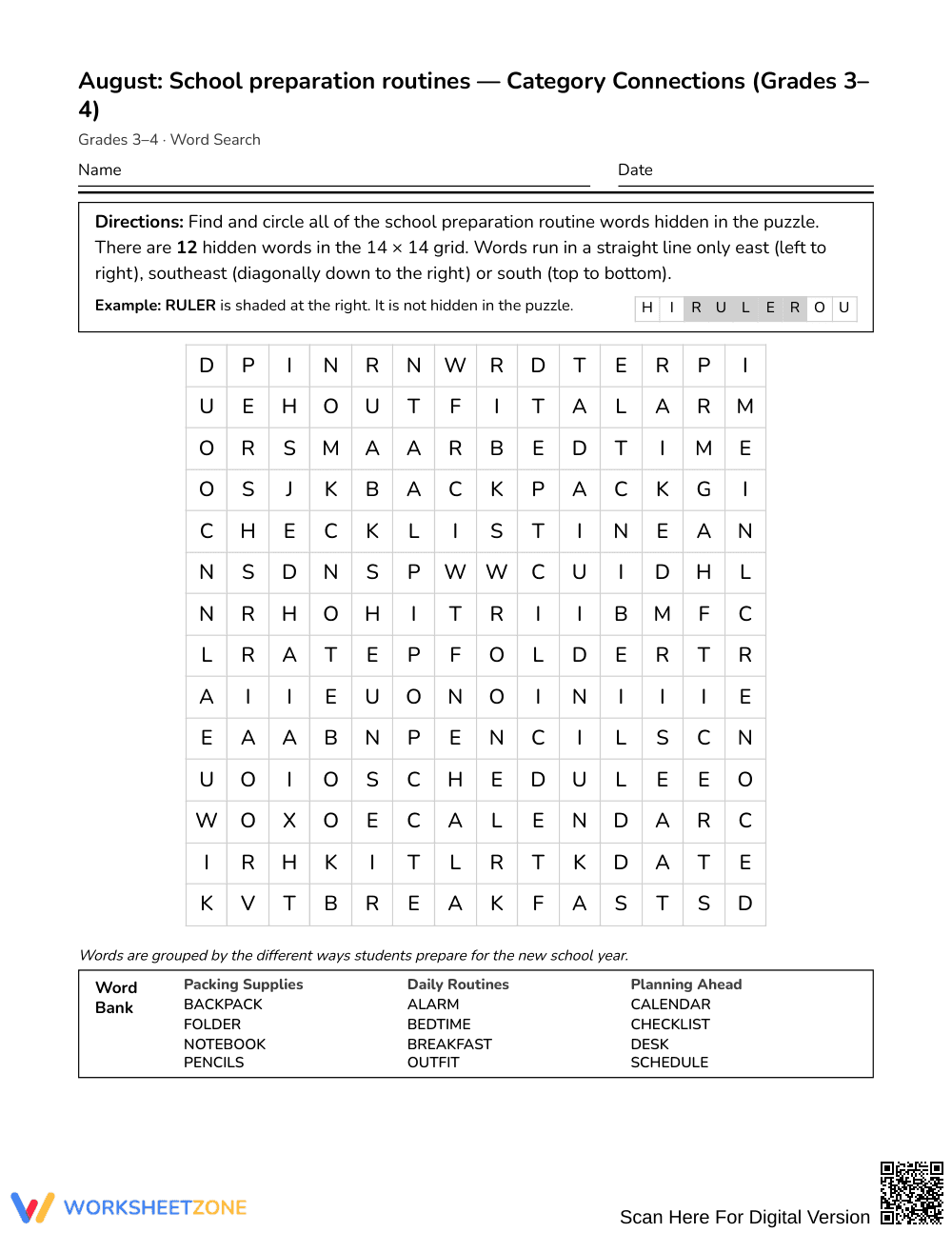


Complete School Routines Word Search | Grades 3–4 ELA

Paste this activity's link or code into your existing LMS (Google Classroom, Canvas, Teams, Schoology, Moodle, etc.).
Students can open and work on the activity right away, with no student login required.
You'll still be able to track student progress and results from your teacher account.
This Grades 3–4 vocabulary word search reinforces essential school preparation routines through an engaging 12-word puzzle. Students locate topical terminology organized into meaningful categories, strengthening orthographic awareness and contextual recall during back-to-school transitions. Complete with teacher solutions, this printable activity builds confidence while fostering positive academic habits.
At a Glance
- Grade: Grades 3–4 · Subject: English Language Arts (ELA)
- Standard:
Not standards-assessed— vocabulary enrichment- Skill Focus: school preparation routines
- Format: 1 pages · 12 words · Answer key included · PDF
- Best For: Morning work and back-to-school transitions
- Time: 15–20 minutes
What's Inside
This single-page vocabulary activity contains 12 thematic target words embedded in an accessible grid layout. Target words are clustered conceptually under three practical headings: Packing Supplies, Daily Routines, and Planning Ahead. Full-sentence clue definitions accompany each term to clarify meaning before solving. A comprehensive multi-page answer key displays exact spatial solutions for quick verification.
Puzzle Structure and Mechanics
The word search utilizes a clear 14 x 14 letter grid designed specifically for intermediate elementary readers. All 12 hidden words run in three forward-facing orientations: east (left to right), southeast (diagonal downward), and south (top to bottom). Letters do not run in reverse, preventing unnecessary visual frustration while still reinforcing scanning discipline. Learners consult the categorized word bank alongside student-friendly definitions to locate terms such as ALARM, CHECKLIST, and BACKPACK.
Standards Alignment
This learning activity serves as supplemental vocabulary enrichment and is not aligned to an assessed state academic standard. It supports foundational literacy by reinforcing spelling patterns, visual word recognition, and routine-based schema during early-year instruction.
How to Use It
Deploy this word search during homeroom arrival on the first week of classes to establish calm morning expectations. Circulate while students search to observe scan patterns and check whether learners read definitions to connect words with their daily schedules. The puzzle also serves as a productive early-finisher task following direct reading lessons, typically requiring 15 to 20 minutes to complete.
Who It's For
This resource supports third and fourth-grade students developing independence with classroom procedures and executive functioning routines. English language learners benefit from the categorized structure and explicit functional definitions. Pair this word search with an interactive anchor chart tracking daily classroom checklists or personal backpack organization routines.
Vocabulary acquisition research highlighted in Fisher & Frey (2014) demonstrates that intentional word exposure paired with thematic categorization accelerates schema building and orthographic retention for developing readers in elementary grades. By organizing 12 practical words into structured functional groups—such as morning routines, supply management, and forward planning—this word search bridges procedural language with daily classroom expectations. Students engage in targeted visual discrimination across a 14 by 14 letter matrix, identifying high-utility terms running east, south, and southeast without the confounding interference of reverse orientations. Accompanying student-friendly glossaries anchor each vocabulary item in concrete actions, ensuring that word hunting reinforces authentic semantic comprehension rather than rote pattern matching. The self-directed puzzle design encourages autonomous completion during critical transitional windows, supporting productive classroom workflows while solidifying foundational language conventions for third and fourth-grade learners navigating back-to-school schedules.


