

































Complete Scholarly Register Worksheet | Grade 12 English IV

Paste this activity's link or code into your existing LMS (Google Classroom, Canvas, Teams, Schoology, Moodle, etc.).
Students can open and work on the activity right away, with no student login required.
You'll still be able to track student progress and results from your teacher account.
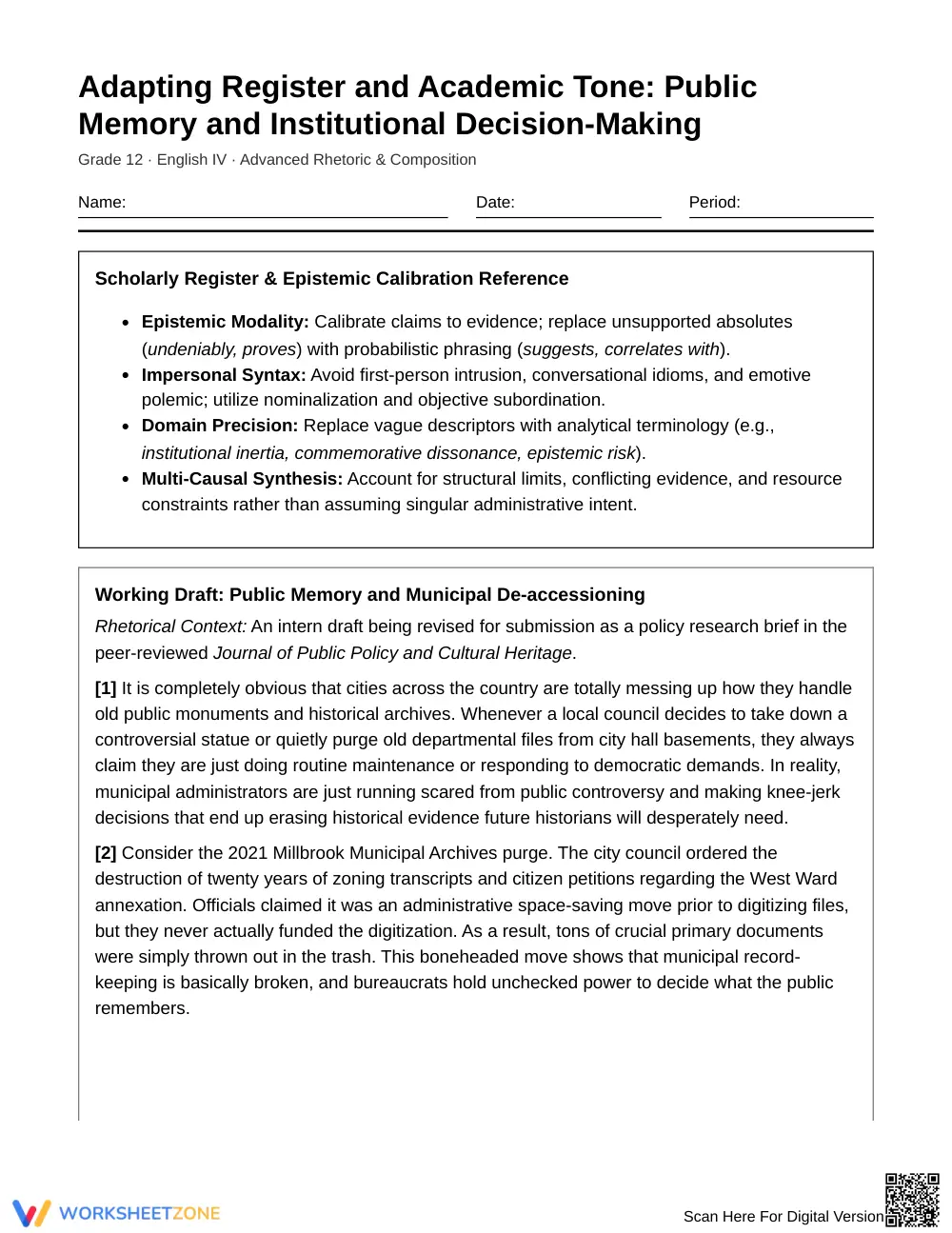
This advanced revision resource trains Grade 12 writers to adapt register, eliminate colloquial bias, and calibrate academic tone. Students examine a municipal policy draft, integrate theoretical perspectives, and transform emotional rhetoric into objective scholarly prose. The 10 tasks develop critical rhetorical awareness for college-level research writing.
At a Glance
- Grade: 12 · Subject: English IV
- Standard:
W.11-12.5— Develop and strengthen writing by planning, revising, editing, and adapting tone for specific audiences- Skill Focus: Scholarly register and academic tone calibration
- Format: 6 pages · 10 problems · Answer key included · PDF
- Best For: Advanced rhetoric and composition revision units
- Time: 45–60 minutes
What's Inside
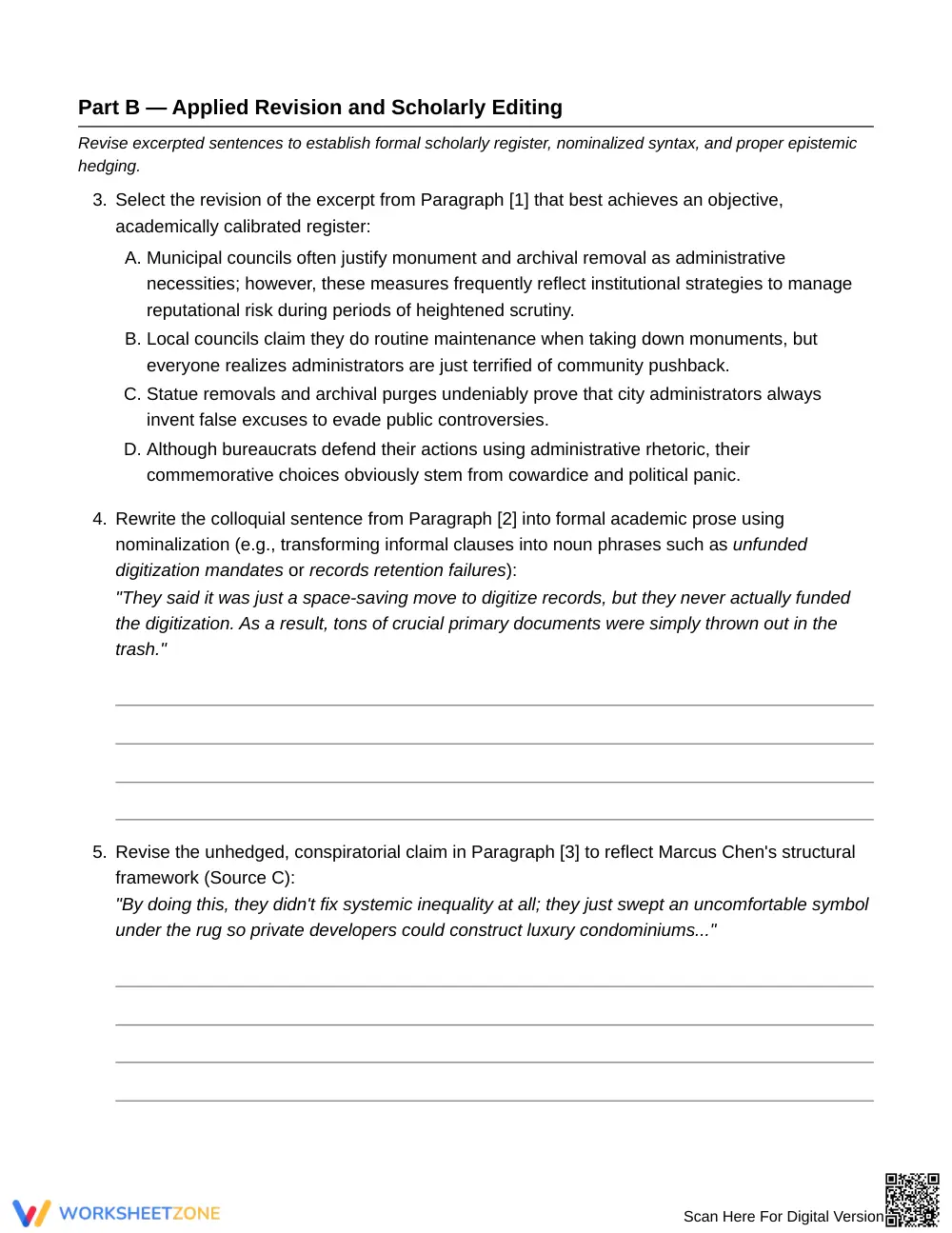
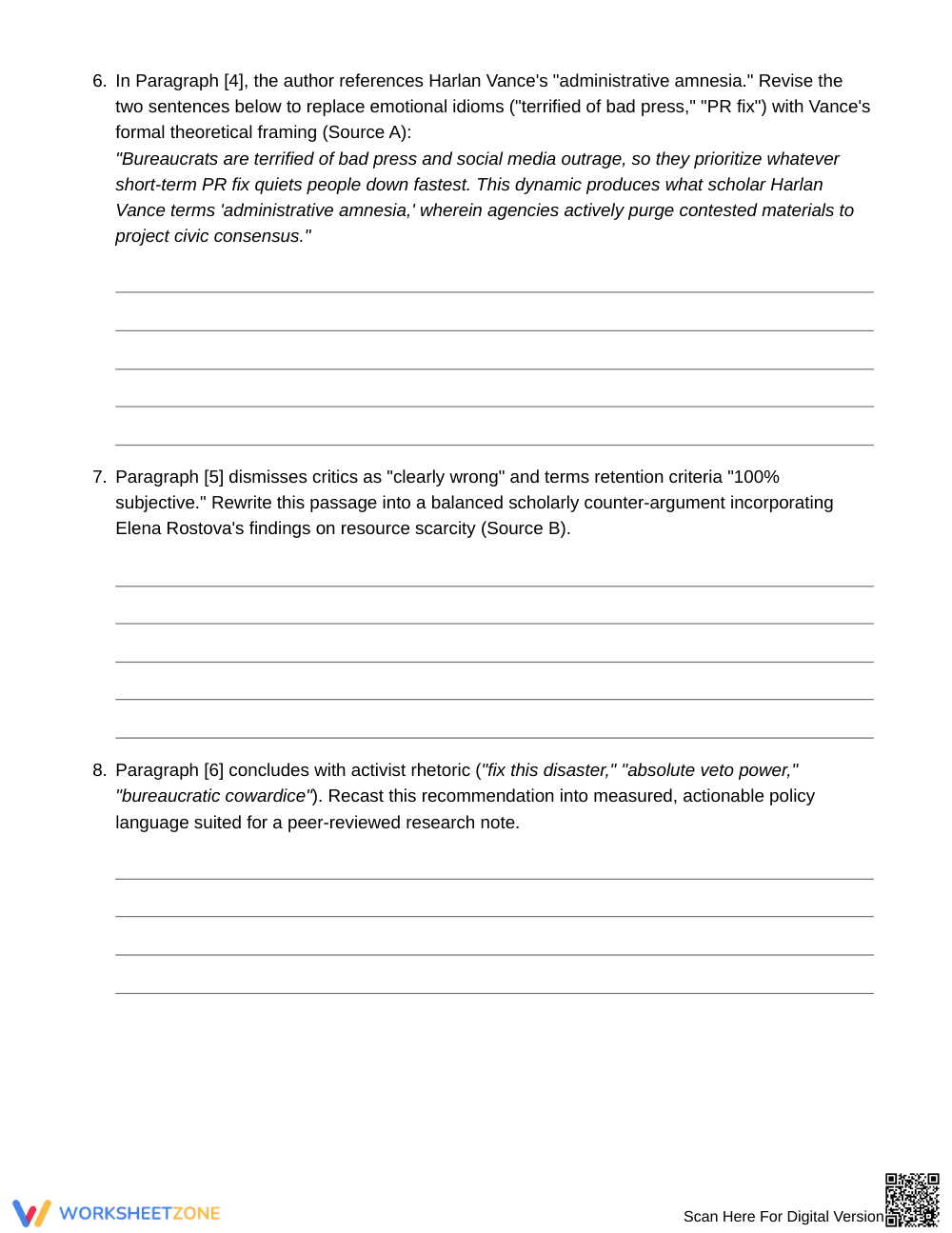
Across 6 instructional pages, this packet guides high school seniors through rhetorical diagnostic analysis, applied sentence editing, and comparative thesis evaluation. Students utilize a four-principle scholarly reference framework, a six-paragraph municipal draft, and three theoretical source excerpts to complete 10 revision tasks. A thorough two-page answer key provides annotated model rewrites, syntactic explanations, and scoring rationales.
Skill Progression
- Guided practice (Tasks 1–2): Students identify register discrepancies and colloquial violations in the draft using the reference framework.
- Supported practice (Tasks 3–8): Writers execute applied revisions, converting colloquial claims into objective academic syntax using theoretical source excerpts.
- Independent practice (Tasks 9–10): Learners complete comparative thesis evaluation and theoretical synthesis, independently justifying academic revisions.
This progression mirrors the gradual release of responsibility model, moving students from diagnostic analysis to independent mastery.
Standards Alignment
The tasks align directly with W.11-12.5: Develop and strengthen writing as needed by planning, revising, editing, rewriting, or trying a new approach, focusing on addressing what is most significant for a specific purpose and audience. As a supporting standard, W.11-12.4 reinforces producing clear, coherent writing with appropriate style. Both standard codes can be copied directly into lesson plans, IEP goals, or district curriculum mapping tools.
How to Use It
Implement this packet during direct instruction on advanced rhetoric or after introducing academic syntax conventions. Assign Part A as a guided partner diagnostic, use Part B for collaborative sentence revision, and assign Part C as an individual summative exit ticket. During work time, observe whether students merely replace vocabulary words or restructure sentences using nominalization and hedging. High school seniors typically finish all 10 tasks in 45 to 60 minutes.
Who It's For
This resource serves Grade 12 English IV, AP English Language, and dual-enrollment writing courses. The theoretical excerpts scaffold analysis for emerging academic writers while challenging advanced students to synthesize complex structural arguments. Pair this activity with an anchor chart on epistemic modality or a lesson on academic syntax.
Mastering scholarly register requires deliberate practice in transforming informal polemic into disciplined, evidence-based academic discourse. Aligned to benchmark W.11-12.5, this high school writing resource targets the essential skill of adapting register and calibrating academic tone for specialized scholarly audiences. Grounded in the instructional principles articulated by Fisher & Frey (2014), the worksheet implements structured cognitive modeling and gradual release mechanisms that transition twelfth-grade students from basic diagnostic awareness to complex rhetorical rewriting. Rather than treating tone revision as arbitrary vocabulary replacement, the exercises scaffold nominalization, epistemic modality, and multi-causal theoretical synthesis through authentic municipal policy scenarios. By engaging directly with academic research excerpts, students learn to moderate unsubstantiated assertions, honor opposing institutional constraints, and construct measured, defensible claims suitable for peer-reviewed academic literature. This deliberate instructional progression builds foundational writing competencies required for sustained college-level research, professional communication, and civic policy analysis.


