































Complete Scale Drawing Lengths Worksheet | Grade 7 Math

Paste this activity's link or code into your existing LMS (Google Classroom, Canvas, Teams, Schoology, Moodle, etc.).
Students can open and work on the activity right away, with no student login required.
You'll still be able to track student progress and results from your teacher account.
This Grade 7 math resource teaches students to convert scale drawing measurements into actual lengths, perimeters, and areas. Through structured calculations and authentic blueprints, learners master unit rates and geometric scaling. The 4-page printable format gives seventh graders the exact structure needed to achieve geometric calculation fluency.
At a Glance
- Grade: 7 · Subject: Math
- Standard:
7.G.A.1— Compute actual lengths and areas from scale drawings using scale factors- Skill Focus: Convert Drawing Measurements to Actual Lengths
- Format: 4 pages · 12 problems · Answer key included · PDF
- Best For: Core geometry instruction and skill mastery
- Time: 35–45 minutes
What's Inside
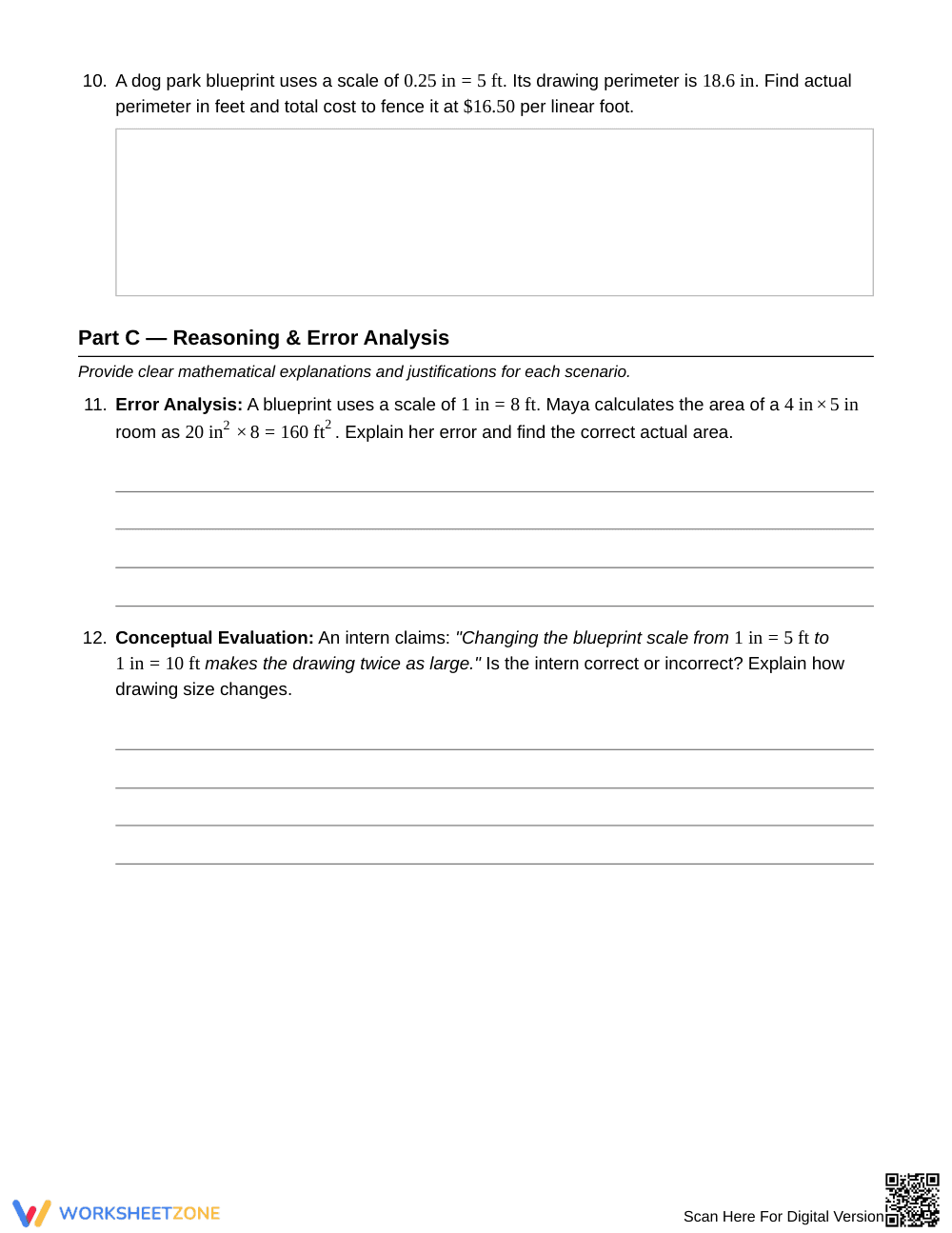
This 4-page resource includes a 2-page student worksheet with 12 structured tasks and a complete 2-page step-by-step answer key. It features formula reference boxes, scaffolded missing-step calculations, multi-step blueprint scenarios, and error-analysis prompts targeting common scaling misconceptions.
Skill Progression
- Guided Practice (Tasks 1–4): Missing-step completions that scaffold unit rate identification, equation setup, and initial conversions.
- Supported Practice (Tasks 5–8): Multi-step blueprint problems involving gym courts, halls, and suites that require finding actual perimeter and area.
- Independent Practice (Tasks 9–12): Autonomous real-world applications and error-analysis tasks where students evaluate flawed scaling claims.
This sequence follows the gradual-release model (I Do, We Do, You Do) to build confidence before independent problem solving.
Standards Alignment
This worksheet aligns with primary standard 7.G.A.1: solve problems involving scale drawings of geometric figures, including computing actual lengths and areas. It also reinforces supporting standard 7.RP.A.2 through proportional relationship modeling. Both standard codes can be copied directly into lesson plans, IEP goals, or district curriculum mapping tools.
How to Use It
Assign this resource after direct instruction on scale ratios or during small-group math intervention. During guided practice, check whether students convert dimensions before calculating area rather than multiplying drawing area by the scale factor. Students typically finish all 12 tasks in 35 to 45 minutes.
Who It's For
Ideal for Grade 7 math classrooms, this worksheet supports general education classes, ELL students requiring diagram scaffolds, and special education students who benefit from structured steps. Pair it with an anchor chart on unit rates for optimal student support.
According to research by Fisher & Frey (2014), gradual release of responsibility frameworks significantly improve student retention of multi-step mathematical procedures by systematically fading instructional scaffolds. This Grade 7 geometry worksheet applies that evidence-based design to standard 7.G.A.1, moving learners from missing-step prompts to independent blueprint conversions. When solving scale drawing tasks, middle school students frequently struggle with the dimensional shift between linear lengths and two-dimensional area calculations. By requiring students to calculate actual linear dimensions prior to finding surface area, the structured sequence prevents common multiplier errors identified across national mathematics benchmarks. The included error-analysis tasks prompt metacognitive evaluation, deepening conceptual grasp of proportional scale factors. With 12 targeted problems spanning guided completion, diagram interpretation, and analytical justification, this resource gives educators a mathematically rigorous tool that reinforces proportional reasoning while meeting state geometry performance standards efficiently.


