



























Complete Roblox Design Terms Word Search | Grades 4–5 ELA
Paste this activity's link or code into your existing LMS (Google Classroom, Canvas, Teams, Schoology, Moodle, etc.).
Students can open and work on the activity right away, with no student login required.
You'll still be able to track student progress and results from your teacher account.
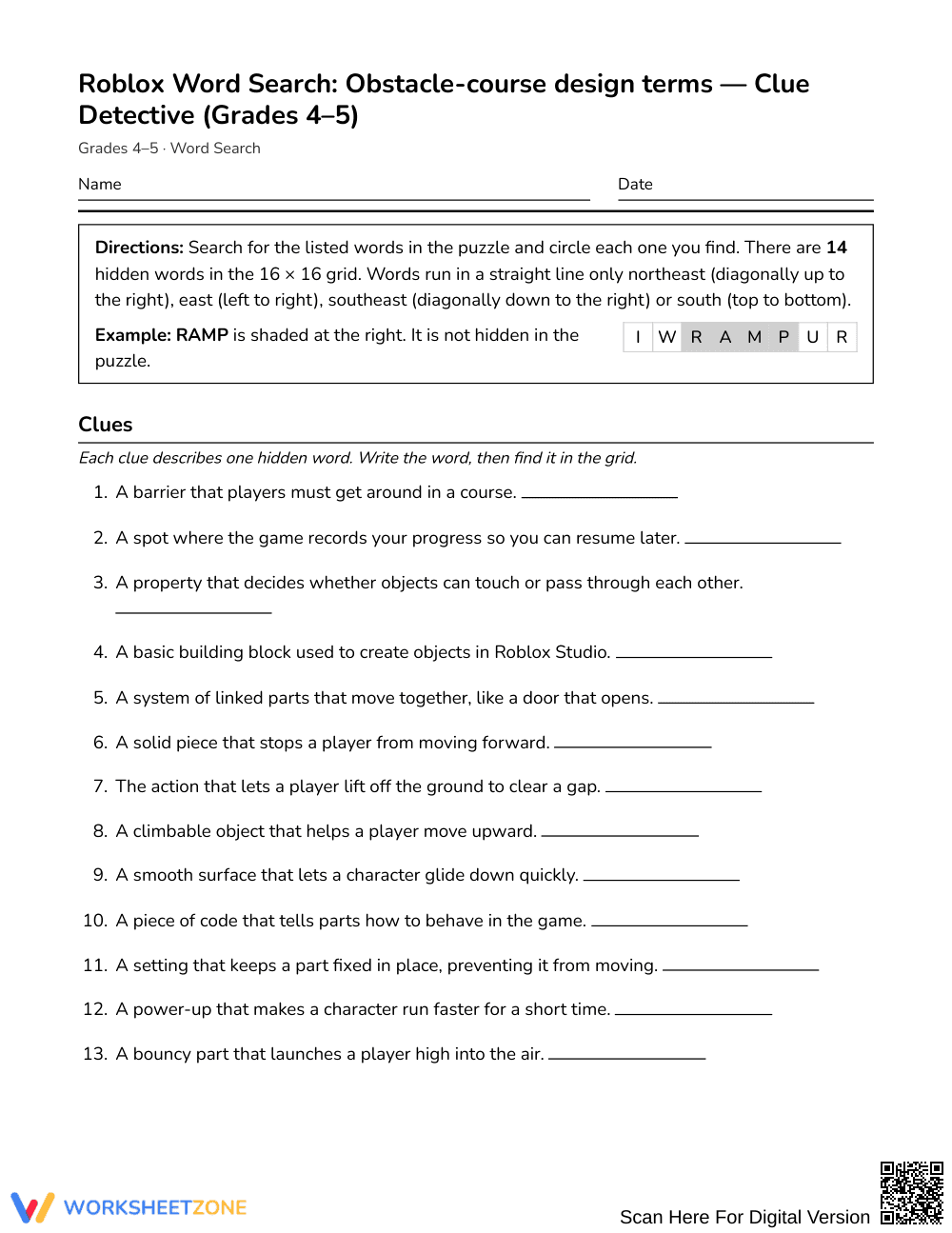
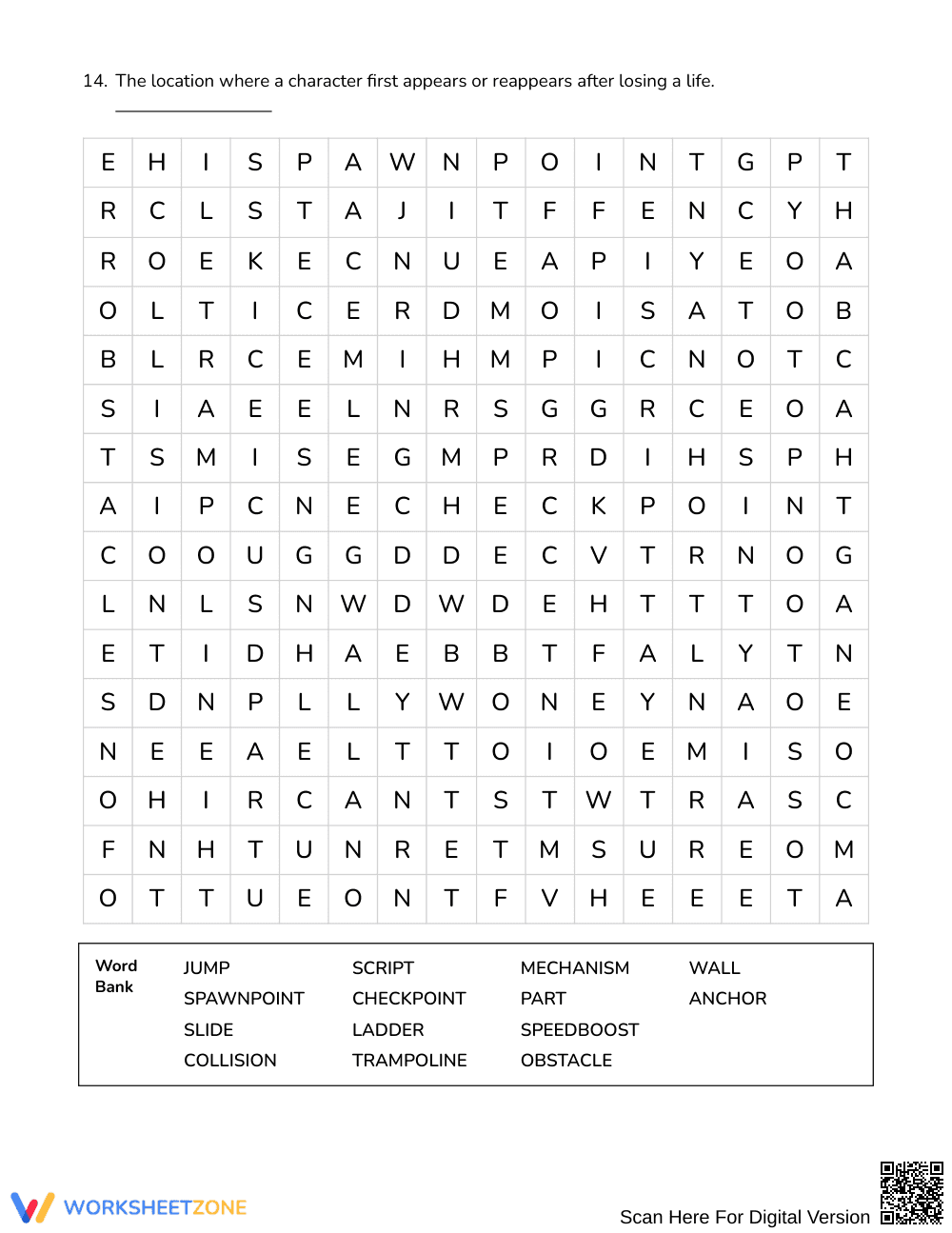
This Grades 4–5 vocabulary word search reinforces 14 essential obstacle-course design terms through clue-driven word recognition. Students read gameplay and development definitions to identify technical vocabulary before searching for each hidden term. The engaging format strengthens spelling, domain-specific terminology, and reading comprehension across a two-page printable format with an included solution guide.
At a Glance
- Grade: Grades 4–5 · Subject: English Language Arts (ELA)
- Standard: Not standards-assessed — vocabulary enrichment
- Skill Focus: Obstacle-course design terms and clue definitions
- Format: 2 pages · 14 words · Answer key included · PDF
- Best For: Vocabulary enrichment, literacy centers, and early finisher work
- Time: 15–25 minutes
This 2-page vocabulary resource features 14 target vocabulary words paired with descriptive, student-friendly clues. Rather than presenting a simple word bank, the sheet challenges learners to match definitions—such as collision, mechanism, and spawnpoint—to target terminology. A full 3-page answer key provides clear solution paths, allowing teachers or students to verify placements instantly without extra prep.
Puzzle Mechanics & Design
The activity is built on a 16 x 16 letter grid containing 14 hidden words oriented across four search directions: northeast (NE), east (E), southeast (SE), and south (S). Instead of a plain alphabetical checklist, students work from a shuffled clue bank. Learners solve each clue by identifying the correct obstacle-course design term, then locate the word within the letter matrix.
Standards Alignment
This activity serves strictly as vocabulary enrichment and is not aligned to a standard. The tasks build general domain-specific language and morphological awareness by engaging students with game-design concepts and structural vocabulary in an applied context.
How to Use It
Deploy this word search during independent reading rotations or as an engaging sponge activity after direct instruction in procedural writing or digital literacy. For formative assessment, observe whether students read the clue definitions first or scan letters blindly; prompt learners to define terms orally before locating them. Students typically complete the 14 words in 15 to 25 minutes.
Who It's For
This resource is tailored for learners in Grades 4–5 who benefit from contextual vocabulary acquisition, including upper-elementary gamified learning fans and English language learners needing concrete definitions. Differentiate by letting striving readers highlight key phrases within the clues before scanning the grid. Pair this activity naturally with a game-design informational text or a procedural coding anchor chart.
According to Fisher & Frey (2014), intentional domain-specific vocabulary acquisition accelerates reading comprehension when students engage with conceptual definitions rather than isolated memorization. This Grades 4–5 vocabulary resource targets obstacle-course design terms through contextual clues, reinforcing academic language and orthographic processing across a 16 x 16 letter grid. By requiring learners to interpret functional descriptions of game development, coding, and spatial mechanics—including scripts, collisions, anchors, and mechanisms—before executing directional word searches, the activity directly links technical definitions to word structures. Systematic retrieval of high-utility terminology supports orthographic mapping, expands morphological awareness, and helps upper-elementary readers internalize complex informational text vocabulary. The puzzle provides classroom educators with a structured, print-ready vocabulary enrichment exercise that bolsters foundational reading strategies while sustaining active student interest during independent learning blocks. Consequently, educators can integrate this puzzle into cross-curricular units to enhance specialized vocabulary recall efficiently.


