


























Views
Downloads




Complete Riemann Sum Bounds Worksheet | Grade 12 Calculus
Paste this activity's link or code into your existing LMS (Google Classroom, Canvas, Teams, Schoology, Moodle, etc.).
Students can open and work on the activity right away, with no student login required.
You'll still be able to track student progress and results from your teacher account.
This Grade 12 Calculus worksheet equips students to analyze and compare numerical approximation bounds against definite integrals. Learners apply monotonicity and concavity rules to evaluate Left, Right, Midpoint, and Trapezoidal sums alongside the Fundamental Theorem of Calculus. Through analytical prompts, students master error bounding and net accumulation across tabular and algebraic models.
At a Glance
- Grade: 12 · Subject: Calculus
- Standard: Advanced Mathematics — Compare numerical integration bounds and exact definite integrals
- Skill Focus: Compare Bounds and Approximation Methods
- Format: 5 pages · 12 problems · Answer key included · PDF
- Best For: AP Calculus exam preparation
- Time: 45–60 minutes
What's Inside
The 5-page worksheet includes 12 calculus tasks across three parts, supported by a 4-page answer key with complete derivations. Students use an introductory reference box covering monotonicity and concavity rules, working through tabular vehicle deceleration data, storage reservoir rates, rational functions, and formal Riemann sum limit proofs.
Skill Progression
- Guided Practice (Part A, Problems 1–3): Students extract tabular and functional rates to calculate Left and Right Riemann sums and net change integrals with explicit units.
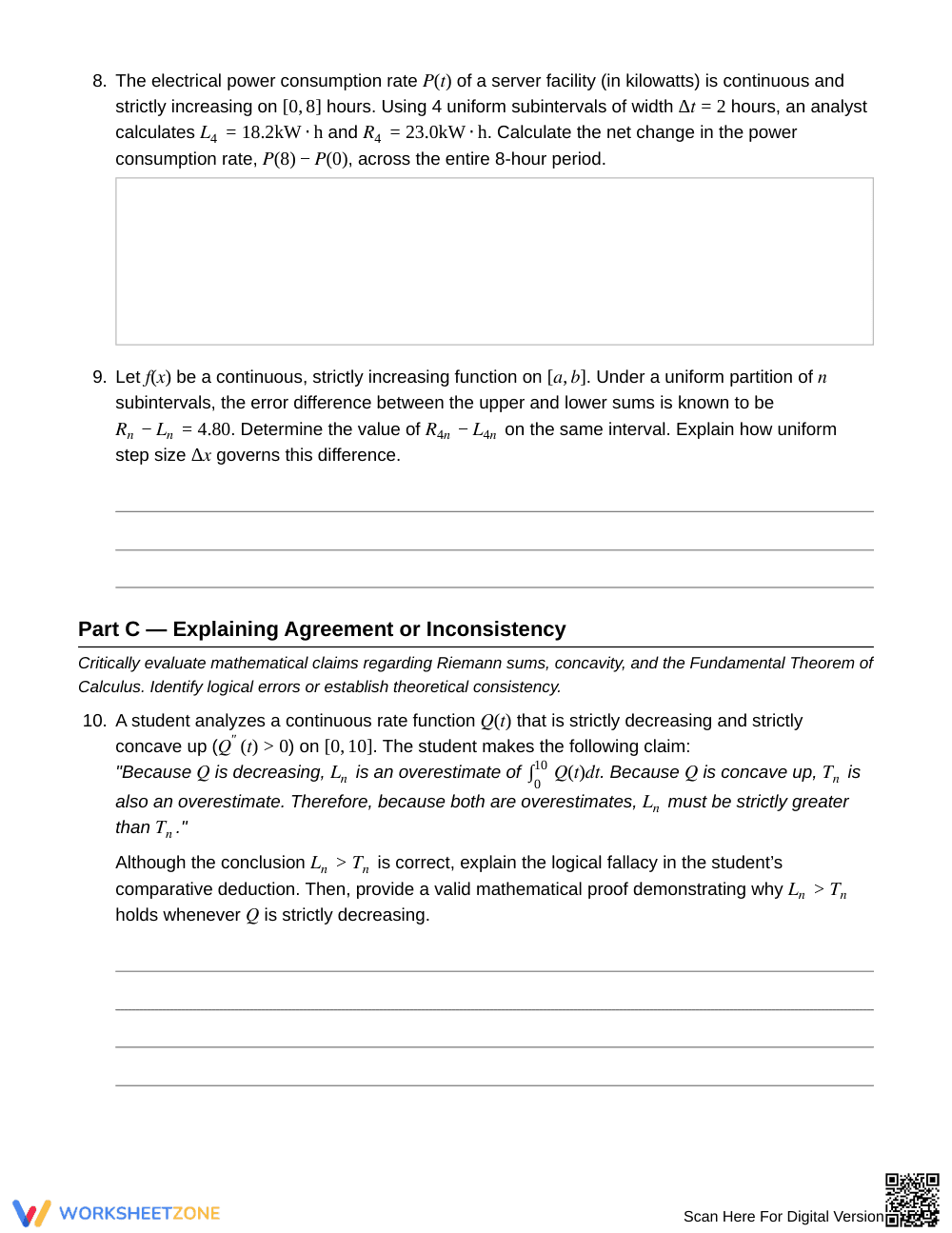
- Supported Practice (Part B, Problems 4–9): Learners link geometric approximations to exact accumulation, deriving trapezoidal formulas, calculating midpoint sums, and bounding errors using second derivatives.
- Independent Practice (Part C, Problems 10–12): Students evaluate bounding arguments, refute inconsistent concavity claims, and prove that Riemann sum limits equal definite integrals.
This progression mirrors the gradual release of responsibility model, moving students from guided computation to rigorous mathematical justification.
Standards Alignment
This resource aligns with high school calculus curriculum standards for numerical integration and the Fundamental Theorem of Calculus. Students examine accumulation rates, calculate partition bounds, and evaluate concavity to verify overestimates and underestimates. Both standard codes can be copied directly into lesson plans, IEP goals, or district curriculum mapping tools.
How to Use It
Deploy this worksheet after direct instruction on Riemann sums and concavity. For a 50-minute class session, have students work collaboratively through Parts A and B while checking for accurate unit analysis. Use Part C as a targeted formative assessment check to verify that students can articulate why concavity dictates over- or under-approximation.
Who It's For
This worksheet is designed for Grade 12 AP Calculus AB and BC students mastering integral approximations. Advanced learners will be challenged by the limit proofs and fallacy evaluations, while scaffolding boxes support students reviewing basic sum formulas. Pair this worksheet with an accumulation anchor chart illustrating tangent and secant bounds.
Advanced placement mathematics requires students to connect discrete approximations with analytic definitions of accumulation. According to EdReports 2024, high-quality secondary mathematics materials build conceptual coherence by linking numerical estimation techniques directly to formal calculus theorems. This worksheet operationalizes that recommendation across 12 structured problems, requiring Grade 12 students to calculate bounds, assess monotonicity, and evaluate concavity conditions. Rather than treating Left, Right, Midpoint, and Trapezoidal sums as rote arithmetic routines, the resource prompts students to prove algebraic relationships, bound error intervals, and identify logical fallacies in bounding arguments. Formative analysis of student explanations regarding concavity and summation limits provides educators with actionable diagnostic evidence of mathematical reasoning before learners advance to differential equations and applications of integration. Consequently, this resource reinforces essential conceptual frameworks that bridge initial numerical exploration with rigorous definite integral analysis and proof.


