





























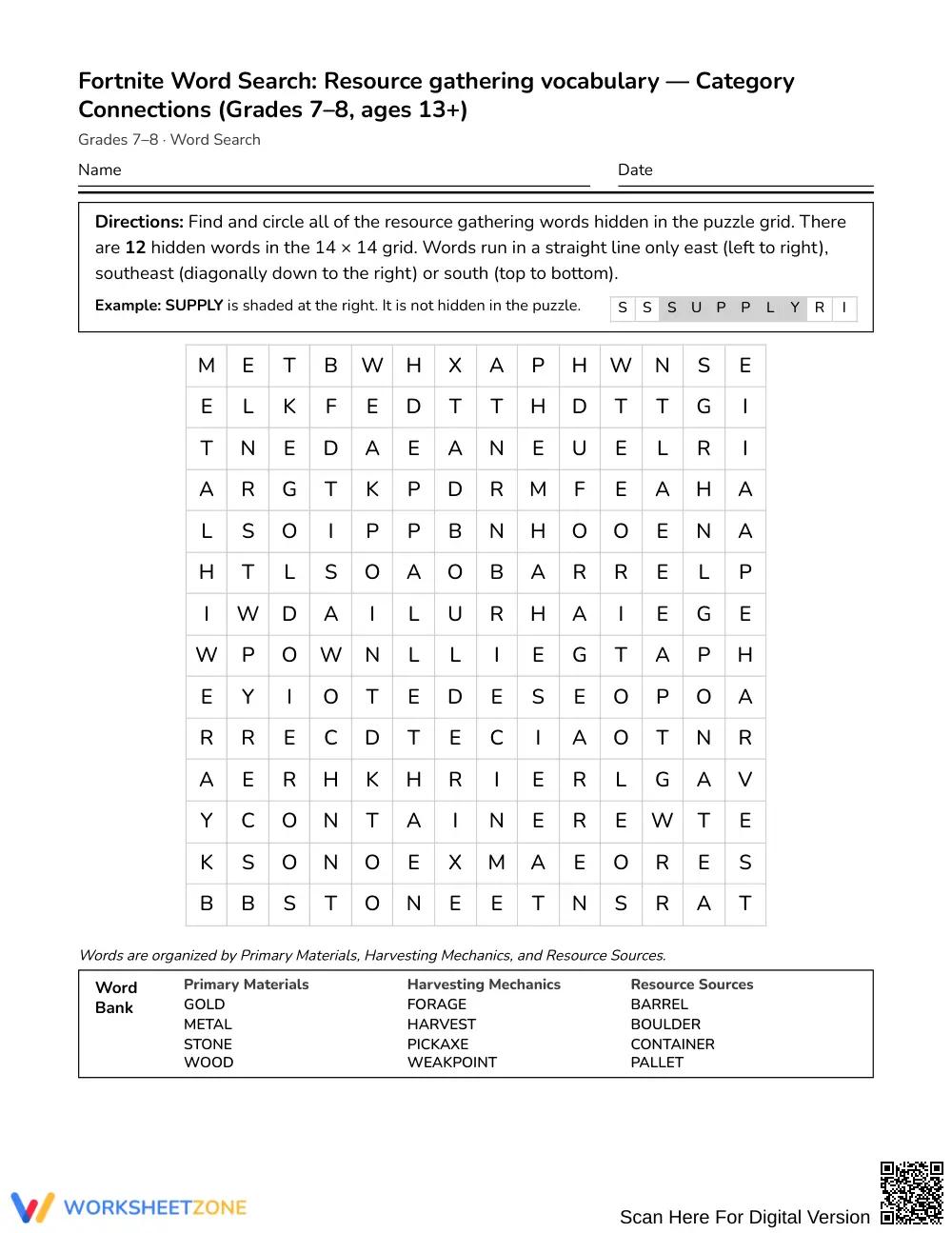


Complete Resource Gathering Word Search | Grades 7–8 ELA

Paste this activity's link or code into your existing LMS (Google Classroom, Canvas, Teams, Schoology, Moodle, etc.).
Students can open and work on the activity right away, with no student login required.
You'll still be able to track student progress and results from your teacher account.
This Grades 7–8 English Language Arts word search builds resource gathering vocabulary through high-interest thematic categorization. Students locate 12 gaming-related terms across three structured semantic groups, reinforcing word recognition, spelling precision, and contextual understanding. It provides an engaging entry point for middle school learners to explore tier-two and domain-specific terminology without intimidation.
At a Glance
- Grade: Grades 7–8 · Subject: English Language Arts (ELA)
- Standard: Not standards-assessed — vocabulary enrichment
- Skill Focus: Resource gathering vocabulary
- Format: 1 page · 12 words · Answer key included · PDF
- Best For: Vocabulary warm-up and fast finishers
- Time: 15–20 minutes
What's Inside
The single-page printable features a clean letter matrix alongside an organized vocabulary bank containing 12 target words. Target terms are sorted into three distinct thematic categories: Primary Materials, Harvesting Mechanics, and Resource Sources. A comprehensive three-page answer key provides clear letter-by-letter solutions for quick checking or self-assessment.
Puzzle Structure and Mechanics
This word search operates on a compact 14 by 14 letter grid designed to keep puzzle-solving focused and purposeful. The 12 target words run in three accessible orientations: East (horizontal left-to-right), South (vertical top-to-bottom), and Southeast (diagonal downward). Students reference a categorized word bank that divides vocabulary into materials like metal and wood, operational mechanics like forage and harvest, and environmental sources like container and boulder, reinforcing conceptual associations during word retrieval.
Standards Alignment
This activity serves strictly as supplemental vocabulary enrichment and is not aligned to a specific Common Core or state academic standard. Instead, it offers thematic language reinforcement that strengthens orthographic mapping, letter pattern recognition, and conceptual categorization within general middle school literacy routines.
How to Use It
Deploy this puzzle as an opening warm-up before a broader lesson on classification and morphology, or assign it as an independent station task for early finishers. During completion, circulate to observe whether students scan randomly or leverage alphabetical and orthographic clusters to spot multi-syllable terms like weakpoint. Most middle school learners finish the search within 15 to 20 minutes.
Who It's For
This word search is designed for Grades 7–8 ELA students who benefit from engaging, game-inspired literacy tasks. It serves general education classes, English language learners developing print familiarity, and reluctant readers who respond well to high-interest themes. Pair this printable with an informational reading passage on natural resources or a companion graphic organizer on word classification.
According to Fisher & Frey (2014), intentional vocabulary acquisition flourishes when educators integrate productive language routines that connect familiar conceptual domains with systematic word study. This Grades 7–8 resource gathering vocabulary word search operationalizes that principle by embedding 12 domain-linked terms within a categorized puzzle structure. Rather than presenting isolated definitions, the activity organizes vocabulary into distinct conceptual bins—materials, mechanics, and environmental sources—fostering orthographic analysis and cognitive grouping during independent literacy practice. The 14 by 14 grid format directs students to locate targeted terms across horizontal, vertical, and diagonal orientations, sharpening visual scanning and spelling retention. Serving as targeted enrichment rather than formal assessment, this printable offers teachers a low-stakes, high-engagement instructional tool that supports active word recognition, reinforces contextual categorizations, and strengthens general print awareness across diverse middle school classroom environments.


