






























Complete Resistance & Recovery Worksheet | Grade 12 Science
Paste this activity's link or code into your existing LMS (Google Classroom, Canvas, Teams, Schoology, Moodle, etc.).
Students can open and work on the activity right away, with no student login required.
You'll still be able to track student progress and results from your teacher account.
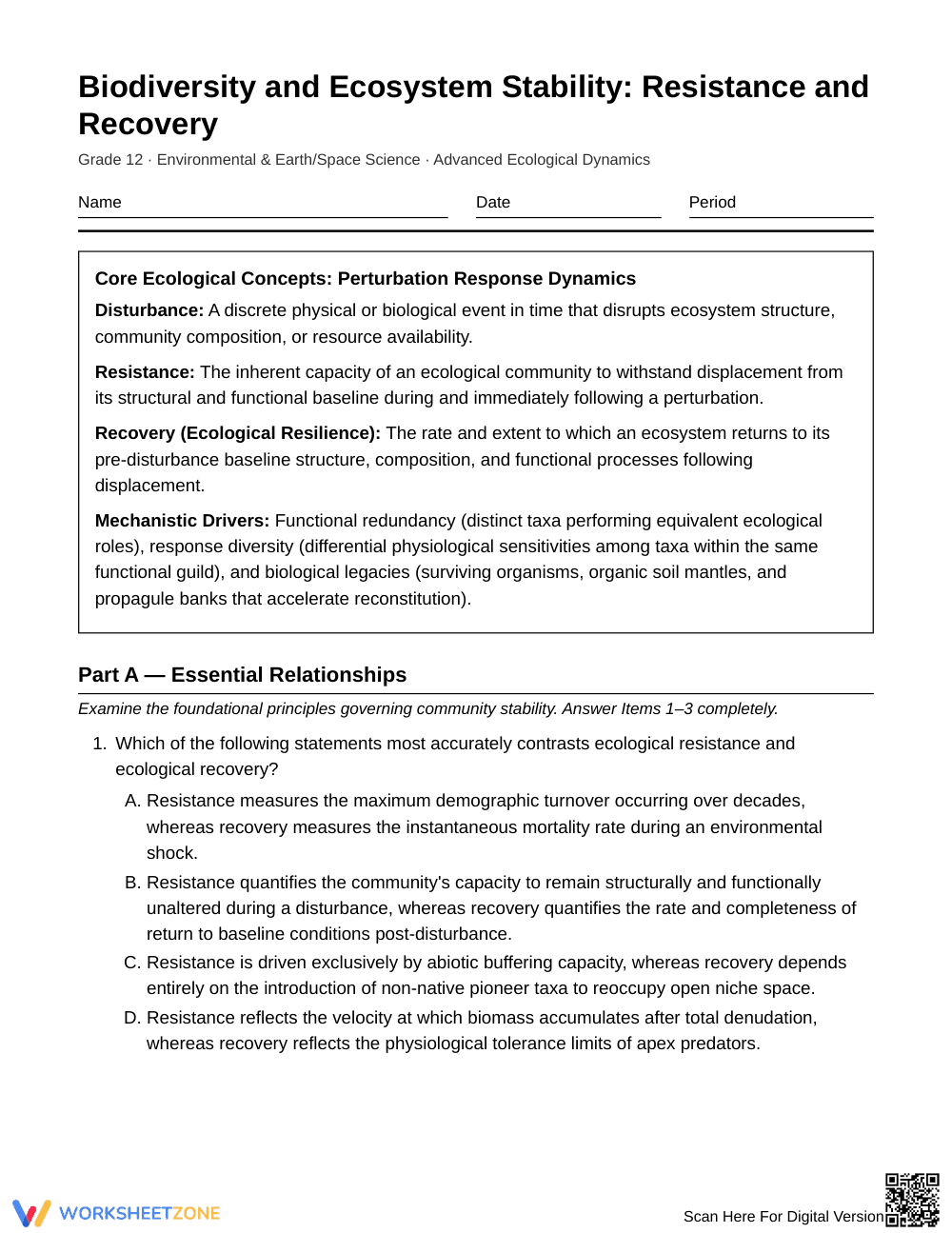
This advanced Grade 12 environmental science worksheet guides students through evaluating ecological stability by contrasting perturbation resistance with post-disturbance recovery. Learners calculate retention metrics from synthetic forest drought studies, evaluate estuarine eutrophication recovery trajectories, and predict community resilience using core principles including functional redundancy, biological legacies, and alternative stable states.
At a Glance
- Grade: 12 · Subject: Environmental & Earth/Space Science
- Standard: Advanced Ecology — Evaluate ecosystem perturbation response dynamics, community resistance, and functional resilience mechanisms
- Skill Focus: Explain Resistance and Recovery
- Format: 7 pages · 12 problems · Answer key included · PDF
- Best For: AP or advanced ecology unit review
- Time: 45–60 minutes
What's Inside: A high-rigor, 7-page print-and-go document containing 12 analytical tasks across three distinct parts. The resource opens with foundational definitions of perturbation drivers, integrates two detailed synthetic ecological datasets with quantitative tables, and provides an exhaustive 6-page teacher answer key complete with exemplar calculations and theoretical justifications.
Skill Progression
- Guided Practice (Items 1–3): Students establish foundational conceptual clarity by identifying core contrasting definitions, applying the Insurance Hypothesis to pathogen outbreaks, and comparing resistance-recovery trade-offs across distinct biomes.
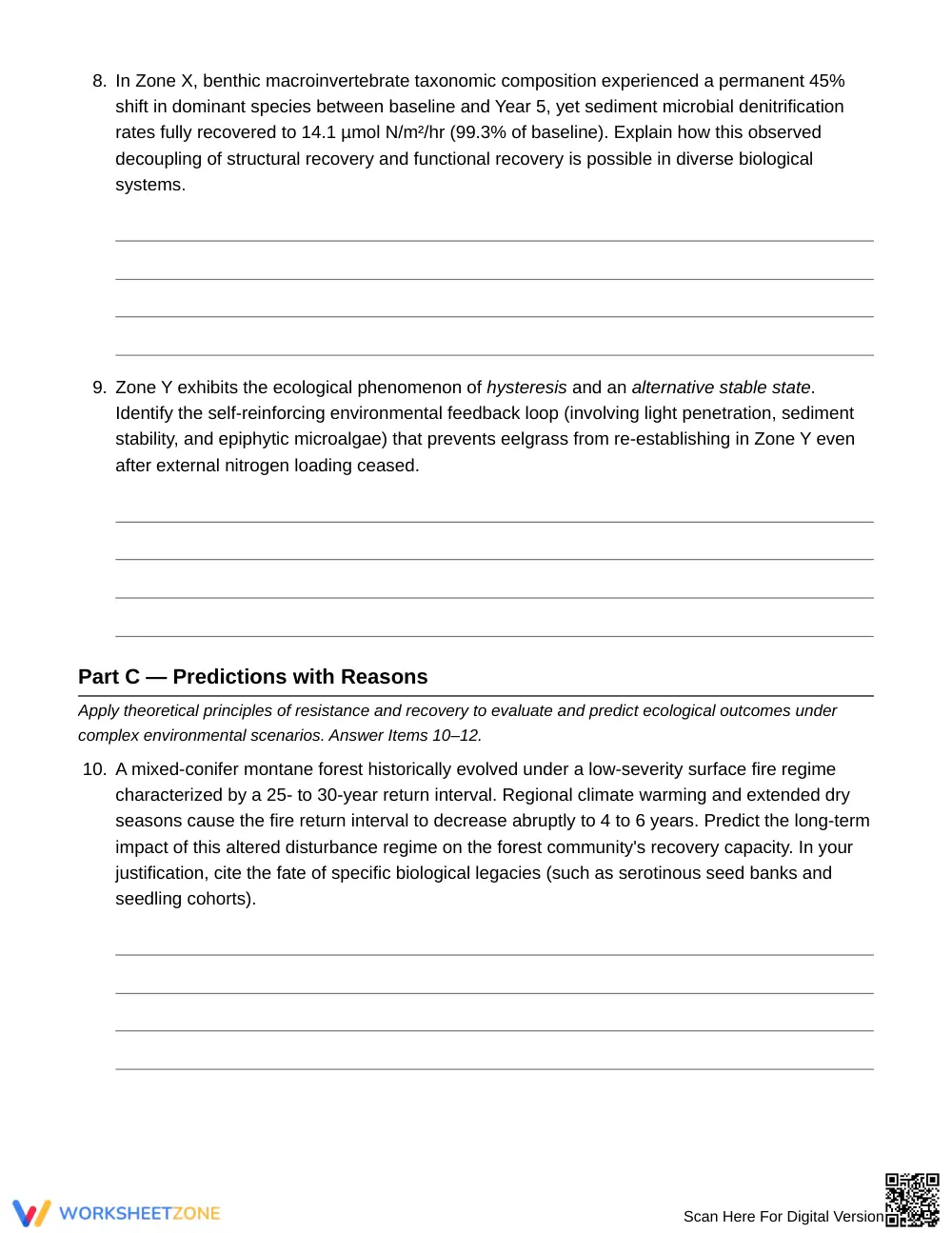
- Supported Practice (Items 4–9): Working with multi-year drought and estuarine hypoxia data tables, learners calculate percentage retention of primary productivity, explain decoupling between taxonomic and functional recovery, and evaluate feedback loops driving alternative stable states.
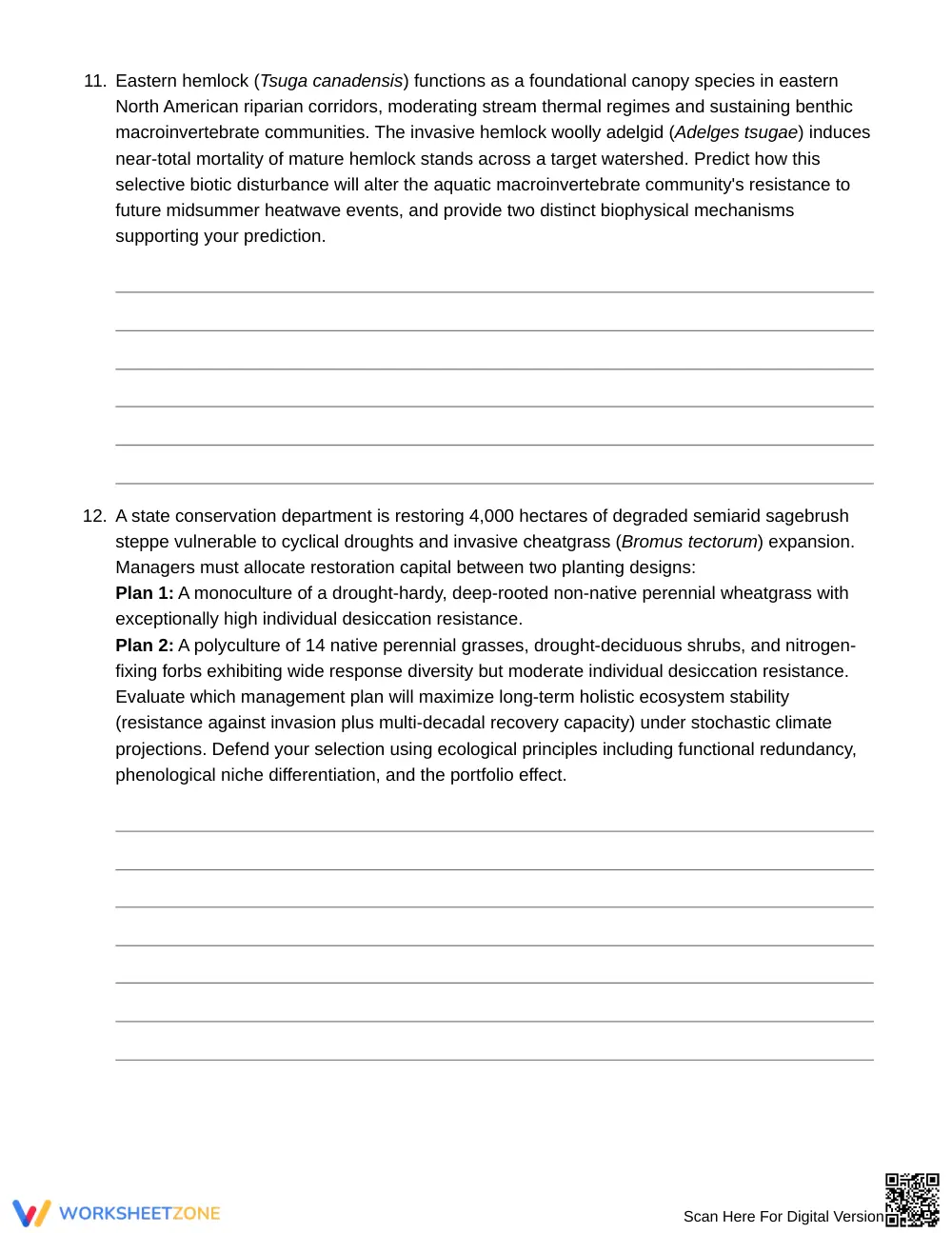
- Independent Practice (Items 10–12): Students apply theoretical dynamics to novel management scenarios, predicting the consequences of truncated fire regimes, foundational tree species loss, and monoculture versus polyculture steppe restoration designs.
This sequence implements a structured gradual-release architecture, transitioning students from qualitative conceptual distinctions to data-driven quantitative evaluation and multi-variable ecological synthesis.
Standards Alignment
This resource aligns with high school advanced ecology and environmental science learning progressions. Students evaluate the complex interactions that affect ecosystem stability, analyze mathematical evidence supporting biodiversity buffers, and construct evidence-based arguments concerning anthropogenic and natural disturbances. These concepts can be copied directly into lesson plans, IEP goals, or district curriculum mapping tools.
How to Use It
Deploy this worksheet after direct instruction on community stability, succession, and biodiversity metrics. During independent or paired problem solving, circulate during Part B to assess whether students correctly distinguish between structural turnover and functional metric stability in the estuarine data set. The activity requires approximately 45 to 60 minutes of focused instructional time.
Who It's For
Designed for Grade 12 Environmental Science, AP Environmental Science, or Advanced Biology students examining ecosystem stability. Pair this worksheet with a laboratory study on microbial diversity or an interactive simulation of ecological food-web perturbations to provide empirical reinforcement.
According to research highlighted in Fisher & Frey (2014), structured scaffolds that transition learners from foundational concept differentiation to data-rich ecological modeling significantly deepen secondary students' capacity to articulate complex biological relationships. This Grade 12 worksheet directly targets the specific mechanisms of ecological resistance and post-disturbance recovery across 12 rigorous analytical tasks. By examining experimental forestry data, estuarine nutrient loading metrics, and real-world habitat restoration dilemmas, students master the critical roles of functional redundancy, response diversity, and biological legacies in maintaining long-term ecosystem preservation. Providing explicit analytical prompts alongside quantitative datasets enables high school scholars to bridge abstract conservation theory with applied environmental problem-solving. Ultimately, this scaffolded instructional framework builds scientific literacy, strengthens critical inquiry, and ensures advanced learners develop the evaluative skills necessary to accurately interpret community stability, recovery trajectories, and ecological resilience across diverse disturbed landscapes.


