































Complete Repeated Growth Worksheet | Grade 11 Algebra II

Paste this activity's link or code into your existing LMS (Google Classroom, Canvas, Teams, Schoology, Moodle, etc.).
Students can open and work on the activity right away, with no student login required.
You'll still be able to track student progress and results from your teacher account.
This high school Algebra II worksheet strengthens students' ability to construct and evaluate exponential functions featuring non-unit time intervals. Learners analyze authentic growth and decay contexts, formulate algebraic models using the fixed-period framework, and calculate precise quantities to evaluate real-world constraints. Complete step-by-step solutions provide teachers with immediate verification tools.
At a Glance
- Grade: 11 · Subject: Algebra II Mathematics
- Standard: Construct and evaluate explicit exponential functions to model periodic growth and decay situations
- Skill Focus: Model Repeated Growth or Decay
- Format: 5 pages · 10 problems · 2-page answer key · Printable PDF
- Best For: Core practice, homework, and contextual modeling
- Time: 45–60 minutes
What's Inside
This 5-page resource provides 10 rigorous mathematical tasks across three sections, supported by a reference box and a 2-page answer key. Students begin with a review of the fixed-period exponential equation and a worked radioisotope decay scenario before tackling explicit model writing, multi-step contextual calculations, and constraint-based decision problems.
Skill Progression
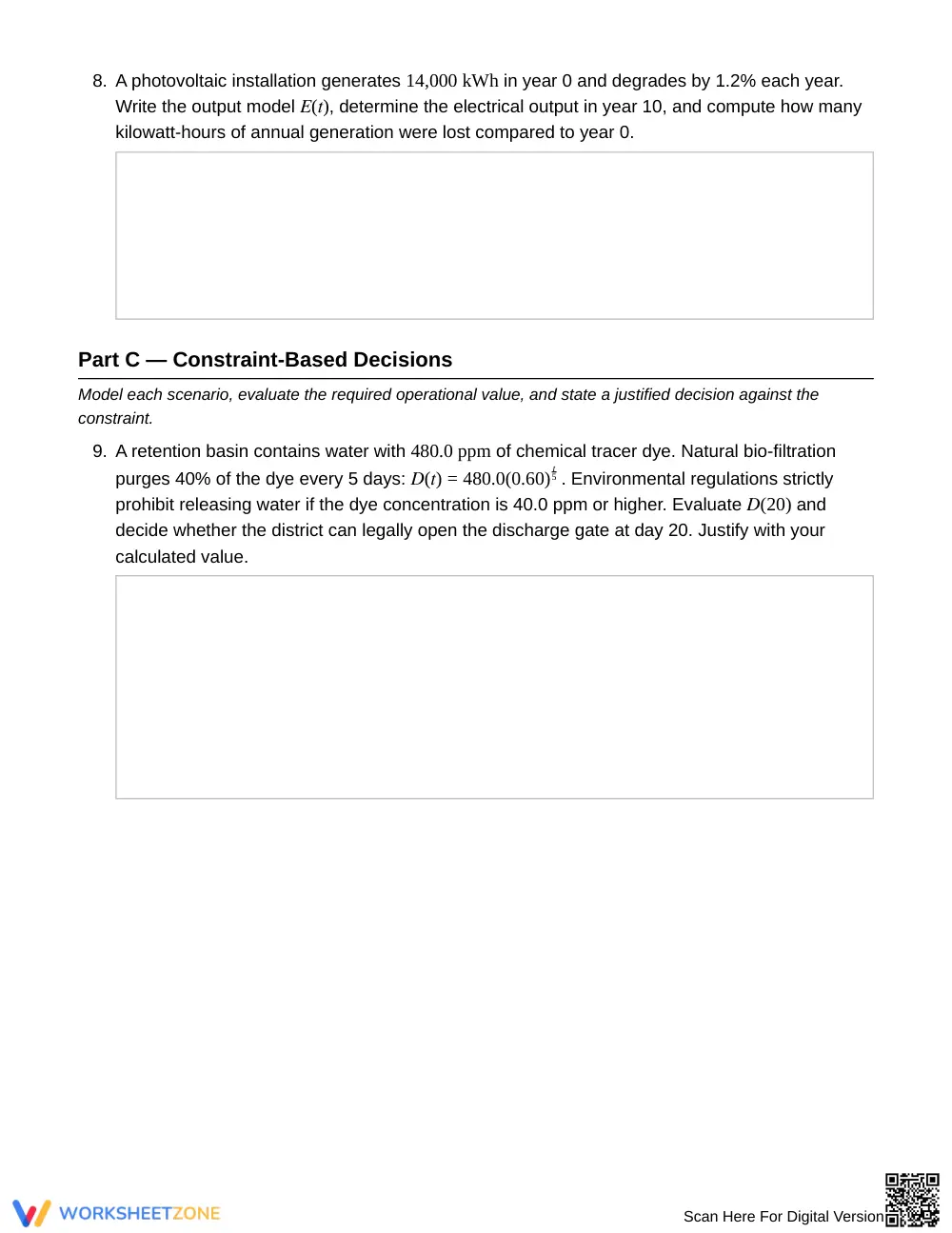
- Guided practice (Part A, 2 problems): Direct explicit modeling with initial values, growth rates, and time intervals to establish formula fluency.
- Supported practice (Part B, 6 problems): Multi-step contextual scenarios requiring secondary calculations such as average rate of change and threshold comparisons.
- Independent practice (Part C, 2 problems): High-stakes constraint evaluations where students model decay or heating processes to justify operational decisions.
This progression follows the gradual-release framework, moving learners systematically from formula application to independent mathematical reasoning.
Standards Alignment
This resource focuses on constructing exponential models that describe real-world relationships where quantities grow or decay by fixed percentages over custom intervals. Students identify initial values, compute growth or decay factors, and write fractional exponents. Both standard codes can be copied directly into lesson plans, IEP goals, or district curriculum mapping tools.
How to Use It
Deploy this worksheet after direct instruction on exponential rates and exponent rules. During independent work, check whether students place the interval divisor in the exponent correctly rather than multiplying the base. Allocate 45 to 60 minutes for completion, followed by targeted review using the provided answer key.
Who It's For
This resource is designed for Grade 11 Algebra II students and STEM-prep courses. Teachers can differentiate by referencing the worked isotope example for tier-two support or assigning Part C constraints to advanced learners. Pair this worksheet with direct instruction on exponential functions or a half-life lab.
Explicit mathematical modeling of periodic growth and decay provides high school students with essential quantitative tools for STEM readiness. According to empirical research from Fisher & Frey (2014) on purposeful instructional design, structured task progressions that bridge guided formulation with complex decision-making yield measurable gains in conceptual retention and algebraic fluency. This 10-problem Algebra II worksheet addresses core curriculum expectations by requiring learners to construct explicit functions of the form f(t) = a · b^(t/k), calculate multi-step values, and apply continuous equations to discrete practical scenarios. By progressing systematically from direct parameter identification to environmental threshold and pharmaceutical viability decisions, students develop robust analytical reasoning. Educators utilizing this 5-page resource ensure that secondary learners master foundational exponential modeling while engaging in authentic, evidence-based problem solving across diverse scientific disciplines.


