




























Views
Downloads



Complete Repairing Bias Claims Worksheet | Grade 9 English I

Paste this activity's link or code into your existing LMS (Google Classroom, Canvas, Teams, Schoology, Moodle, etc.).
Students can open and work on the activity right away, with no student login required.
You'll still be able to track student progress and results from your teacher account.
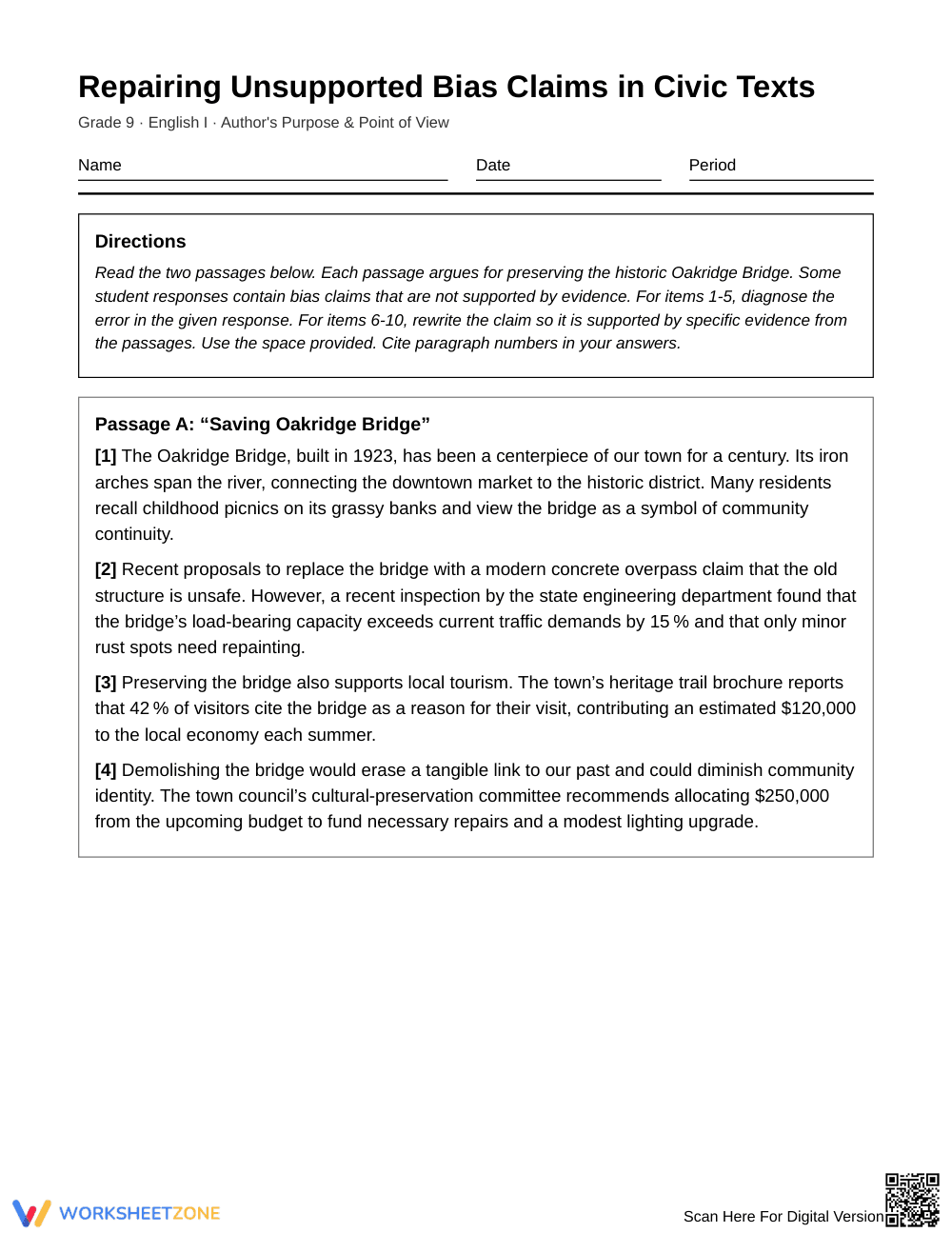
This Grade 9 English I worksheet trains students to evaluate arguments and repair unsupported bias claims using textual evidence. Working with paired civic arguments, high school learners identify logical errors in student statements and rewrite them into factual, text-supported claims, building essential rhetorical analysis skills.
At a Glance
- Grade: 9 · Subject: English I
- Standard:
RI.9-10.8— Evaluate argument validity and evidence sufficiency in informational texts- Skill Focus: Repair an Unsupported Bias Claim
- Format: 5 pages · 10 problems · Answer key included · PDF
- Best For: Argumentative analysis and claim revision
- Time: 35–45 minutes
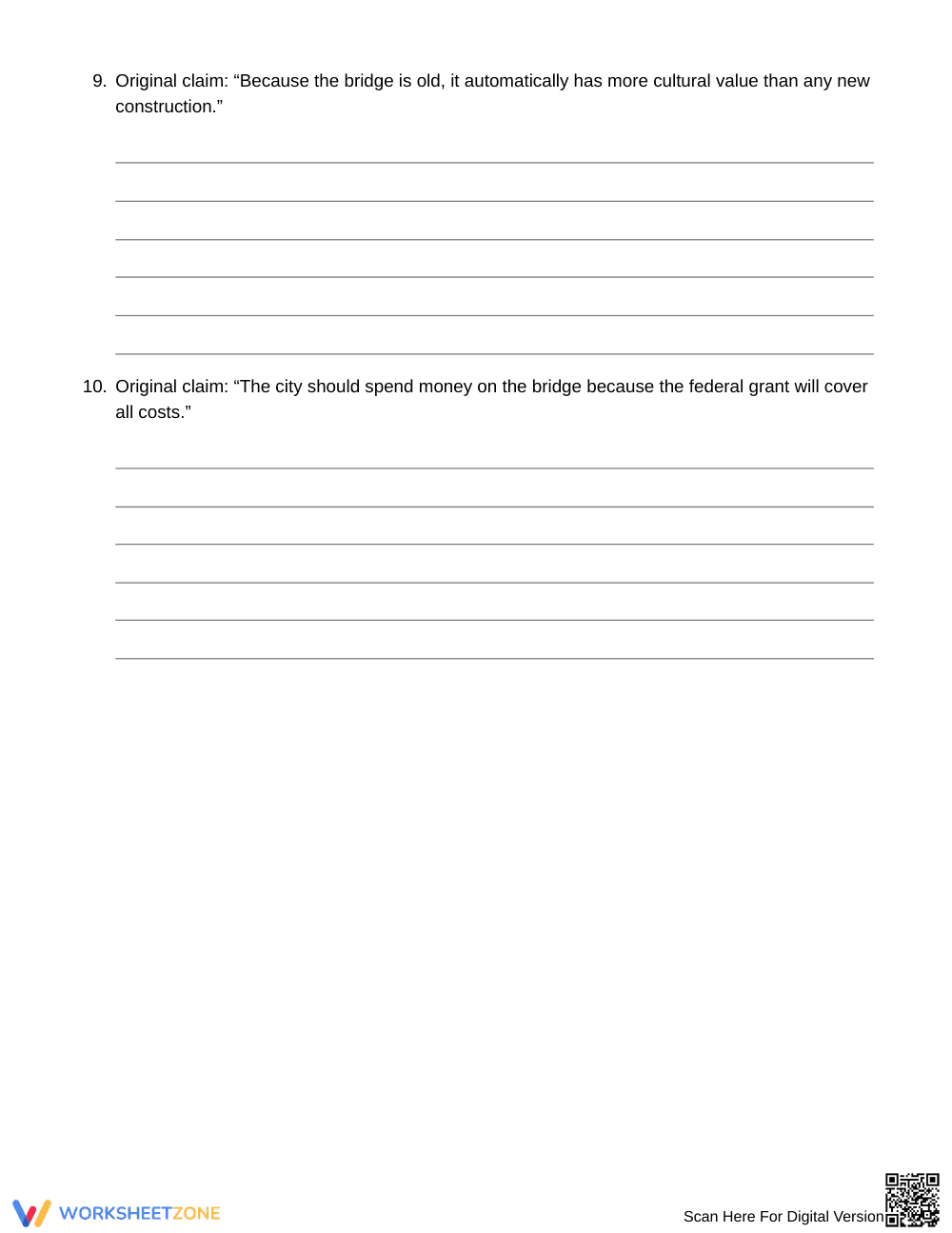
What's Inside: The 5-page resource includes two contrasting civic passages about a historic bridge project. Students complete 10 total tasks across two parts: 5 error-diagnosis prompts addressing sweeping generalizations and assumptions, and 5 evidence-based revision prompts requiring paragraph citations. A 2-page detailed answer key provides full explanations and model revisions.
Skill Progression
- Guided practice: Items 1–2 isolate subjective overstatements and absolute language with clear error patterns.
- Supported practice: Items 3–5 challenge students to identify subtle false assumptions and misattributed data.
- Independent practice: Items 6–10 require students to rewrite flawed statements into evidenced claims using paragraph citations.
This gradual-release sequence guides students from targeted error identification to independent claim synthesis.
Standards Alignment
Primary alignment is `RI.9-10.8`: Delineate and evaluate the argument and specific claims in a text, assessing whether reasoning is valid and evidence is sufficient. Additionally, `RI.9-10.1` supports citing strong textual evidence. Both standard codes can be copied directly into lesson plans, IEP goals, or district curriculum mapping tools.
How to Use It
Use this worksheet after direct instruction on logical fallacies. In a 40-minute session, allocate 15 minutes for paired text reading and Part 1 diagnosis, then 20 minutes for independent Part 2 revisions. For formative assessment, check whether students integrate numerical bridge data from the text into their rewrites. Spend the final 5 minutes reviewing model answers.
Who It's For
Designed for Grade 9 English I students analyzing informational arguments. Provide sentence stems for striving readers during Part 2 rewrites, and challenge advanced students to compose full rebuttal paragraphs. Pair this activity with an anchor chart on logical fallacies or a persuasive rhetoric mini-lesson.
Research by Fisher & Frey (2014) demonstrates that guided argumentative analysis and structured error correction substantially enhance secondary reading comprehension and critical writing performance. By diagnosing logical fallacies and actively rewriting flawed assertions with textual data, high school students develop the evaluative habits required under standard RI.9-10.8. When students delineate and evaluate arguments, they learn to distinguish subjective bias from empirical proof, establishing essential analytical foundations for advanced high school literacy and civic readiness. Structured practice exercises that shift from error diagnosis to evidence-based claim reconstruction strengthen students' abilities to evaluate reasoning validity and cite relevant details across complex civic topics. Implementing explicit revision routines with paired informational texts ensures learners internalize rigorous rhetorical standards, resulting in measurable progress in informational reading achievement and analytical writing proficiency across secondary English I classrooms.


