




























Complete Red Fruits Word Search | Grades 7–8 Science
Paste this activity's link or code into your existing LMS (Google Classroom, Canvas, Teams, Schoology, Moodle, etc.).
Students can open and work on the activity right away, with no student login required.
You'll still be able to track student progress and results from your teacher account.
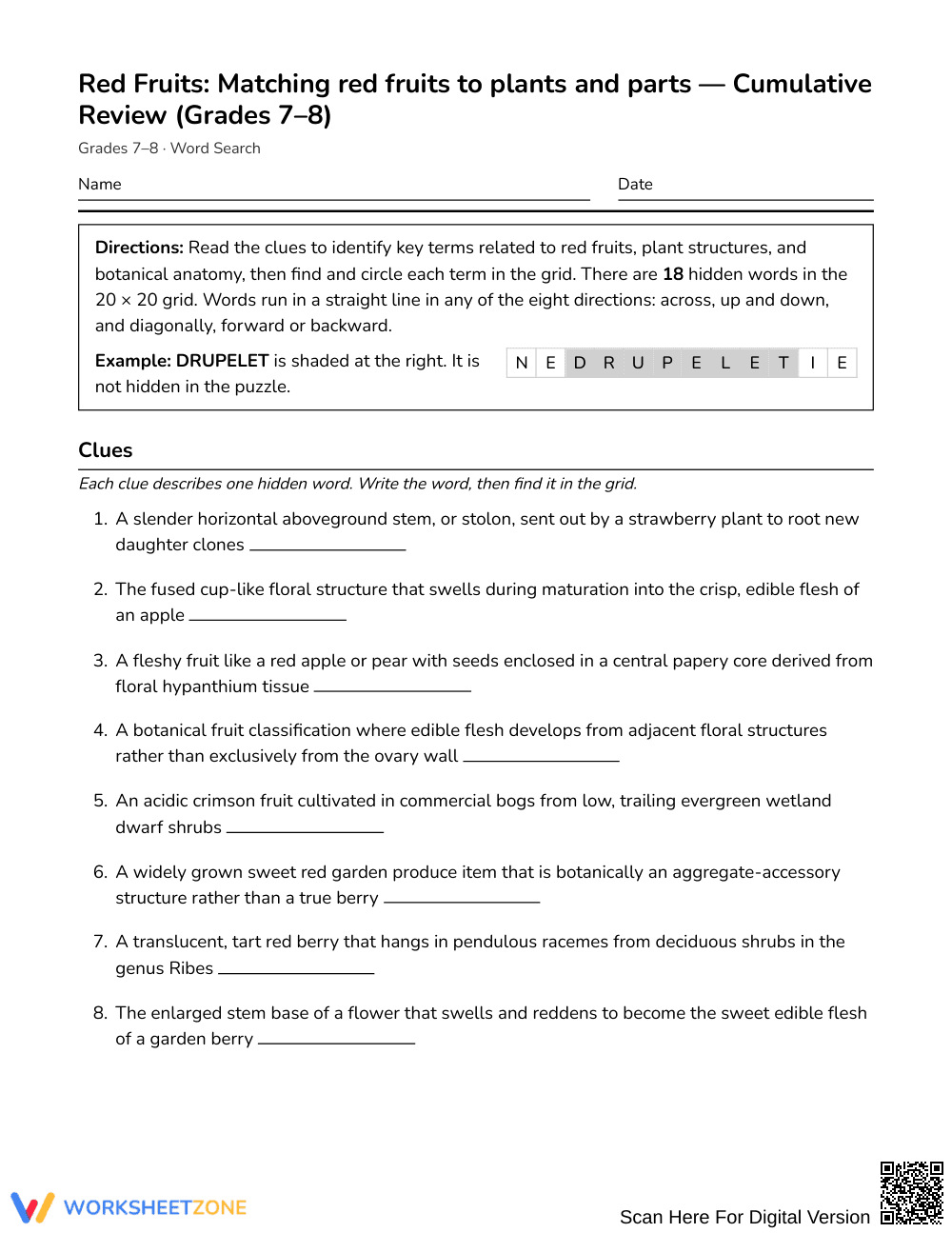
This science word search helps middle school students master plant anatomy by connecting familiar red fruits with their botanical classifications and structural components. Students read 18 detailed clues covering terms like exocarp, hypanthium, and aggregate drupelets, building precise botanical literacy through engaging vocabulary retrieval practice.
At a Glance
- Grade: Grades 7–8 · Subject: Science
- Standard: Not standards-assessed — vocabulary enrichment
- Skill Focus: Matching red fruits to plants and parts
- Format: 3 pages · 18 words · Answer key included · PDF
- Best For: Botanical unit review and vocabulary reinforcement
- Time: 25–35 minutes
What's Inside
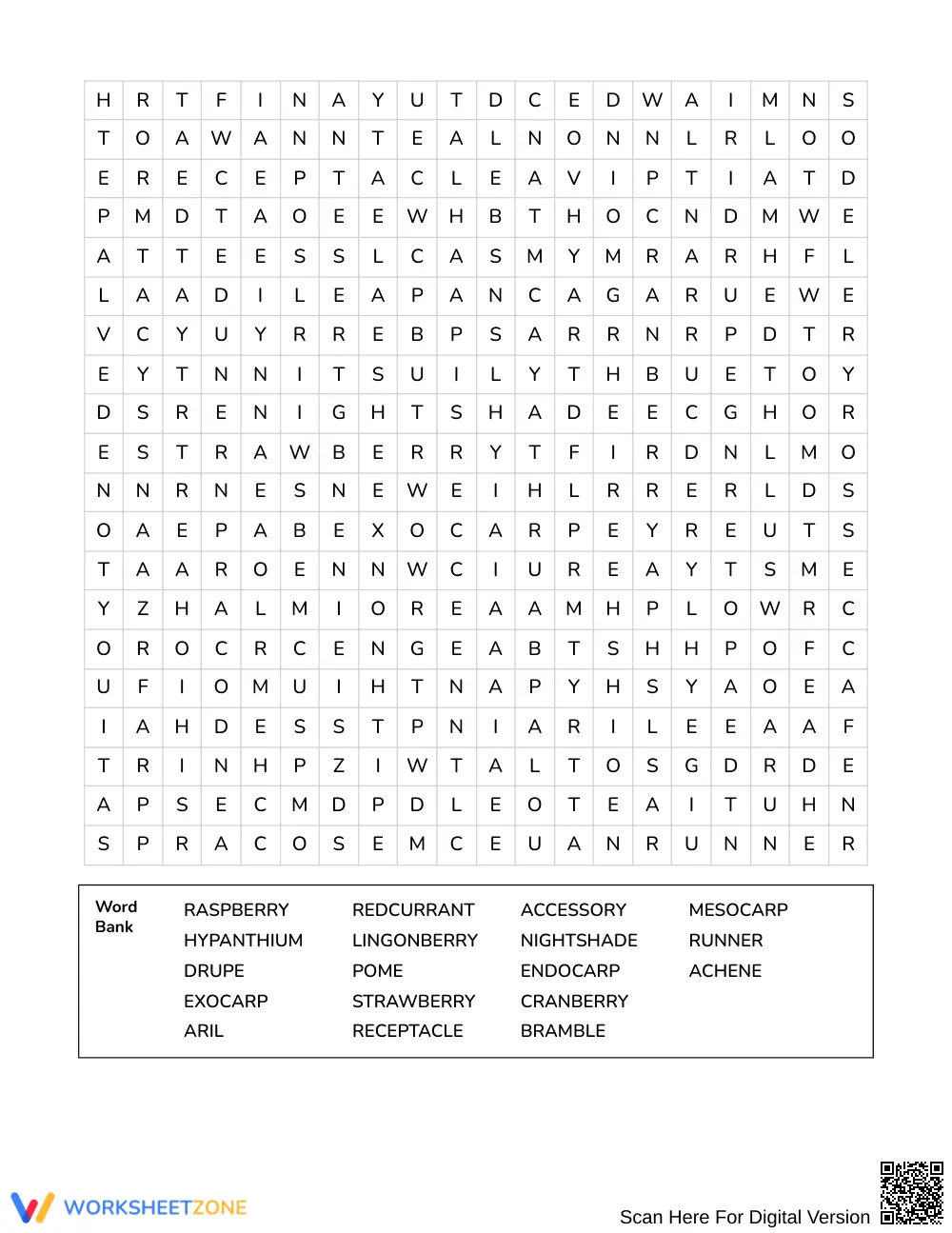
The 3-page printable resource includes 18 botanical terms embedded within the activity. Rather than relying on a simple search list, the resource provides descriptive clues defining fruit structures, tissues, and plant families alongside a shuffled word bank. A dedicated answer key clearly highlights every word location for quick verification.
Puzzle Structure and Mechanics
The activity features a 20 by 20 letter grid containing 18 hidden vocabulary terms. Words are oriented in all eight compass directions: north, northeast, east, southeast, south, southwest, west, and northwest. Students read each descriptive clue to identify the targeted botanical structure, locate the matching term in the shuffled bank, and trace it across the grid.
Standards Alignment
This activity provides supplementary vocabulary enrichment and is not aligned to a specific state or national standard. It reinforces essential life science terminology, supporting middle school units on plant reproduction, angiosperm structures, and specialized fruit adaptations.
How to Use It
Deploy this word search during independent seatwork after direct instruction on floral anatomy, or assign it as an interactive review station during cumulative exam preparation. As a formative assessment check, monitor whether students can determine the correct fruit layer or structure from the clue before scanning the grid. Most students will finish the puzzle within 25 to 35 minutes.
Who It's For
This resource serves Grades 7–8 life science classrooms reviewing plant anatomy and fruit development. For students needing support, pair the activity with a labeled fruit diagram to connect structural terms to visual features. For advanced learners, challenge them to classify each fruit into dry versus fleshy categories. It pairs naturally with a hands-on strawberry or apple dissection lab.
Vocabulary acquisition in secondary science requires deliberate opportunities to encounter domain-specific terms across varied contexts. Research documented by Fisher & Frey (2014) demonstrates that structured vocabulary reinforcement, when paired with descriptive context clues rather than rote memorization, solidifies conceptual frameworks in adolescent learners. By challenging students in Grades 7–8 to match specialized botanical terms—such as hypanthium, receptacle, and endocarp—with their structural definitions, this activity strengthens disciplinary reading comprehension and memory retention. Content-area literacy relies heavily on repeated, active retrieval of precise nomenclature, particularly within complex life science topics involving plant reproductive anatomy and fruit morphology. Integrating contextual clues with systematic word location exercises encourages students to process definitions deeply before searching for terms, bridging the gap between casual plant recognition and rigorous scientific classification across middle school life science curricula. Consequently, focused vocabulary enrichment supports long-term botanical understanding.


