




























Complete Red Fruit Harvesting Word Search | Grades 4–5 ELA
Paste this activity's link or code into your existing LMS (Google Classroom, Canvas, Teams, Schoology, Moodle, etc.).
Students can open and work on the activity right away, with no student login required.
You'll still be able to track student progress and results from your teacher account.
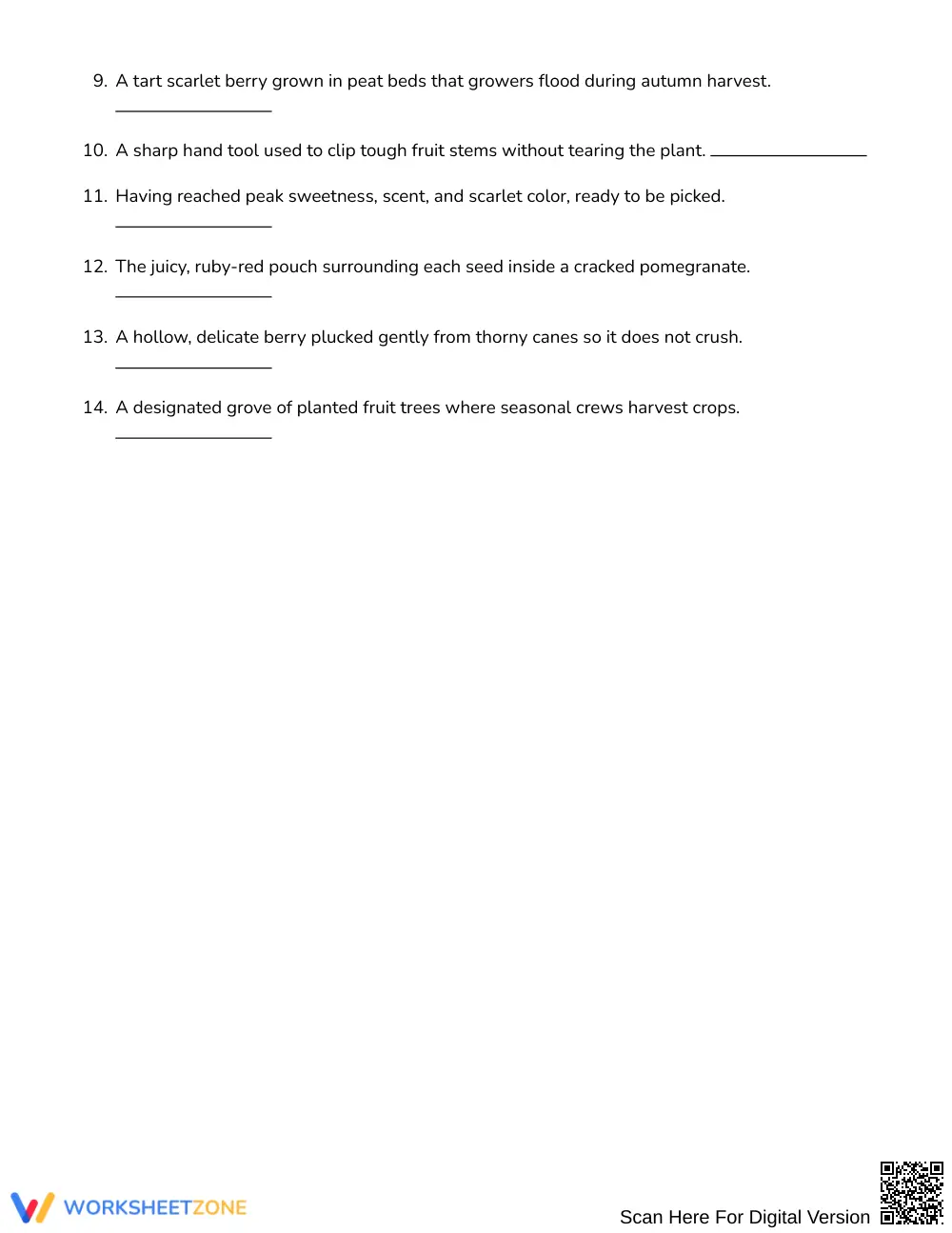
This Grades 4–5 vocabulary word search challenges students to decode agriculture clues and locate 14 specialized terms related to harvesting red fruits. Working through descriptive definitions, learners connect domain-specific botanical concepts to terms like aril, orchard, and pruner, building contextual comprehension alongside visual scanning accuracy.
At a Glance
- Grade: Grades 4–5 · Subject: English Language Arts (ELA)
- Standard: Not standards-assessed — vocabulary enrichment
- Skill Focus: harvesting red fruits
- Format: 3 pages · 14 words · Answer key included · PDF
- Best For: Independent vocabulary stations and early finishers
- Time: 20–30 minutes
What's Inside: The three-page resource features a 14-item clue detective puzzle where students match descriptive agricultural hints to target vocabulary before locating each term. A complete three-page answer key provides quick verification, showing exact letter coordinates for every hidden word to support fast self-checking or teacher grading.
How the Puzzle Works: Learners solve the vocabulary challenge on a clear 16 x 16 letter grid. Target terms run across four distinct orientations: northeast, east, southeast, and south. Rather than relying on a simple word bank, students read informative clues detailing crop traits, harvesting tools, and growing environments to deduce each term before searching the puzzle.
Standards Alignment: This activity serves as targeted vocabulary enrichment and is not aligned to a formal grade-level standard. It supports cross-curricular literacy by introducing intermediate learners to functional botanical and agricultural terminology without formal assessment constraints.
How to Use It: Deploy this puzzle as an independent literacy center activity following direct instruction on context clues, or assign it during seasonal science and reading units. During independent work time, observe whether students identify terms using root clues before scanning the grid. Most upper elementary students will complete the reading and word search within 20 to 30 minutes.
Who It's For: Designed specifically for Grades 4–5 learners expanding their informational reading vocabulary. It works smoothly as an enrichment task, quiet morning work activity, or sub-plan supplement, pairing naturally with non-fiction agricultural articles, botany anchor charts, or guided reading passages on seasonal farm harvests.
Contextual vocabulary exposure actively strengthens reading comprehension by helping intermediate learners bridge conceptual knowledge with technical terminology. According to Fisher & Frey (2014), intentional word exposure through definition analysis and interactive puzzle tasks reinforces orthographic memory and conceptual retention more effectively than rote list memorization. By evaluating 14 descriptive clues regarding fruit anatomy, harvesting equipment, and agricultural environments, upper elementary students engage in meaningful semantic processing. The clue-driven format prompts learners to verify meaning prior to visual search, cementing domain-specific vocabulary into long-term memory. This self-contained enrichment activity offers focused language practice adaptable across diverse upper elementary classroom routines.


