


























Views
Downloads




Complete Reaction Prediction Worksheet | Grade 11 Chemistry
Paste this activity's link or code into your existing LMS (Google Classroom, Canvas, Teams, Schoology, Moodle, etc.).
Students can open and work on the activity right away, with no student login required.
You'll still be able to track student progress and results from your teacher account.
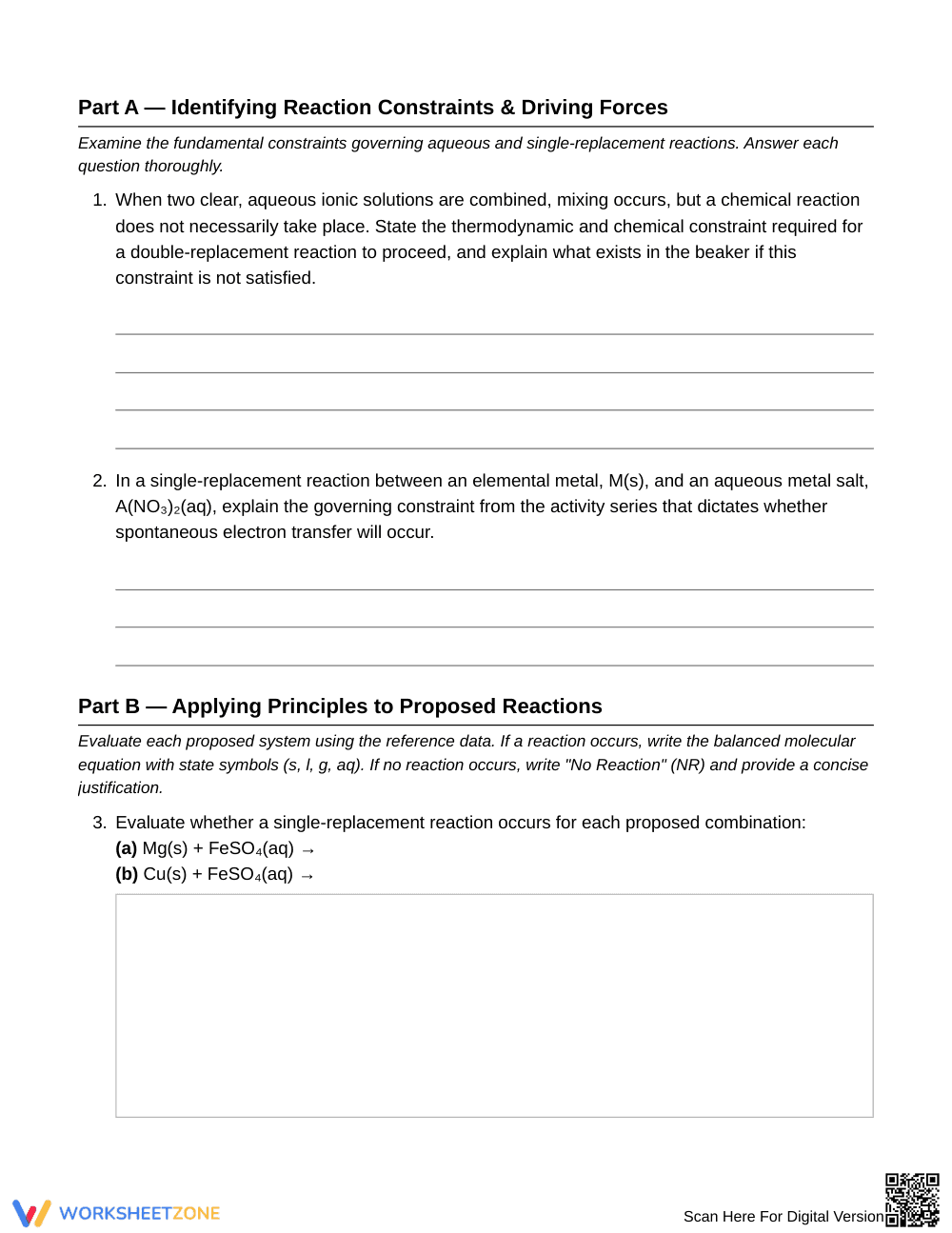
This Grade 11 chemistry worksheet equips students to evaluate whether proposed chemical reactions occur in aqueous systems. Learners analyze solubility rules and the activity series to predict single-replacement, precipitation, and neutralization outcomes. By examining balanced molecular and net ionic equations, students determine reaction spontaneity and explain why specific mixtures yield no reaction.
At a Glance
- Grade: 11 · Subject: Chemistry
- Standard: High School Chemistry Core — Predict chemical reaction outcomes using solubility guidelines and elemental reactivity series
- Skill Focus: Evaluate Whether a Proposed Reaction Occurs
- Format: 5 pages · 10 complex problems · Complete answer key included · PDF
- Best For: Independent practice, post-lab analysis, and test review
- Time: 40–50 minutes
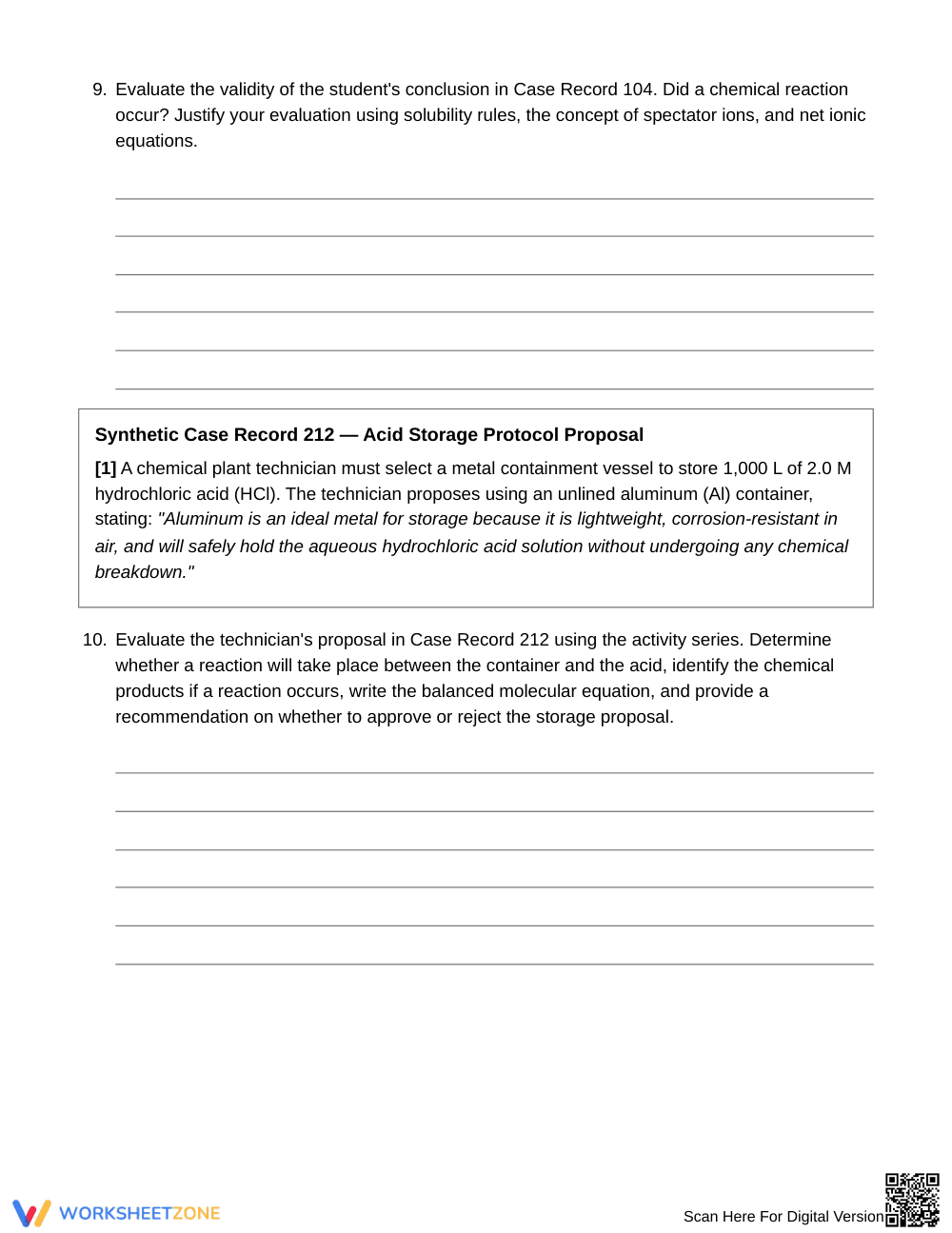
This 5-page worksheet includes 10 chemistry problems across three sections, supported by a reference chart of solubility rules and elemental activity series. Part A targets reaction constraints. Part B provides six equation-based problems requiring molecular formulas, driving forces, and net ionic equations. Part C presents two bounded laboratory case studies examining precipitate formation and chemical storage safety. A detailed 3-page answer key provides complete balanced equations and explanations.
Skill Progression
- Guided practice (Part A, 2 tasks): Students review provided reference tables to identify thermodynamic constraints and activity series rules governing reaction spontaneity.
- Supported practice (Part B, 6 tasks): Learners evaluate proposed combinations of metals, acids, and salts, identifying driving forces and writing balanced net ionic equations.
- Independent practice (Part C, 2 tasks): Students analyze realistic case studies, evaluating scientific claims about solution mixing and acid containment safety.
This sequence mirrors the gradual-release model, transitioning learners from foundational conceptual rules to independent chemical evaluation.
Standards Alignment
This worksheet aligns with high school chemistry expectations for matter and chemical reactions: students construct explanations by predicting reaction outcomes, writing balanced equations, and applying models of reactivity and solubility. Supporting physical science standards address conservation of mass and electron transfer in single-replacement systems. Both standard descriptions can be copied directly into lesson plans, IEP goals, or district curriculum mapping tools.
How to Use It
Assign this activity after introducing solubility rules and the activity series. Use Part B for mid-lesson partner practice, and assign Part C as an exit ticket or post-lab analysis. During class, check whether students automatically write double-replacement products without verifying driving forces; prompt them to confirm precipitate or molecular product formation first. Completion takes 40 to 50 minutes.
Who It's For
This resource is designed for Grade 11 chemistry students in general, honors, or pre-AP classes. For struggling learners, have students highlight soluble versus insoluble ions on the reference table before solving equations. Pair this worksheet with an aqueous precipitation laboratory or chemical equation balancing review to bridge observable physical phenomena with chemical notation.
According to Fisher & Frey (2014), structured instructional frameworks that guide learners through deliberate shifts in cognitive responsibility foster deeper conceptual mastery in secondary science disciplines. This Grade 11 chemistry resource targets the core skill of evaluating whether proposed reactions occur by systematically integrating reference tables with multi-step chemical reasoning. Rather than relying on algorithmic partner-swapping, students apply aqueous solubility rules and element reactivity hierarchies to justify reaction spontaneity, construct net ionic equations, and analyze laboratory anomalies. Research in science education underscores that authentic case analysis and structured justification prevent persistent misconceptions surrounding spectator ions and physical phase changes during precipitation and single-replacement events. The included 10 problems, explicit reference tables, and thorough 3-page explanatory answer key ensure high school chemistry teachers can diagnose student misconceptions and support rigorous evidentiary reasoning aligned with modern college-and-career readiness chemistry standards.


