


























Views
Downloads



Complete Reaction Prediction Worksheet | Grade 11 Chemistry
Paste this activity's link or code into your existing LMS (Google Classroom, Canvas, Teams, Schoology, Moodle, etc.).
Students can open and work on the activity right away, with no student login required.
You'll still be able to track student progress and results from your teacher account.
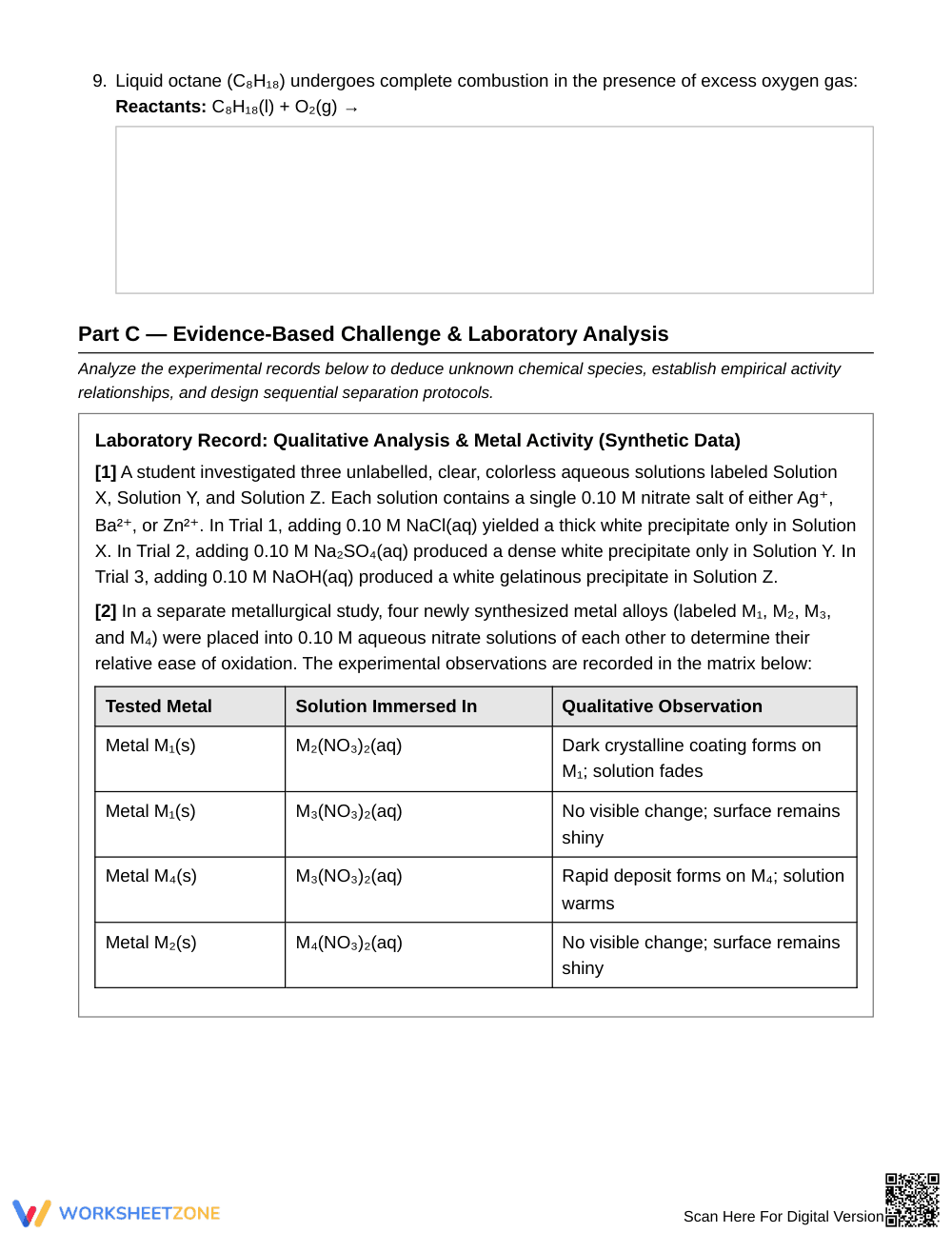
This high school chemistry worksheet guides Grade 11 students to master chemical reaction prediction, equation balancing, and phase determination. Students evaluate reaction feasibility using solubility rules and activity series, write balanced molecular equations with state symbols, and analyze multi-step qualitative laboratory data to deduce unknown chemical species.
At a Glance
- Grade: 11 · Subject: Chemistry
- Standard: Predict chemical reaction products, precipitation, and states using empirical reference rules
- Skill Focus: Reaction-Prediction Check
- Format: 5 pages · 12 problems · Answer key included · PDF
- Best For: Reaction unit practice and review
- Time: 45–60 minutes
What's Inside
This 5-page resource provides 12 problems and a comprehensive 3-page answer key. An integrated reference guide equips students with solubility rules, activity series data, and gas evolution pathways. Tasks span multiple-choice concept checks, precipitate prediction tables, balanced equation writing, and laboratory scenario analysis.
Skill Progression
- Guided practice (Part A, Problems 1–3): Students examine thermodynamic driving forces, explain metal reactivity differences, and predict precipitate formation across 4 aqueous reactant pairs.
- Supported practice (Part B, Problems 4–9): Learners predict products, check feasibility, and balance 6 molecular equations spanning displacement, precipitation, neutralization, and combustion.
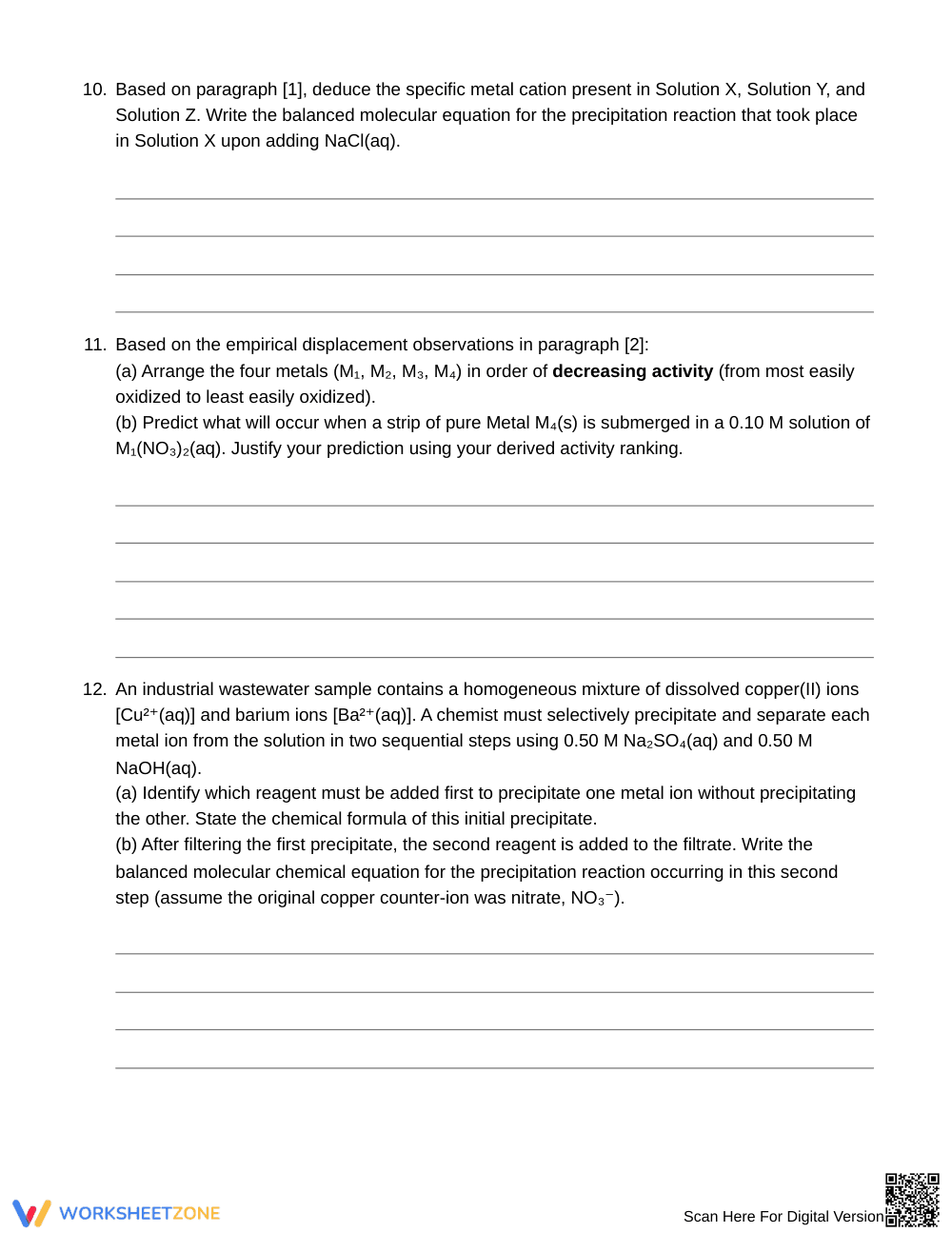
- Independent practice (Part C, Problems 10–12): Students analyze laboratory data to identify unknown cations, establish metal activity rankings, and design sequential separation protocols.
This sequence follows a gradual-release model from scaffolded rule application to authentic scientific deduction.
Standards Alignment
This worksheet aligns with high school chemistry expectations for predicting reaction outcomes, classifying chemical changes, and modeling matter conservation. Both standard codes can be copied directly into lesson plans, IEP goals, or district curriculum mapping tools.
How to Use It
Assign this worksheet after direct instruction on reaction types or as a targeted review before unit exams. Circulate during Part B to assess whether students accurately identify spectator ions and oxidation limits. Completion typically requires 45 to 60 minutes.
Who It's For
Designed for Grade 11 chemistry students developing predictive fluency, this worksheet features tiered scaffolding suitable for standard and honors tracks. It pairs effectively with precipitation laboratory investigations or chemical equations anchor charts.
Mastering chemical reaction prediction requires students to synthesize abstract thermodynamic driving forces, solubility equilibria, and empirical reactivity rules into coherent symbolic equations. According to Fisher & Frey (2014), structured instructional frameworks that transition from guided rule application to unprompted evidence analysis significantly improve student retention of complex scientific reasoning. This Grade 11 chemistry resource operationalizes that research through a 12-problem sequence spanning conceptual recognition, balanced molecular equation formulation, and multi-step qualitative data deduction. By engaging with authentic lab scenarios involving cation identification, metal displacement series construction, and selective precipitation separation protocols, high school learners transition from rote memorization of solubility charts to functional mechanistic comprehension. Teachers can utilize the detailed three-page answer key to deliver timely, targeted feedback on state symbols, net ionic feasibility, and reaction classifications, ensuring durable mastery across foundational chemical reaction standards.


