
































Complete Quadratic Methods Worksheet | Grade 9 Algebra I

Paste this activity's link or code into your existing LMS (Google Classroom, Canvas, Teams, Schoology, Moodle, etc.).
Students can open and work on the activity right away, with no student login required.
You'll still be able to track student progress and results from your teacher account.
This Algebra I worksheet trains ninth-grade students to analyze, select, and execute the most efficient method for solving quadratic equations. By contrasting factoring, square roots, completing the square, and the quadratic formula, learners transition from formulaic repetition to deliberate mathematical reasoning across 16 rigorous problems.
At a Glance
- Grade: 9 · Subject: Algebra I
- Standard:
HSA-REI.B.4— Solve quadratic equations in one variable using multiple algebraic methods- Skill Focus: Mix Real Quadratic Solution Methods
- Format: 5 pages · 16 problems · Answer key included · PDF
- Best For: Mixed review and assessment prep
- Time: 45–60 minutes
What's Inside
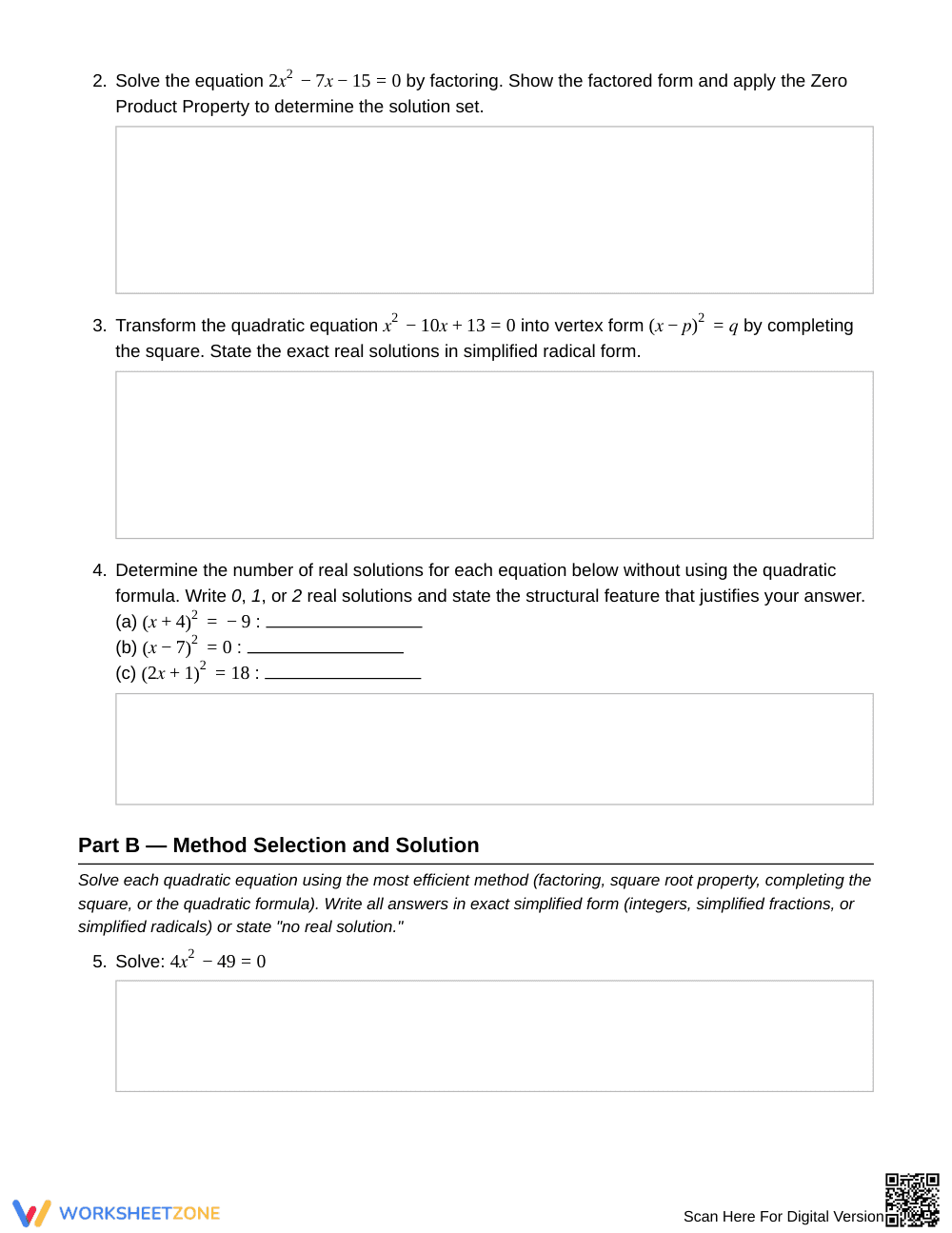
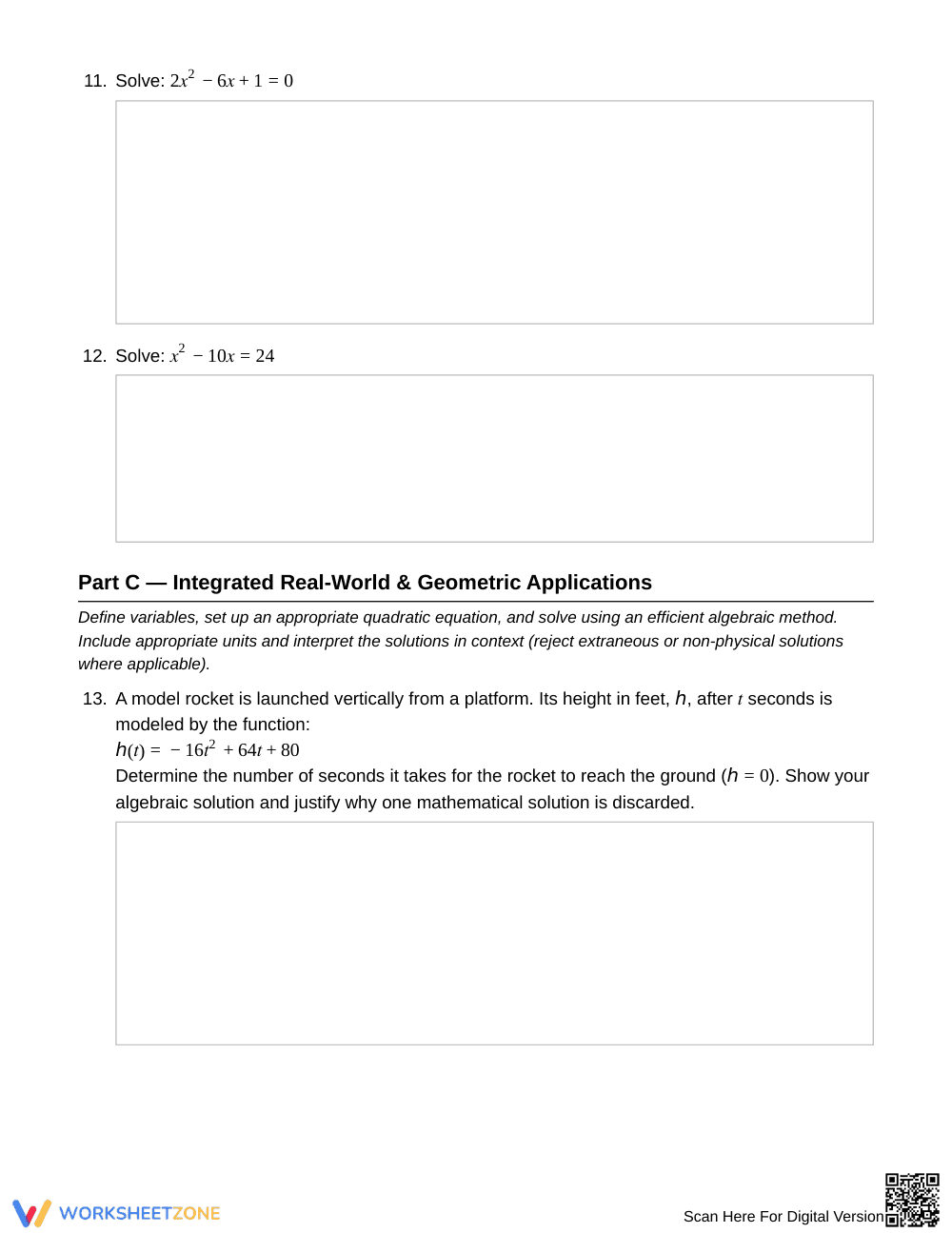
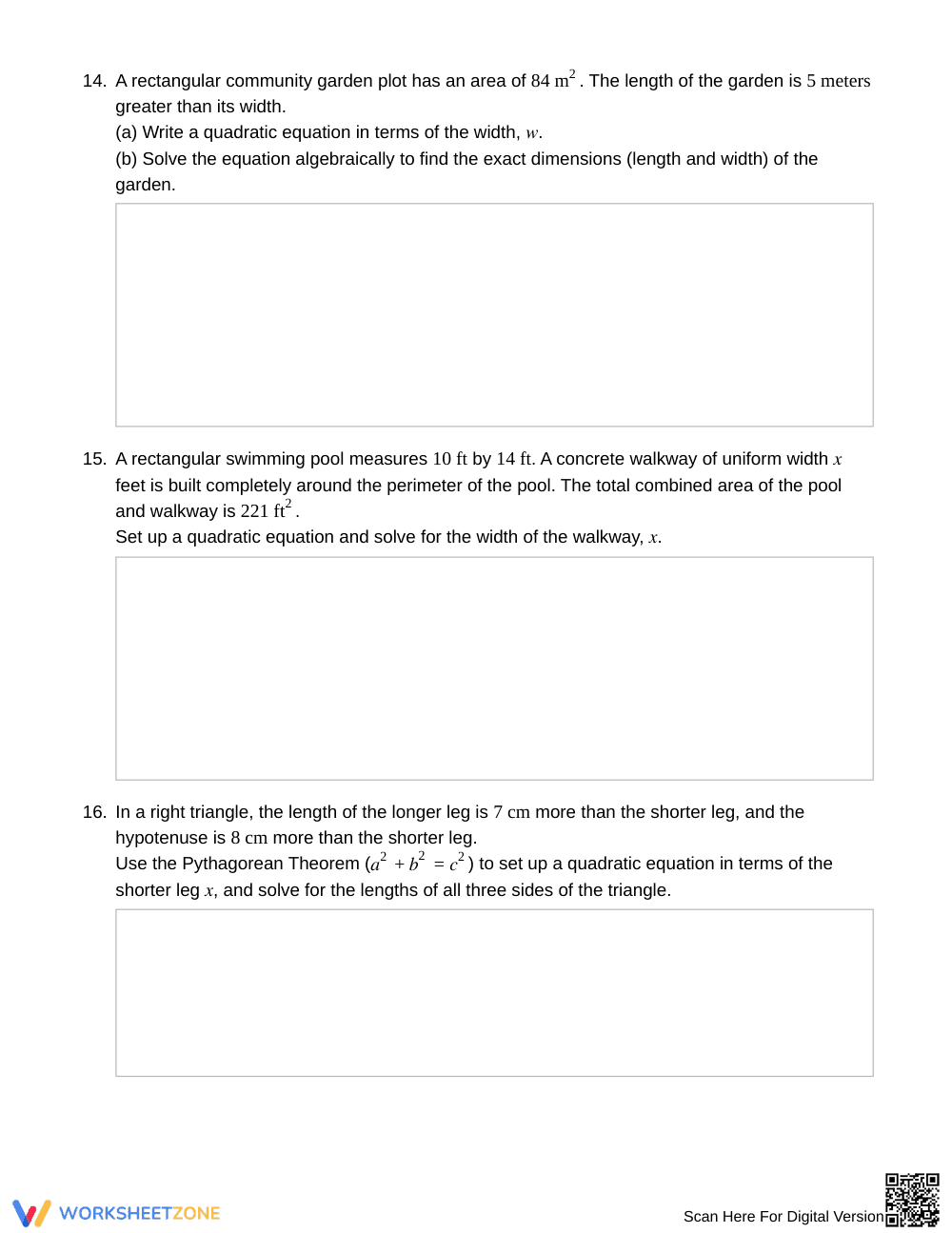
The 5-page worksheet begins with a reference table detailing when to apply each quadratic technique. Students complete 16 problems across three sections: structural analysis, mixed method execution, and multi-step geometric applications. A 4-page answer key provides step-by-step solutions and explanations.
Skill Progression
- Guided practice (Part A, 4 problems): High scaffolding with a method reference chart, prompts requiring written justification, and guided vertex-form transformations.
- Supported practice (Part B, 8 problems): Moderate scaffolding where students independently evaluate equation structures and select optimal solving methods across mixed equations.
- Independent practice (Part C, 4 problems): Minimal scaffolding requiring students to formulate quadratic models from projectile and geometric contexts, solve them, and interpret extraneous roots.
This sequence implements a gradual-release model transitioning learners from structural analysis to autonomous problem solving.
Standards Alignment
This worksheet directly targets `HSA-REI.B.4`: Solve quadratic equations in one variable using multiple algebraic methods while recognizing when specific approaches produce real solutions. It also reinforces `HSA-CED.A.1` through contextual quadratic modeling in real-world problems. Both standard codes can be copied directly into lesson plans, IEP goals, or district curriculum mapping tools.
How to Use It
Use this worksheet as a synthesis activity after direct instruction on individual quadratic methods. Alternatively, deploy it during targeted intervention where students analyze equation structures before solving. Monitor whether students spot square roots before defaulting to the quadratic formula. Completion takes approximately 45 to 60 minutes.
Who It's For
This resource serves Grade 9 Algebra I students preparing for unit assessments. Teachers can assign Part A and Part B for students needing focused procedural support, reserving Part C for advanced modeling practice. Pair this worksheet with an anchor chart summarizing quadratic method selection rules.
Mastering quadratic equations under HSA-REI.B.4 requires students to develop strategic flexibility rather than relying on a single memorized algorithm. In their foundational research on classroom instructional design, Fisher & Frey (2014) demonstrated that structured gradual-release frameworks significantly increase student retention and cognitive transfer in secondary mathematics. When learners first evaluate equation properties through guided prompts, practice method selection across diverse problem sets, and synthesize their understanding through contextual modeling, they construct resilient conceptual schema. This 16-problem resource exemplifies that progression by pairing an initial structural decision matrix with open mixed practice and real-world geometric tasks. As students articulate why a specific approach is optimal—such as utilizing the square root property for vertex-form equations or factoring for clear integer roots—they achieve measurable proficiency in quadratic problem solving while building the higher-level analytical reasoning required for advanced high school STEM coursework.


