































Complete Pythagorean Missing Sides Worksheet | Grade 8 Math

Paste this activity's link or code into your existing LMS (Google Classroom, Canvas, Teams, Schoology, Moodle, etc.).
Students can open and work on the activity right away, with no student login required.
You'll still be able to track student progress and results from your teacher account.
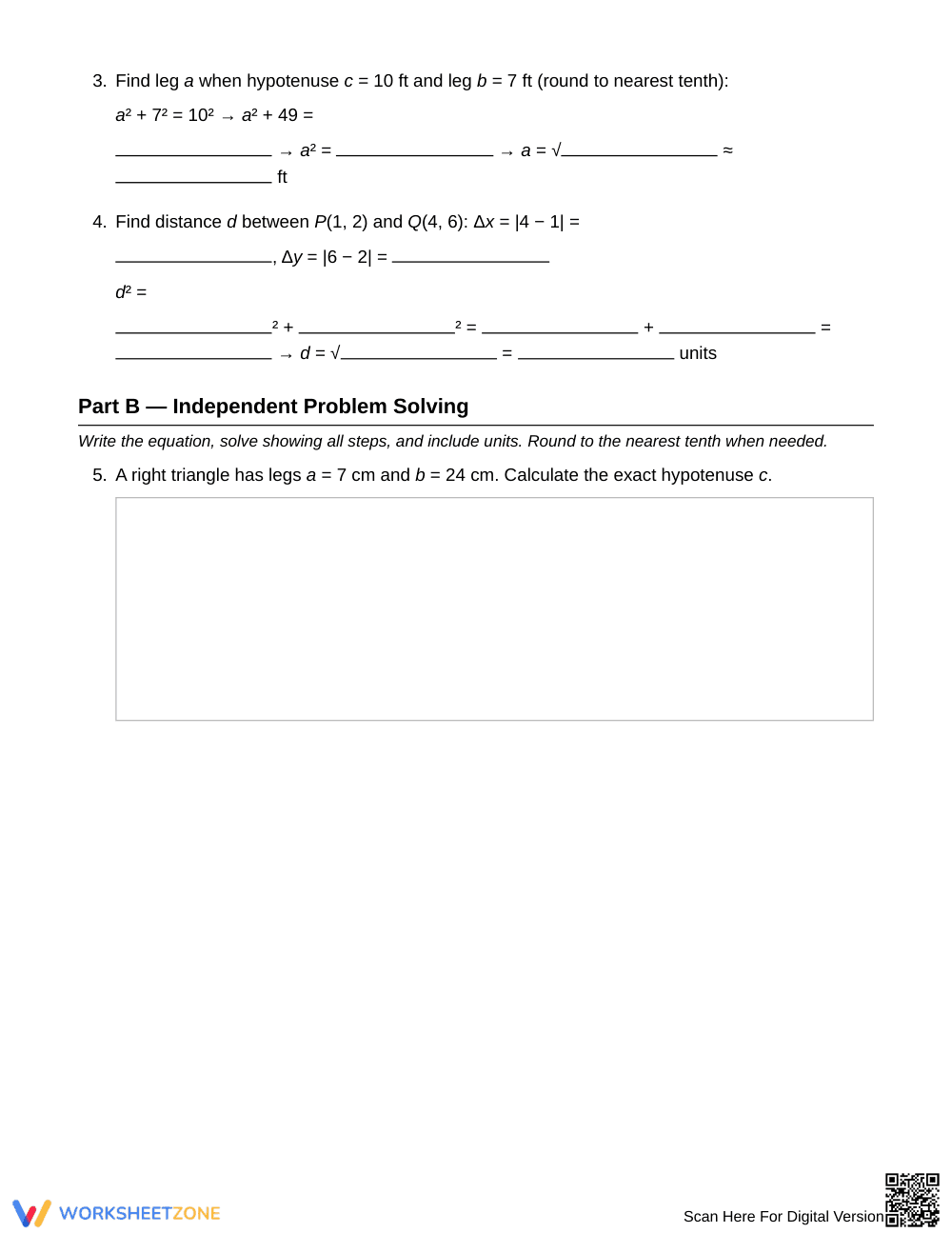
This Grade 8 math worksheet builds student mastery in calculating unknown leg and hypotenuse lengths using the Pythagorean Theorem. Students move methodically from fill-in-the-blank equation scaffolds to real-world geometric modeling, coordinate distance problems, and rigorous error analysis justifications.
At a Glance
- Grade: 8 · Subject: Math
- Standard:
Grade 8 Geometry— Apply the Pythagorean Theorem to determine unknown side lengths in right triangles- Skill Focus: Solving for missing legs and hypotenuses using a² + b² = c²
- Format: 5 pages · 12 problems · Answer key included · PDF
- Best For: Independent practice, homework, or targeted intervention
- Time: 35–45 minutes
What's Inside
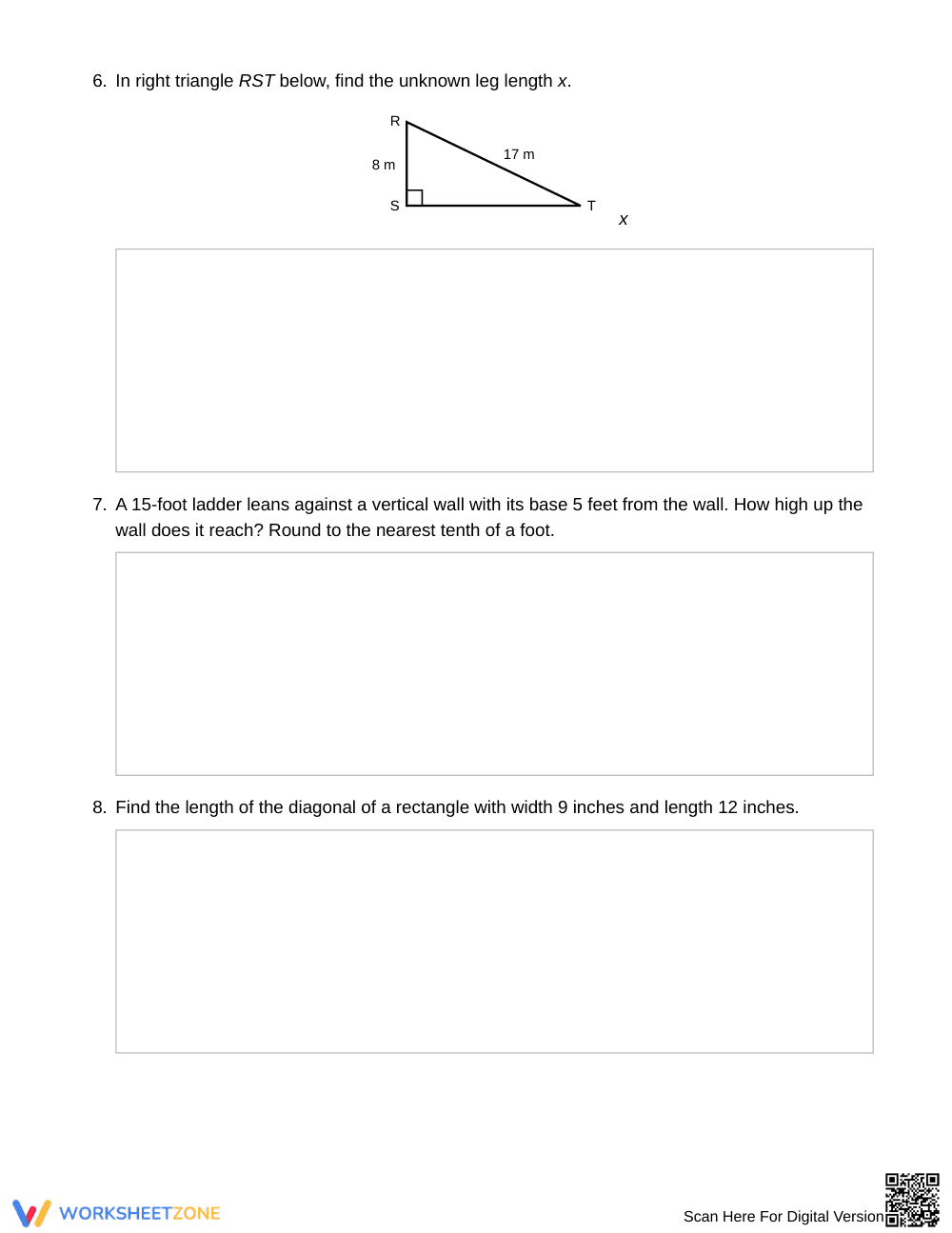
This 5-page instructional resource contains 12 multi-step math problems, visual geometry diagrams, an integrated reference box with rounding rules, and a complete 2-page worked answer key. Scaffolds include two fully worked models illustrating hypotenuse and leg solutions, structured fill-in computation lines, coordinate grid distance formulas, and written conceptual analysis prompts.
Skill Progression
- Guided Practice (Part A, Problems 1–4): Scaffolds algebraic substitution with pre-formatted calculation frames, guiding students through squaring values, isolating variables, extracting square roots, and applying the coordinate distance formula.
- Supported Practice (Part B, Problems 5–8): Removes calculation frames, requiring students to establish equations independently from right-triangle diagrams, real-world ladder applications, and rectangle diagonals.
- Independent Practice (Part C, Problems 9–12): Challenges learners with multi-step coordinate plane distances, 3D contextual base diagonals, misconception error analysis, and algebraic scale factor proofs.
This sequence follows a gradual-release instructional model that transitions learners from guided equation execution to autonomous geometric reasoning.
Standards Alignment
Aligned to middle school geometry standards for Grade 8, this worksheet requires students to explain a proof of the Pythagorean Theorem and apply the formula a² + b² = c² to find unknown side lengths in real-world and mathematical problems in two and three dimensions, as well as calculate the distance between two points in a coordinate system. Both standard codes can be copied directly into lesson plans, IEP goals, or district curriculum mapping tools.
How to Use It
Deploy this activity directly after initial instruction on square roots and right-triangle anatomy. Use Part A for paired guided practice during class to identify students who struggle with isolating a variable versus solving directly for the hypotenuse. Use Parts B and C for independent seatwork or small-group remediation. Expected completion time is 35 to 45 minutes.
Who It's For
Designed for general Grade 8 mathematics students, introductory Algebra I courses, and Tier 2 math intervention groups. Pair this printable with a direct instruction lesson on radical simplification or an anchor chart displaying common Pythagorean triples (3-4-5, 5-12-13, 7-24-25).
According to Fisher & Frey (2014), structured gradual-release frameworks significantly enhance problem-solving retention in secondary mathematics by systematically fading instructional scaffolds. This 5-page Grade 8 Pythagorean Theorem resource operationalizes this evidence-based model across 12 targeted exercises. Students progress through structured algebraic frames before tackling authentic word problems, coordinate plane distances, and written error justifications. By requiring learners to distinguish between solving for legs versus the hypotenuse, the resource addresses persistent middle school misconceptions identified in empirical mathematics education research. The comprehensive 2-page answer key provides complete step-by-step arithmetic, making it an efficient tool for progress monitoring, differentiated small-group instruction, and standards-aligned formative assessment.


