


























Views
Downloads



Complete Protein Synthesis Worksheet | Grade 10 Biology
Paste this activity's link or code into your existing LMS (Google Classroom, Canvas, Teams, Schoology, Moodle, etc.).
Students can open and work on the activity right away, with no student login required.
You'll still be able to track student progress and results from your teacher account.
Mastering molecular genetics requires students to trace genetic information from DNA to functional polypeptides. This worksheet guides tenth-grade biology students through twelve structured tasks, helping them distinguish transcription from translation, model mRNA codon and tRNA anticodon pairing, and predict how mutations alter polypeptide sequences.
At a Glance
- Grade: 10 · Subject: Biology
- Standard: Molecular Genetics — Model protein synthesis from DNA transcription to polypeptide translation
- Skill Focus: Transcription and translation molecular roles
- Format: 5 pages · 12 problems · Answer key included · PDF
- Best For: Post-instruction practice and formative skill checks
- Time: 45–60 minutes
What's Inside
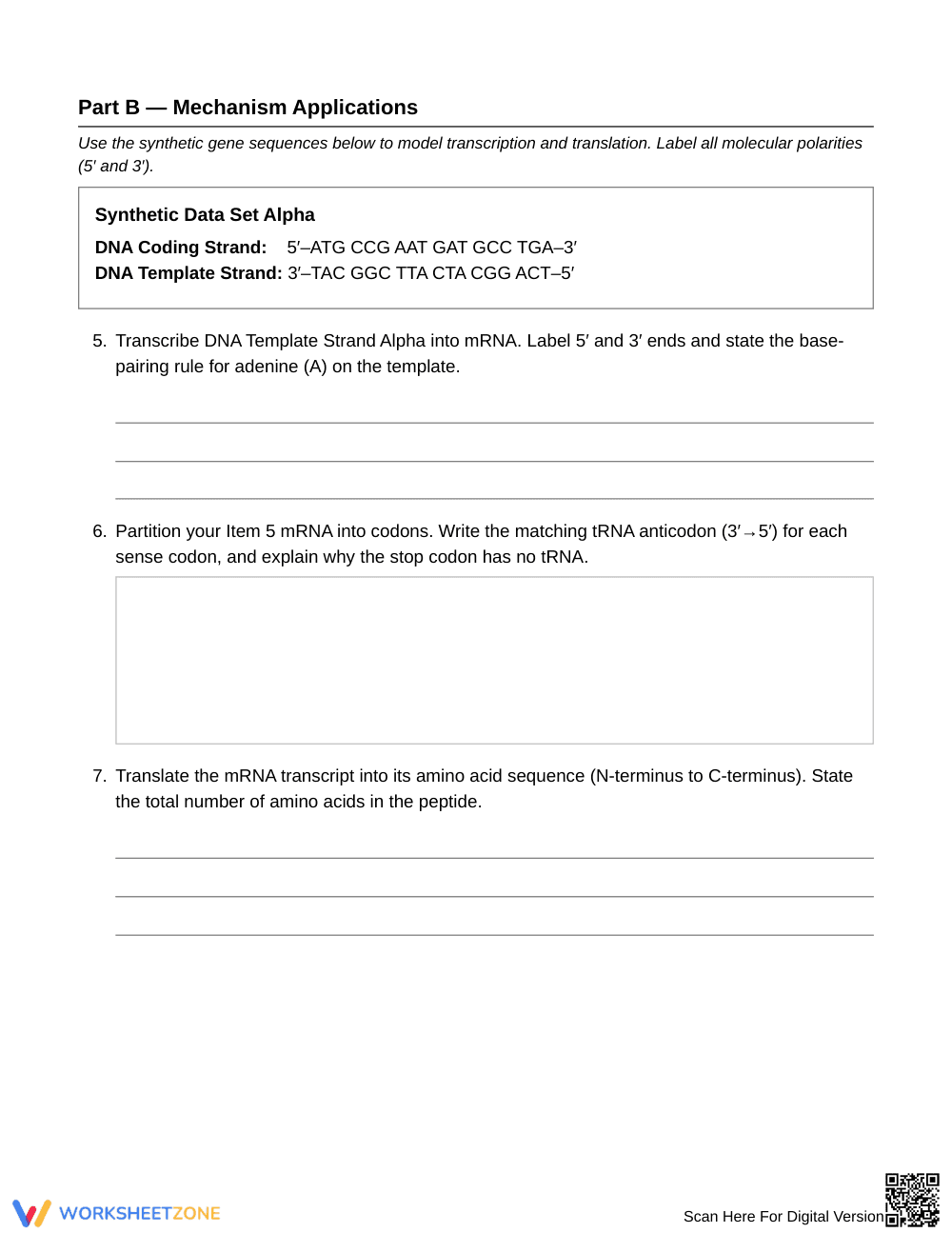
This 5-page resource contains 12 problems across three sections. Students use a complete mRNA codon table and synthetic DNA data sets to transcribe sequences, verify polarities, and translate amino acids. A full 3-page answer key provides step-by-step transcripts, peptide sequences, and scoring justifications.
Skill Progression
- Guided Practice (Part A, Problems 1–4): Students complete a comparison table and answer prompts on cellular locations, enzymes, antiparallel pairing, and codon degeneracy.
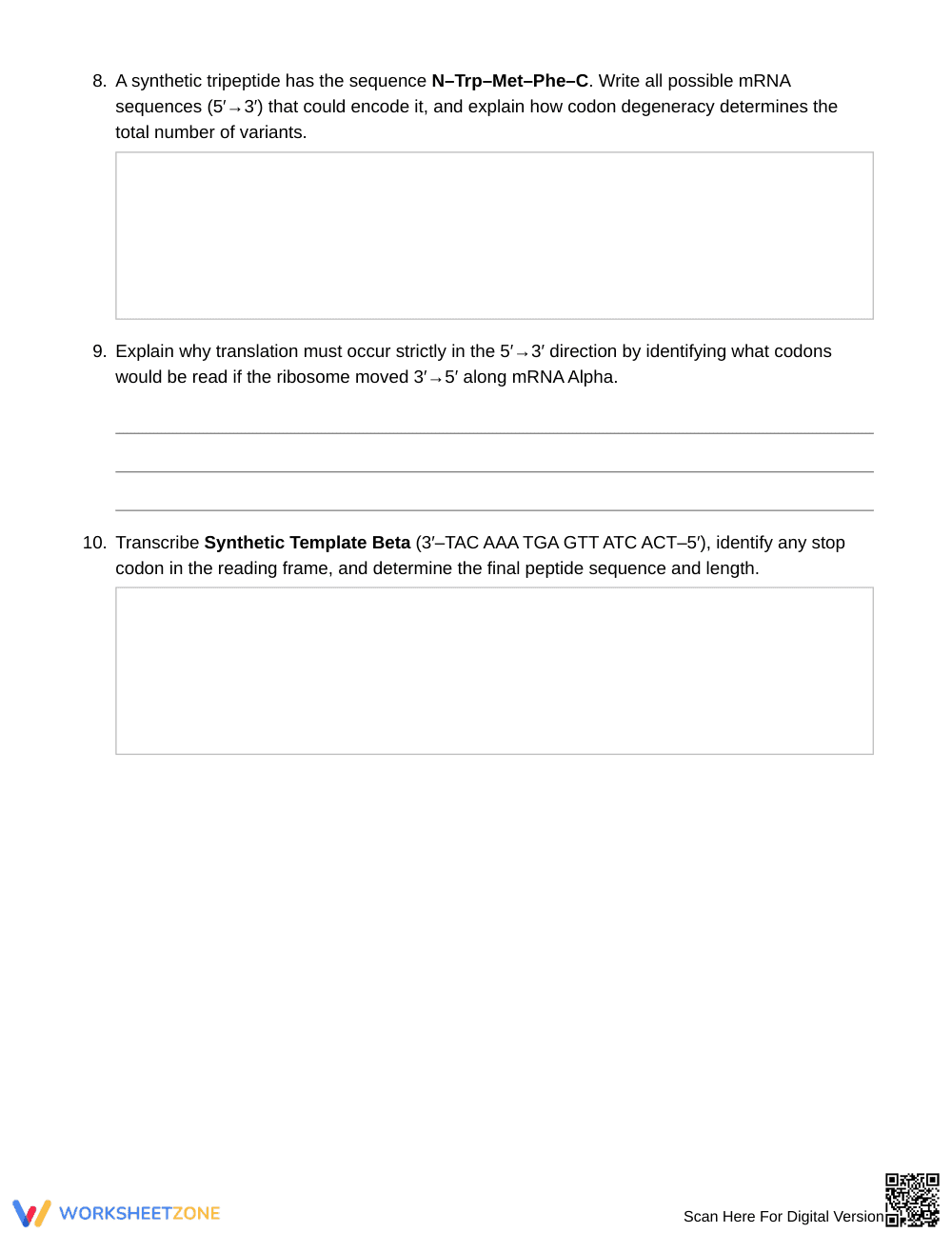
- Supported Practice (Part B, Problems 5–10): Learners transcribe synthetic DNA, determine tRNA anticodons, and translate mRNA transcripts into peptides.
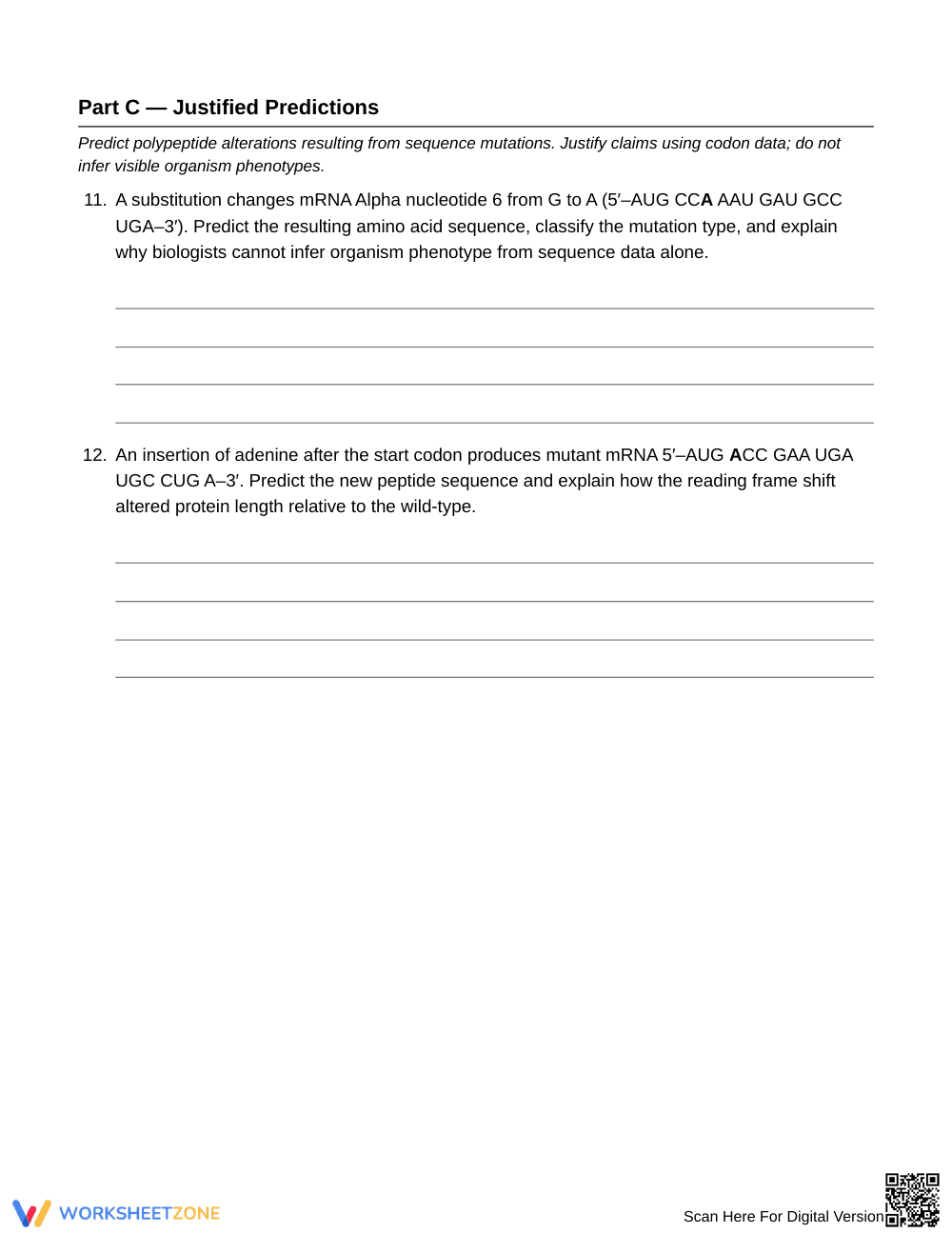
- Independent Practice (Part C, Problems 11–12): Students predict polypeptide changes caused by point and frameshift mutations without scaffolding.
This progression uses the gradual-release framework to move learners from concept recall to sequence modeling.
Standards Alignment
This worksheet aligns with high school biology expectations for modeling how DNA sequences direct protein synthesis. Students trace information flow from nuclear transcription to ribosomal translation, showing how codons specify amino acids. Both standard codes can be copied directly into lesson plans, IEP goals, or district curriculum mapping tools.
How to Use It
Assign this worksheet directly following instruction on gene expression. For formative assessment, check Part B to confirm students pair adenine with uracil in mRNA and reverse anticodon polarities before translating. Expected completion time is 45 to 60 minutes.
Who It's For
Designed for Grade 10 biology students, this activity supports varied readiness levels. Pair it with a visual codon chart for struggling learners or challenge advanced students to design silent mutations.
Structured practice in molecular genetics reinforces how nucleotide sequences dictate protein synthesis through transcription and translation. According to research on explicit instruction synthesized by Fisher & Frey (2014), scaffolds that move from guided structural analysis to independent sequence modeling produce measurable gains in scientific literacy and retention. By progressing from eukaryotic mechanism comparisons to synthetic gene transcription and frameshift mutation analysis, this resource develops rigorous foundational competency in central dogma concepts. Students actively manipulate 5′ to 3′ polarities, match antiparallel tRNA anticodons, and interpret degenerate codon tables, transforming abstract genetic abstractions into concrete biochemical models. The comprehensive 12-task design prevents common student misconceptions regarding RNA polymerase function, stop codon recognition, and phenotype overextension. Designed for high school life science courses, this curriculum-aligned resource provides educators with structured diagnostic data to verify student mastery across essential molecular biology and protein synthesis benchmarks.


