


























Views
Downloads




Complete Product Prediction Worksheet | Grade 11 Chemistry
Paste this activity's link or code into your existing LMS (Google Classroom, Canvas, Teams, Schoology, Moodle, etc.).
Students can open and work on the activity right away, with no student login required.
You'll still be able to track student progress and results from your teacher account.
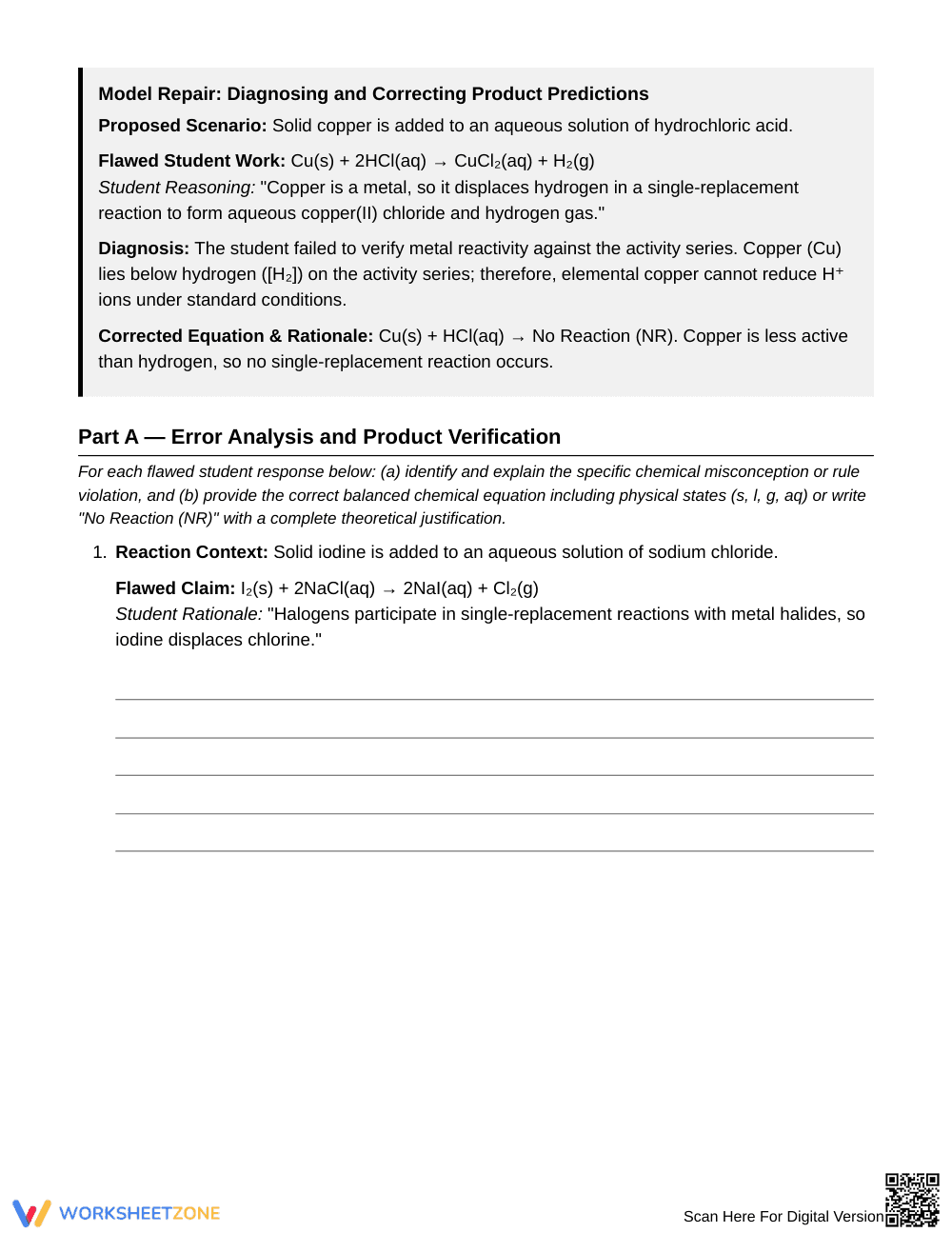
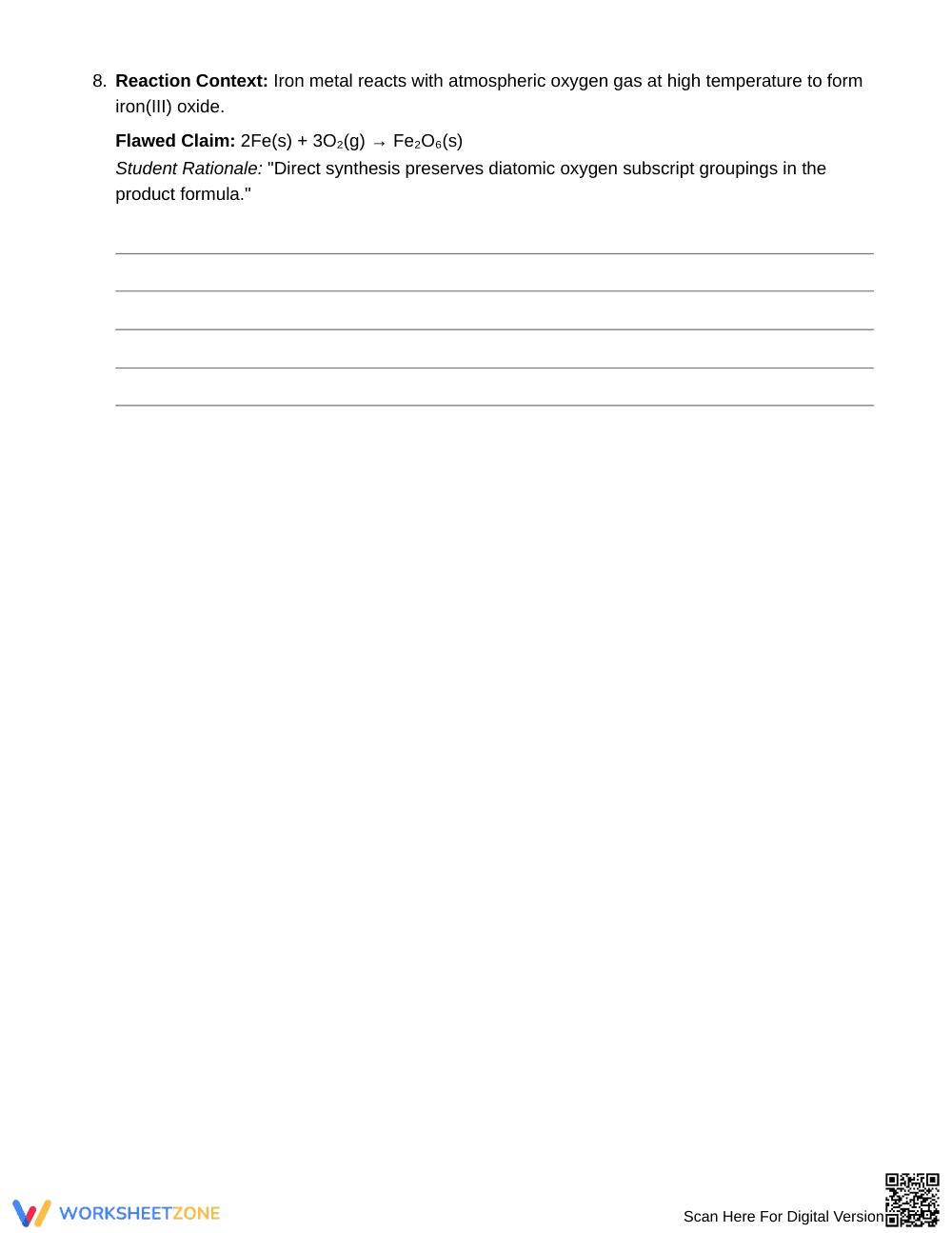
Mastering chemical reactions requires students to recognize and rectify common misconceptions in reaction outcomes. This Grade 11 chemistry worksheet provides 8 error-analysis scenarios where students diagnose flawed logic, evaluate reactivity rules, and write correct balanced equations with physical states for single-replacement, double-replacement, combustion, and decomposition reactions.
At a Glance
- Grade: 11 · Subject: Chemistry
- Standard: Chemical Reactions — Predict reaction products and construct balanced chemical equations based on reactivity patterns
- Skill Focus: Correct Product-Prediction Errors
- Format: 5 pages · 8 problems · Answer key included · PDF
- Best For: Reaction review and misconception remediation
- Time: 40–50 minutes
What's Inside
This 5-page printable resource provides reference tables for metal and halogen activity series, solubility rules at 25 °C, and decomposition guidelines. An annotated model repair example demonstrates how to evaluate single-replacement reactivity before writing corrected equations. Across 8 multi-step error-analysis tasks, students diagnose flawed student logic and supply corrected balanced equations, supported by a 3-page answer key detailing explicit misconception rationales.
Skill Progression
- Guided practice: Students study reference charts and an annotated worked example illustrating how to check metal activity before predicting reaction feasibility.
- Supported practice: Tasks 1 through 4 present flawed student claims across single-replacement, double-replacement, decomposition, and combustion reactions.
- Independent practice: Tasks 5 through 8 challenge students to resolve complex double-replacement gas evolution, ionic synthesis subscripts, and solubility exceptions.
This sequence implements an I Do, We Do, You Do gradual-release model to reinforce systematic equation analysis.
Standards Alignment
This worksheet supports high school chemistry standards on chemical reactions and reactivity trends. Students construct explanations and predict products based on periodic trends, solubility rules, and activity series patterns. Alignment text can be copied directly into lesson plans, IEP goals, or district curriculum mapping tools.
How to Use It
Use this worksheet after direct instruction on reaction types as a mid-unit diagnostic task or collaborative partner activity. During class, observe student work on Tasks 2 and 7 to spot cation-cation bonding misconceptions early. Expected completion time is 40 to 50 minutes.
Who It's For
This activity is designed for Grade 11 chemistry students refining their chemical equation accuracy. Reference tables scaffold developing learners, while error-analysis tasks stretch advanced thinkers. Pair this worksheet with a precipitation laboratory investigation or reactivity series demonstration.
Predicting reaction outcomes requires learners to coordinate multiple chemical principles, including solubility guidelines, oxidation states, and relative elemental reactivities. According to research on conceptual scaffolding by Fisher & Frey (2014), engaging students in systematic error analysis and guided model repair directly strengthens metacognitive evaluation and prevents the reinforcement of common chemical misconceptions. Rather than rote formula memorization, analyzing flawed peer rationale forces students to justify why specific chemical interactions occur or yield no reaction under standard conditions. This 5-page worksheet provides 8 high-leverage diagnostic tasks supported by reference data tables and complete worked examples, enabling Grade 11 chemistry learners to transition from guided rule application to independent chemical reasoning. The structured layout facilitates immediate formative assessment, ensuring high school educators can systematically verify student mastery of reaction types, state designations, and balanced chemical equations.


