


























Views
Downloads


Complete Predicting Products Worksheet | Grade 11 Chemistry
Paste this activity's link or code into your existing LMS (Google Classroom, Canvas, Teams, Schoology, Moodle, etc.).
Students can open and work on the activity right away, with no student login required.
You'll still be able to track student progress and results from your teacher account.
This Grade 11 chemistry worksheet equips students to master predicting products under supplied reaction conditions. Through focused chemical analysis, learners evaluate single replacement, double replacement, combustion, and decomposition pathways, writing balanced equations with state symbols. By integrating solubility rules and activity series reference tables, students determine reaction feasibility with precision.
At a Glance
- Grade: 11 · Subject: Chemistry
- Standard: High School Chemistry — Predict chemical reaction products and physical states using activity series and aqueous solubility rules
- Skill Focus: Predict Products Under Supplied Conditions
- Format: 5 pages · 10 structured problems · 2-page answer key included · PDF
- Best For: Post-lecture independent practice and conceptual unit review
- Time: 45–60 minutes total
What's Inside
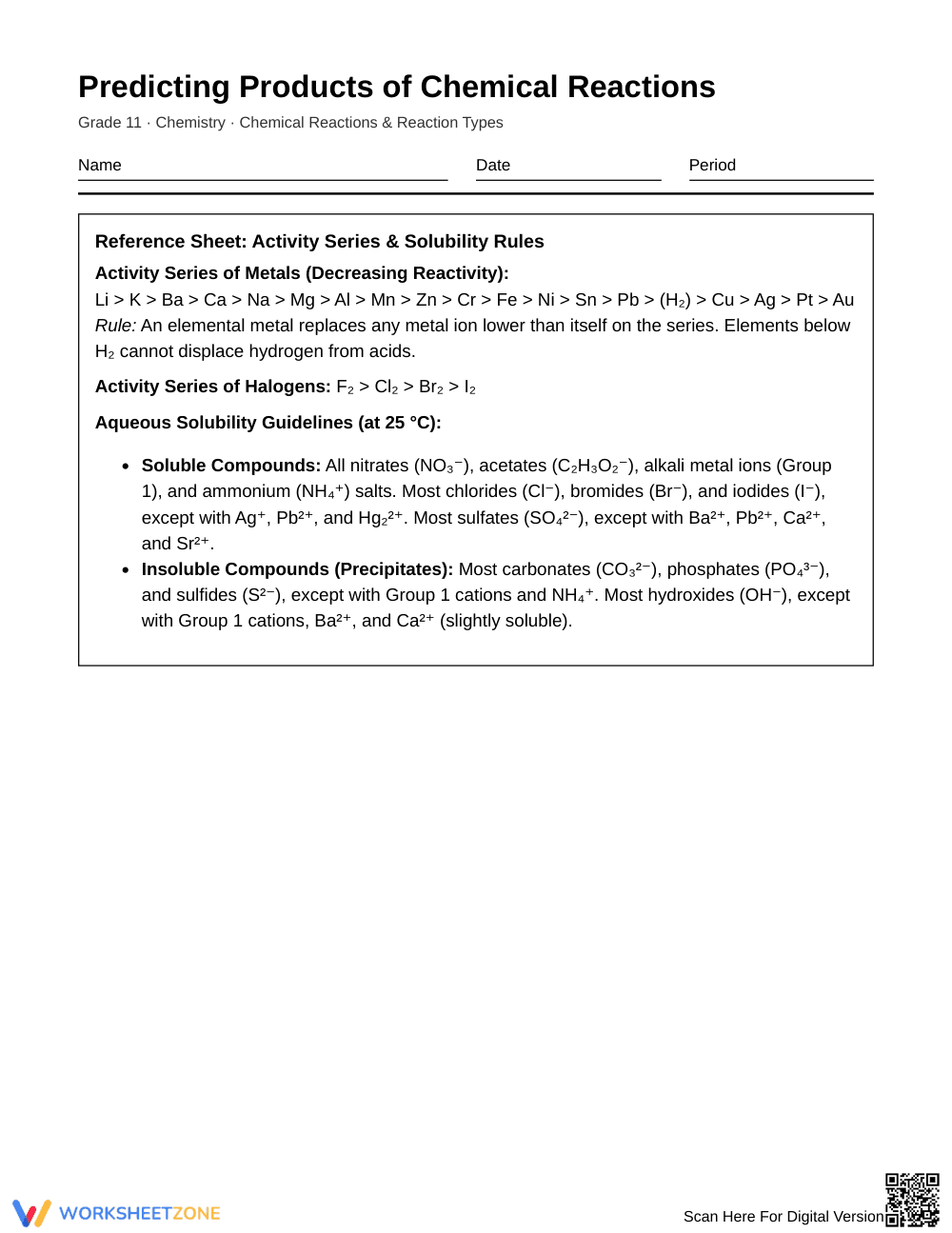
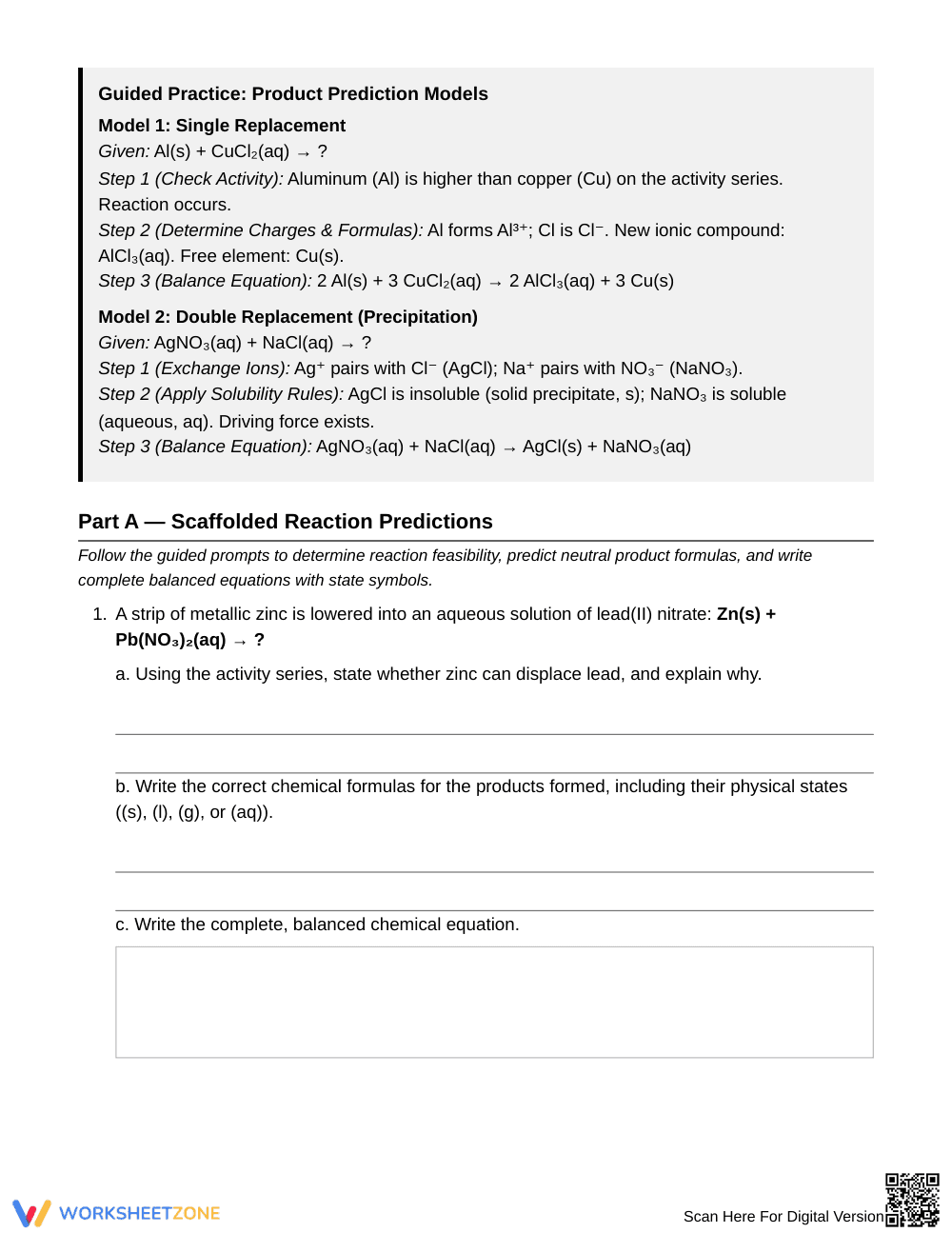
This 5-page resource includes a complete reference sheet featuring metal and halogen activity series alongside aqueous solubility guidelines. Two worked models demonstrate exact protocols for single and double replacement reactions. Across 10 tasks, students evaluate reaction feasibility, formulate ionic compounds, balance equations, and construct written explanations. A 2-page answer key provides full solutions.
Skill Progression
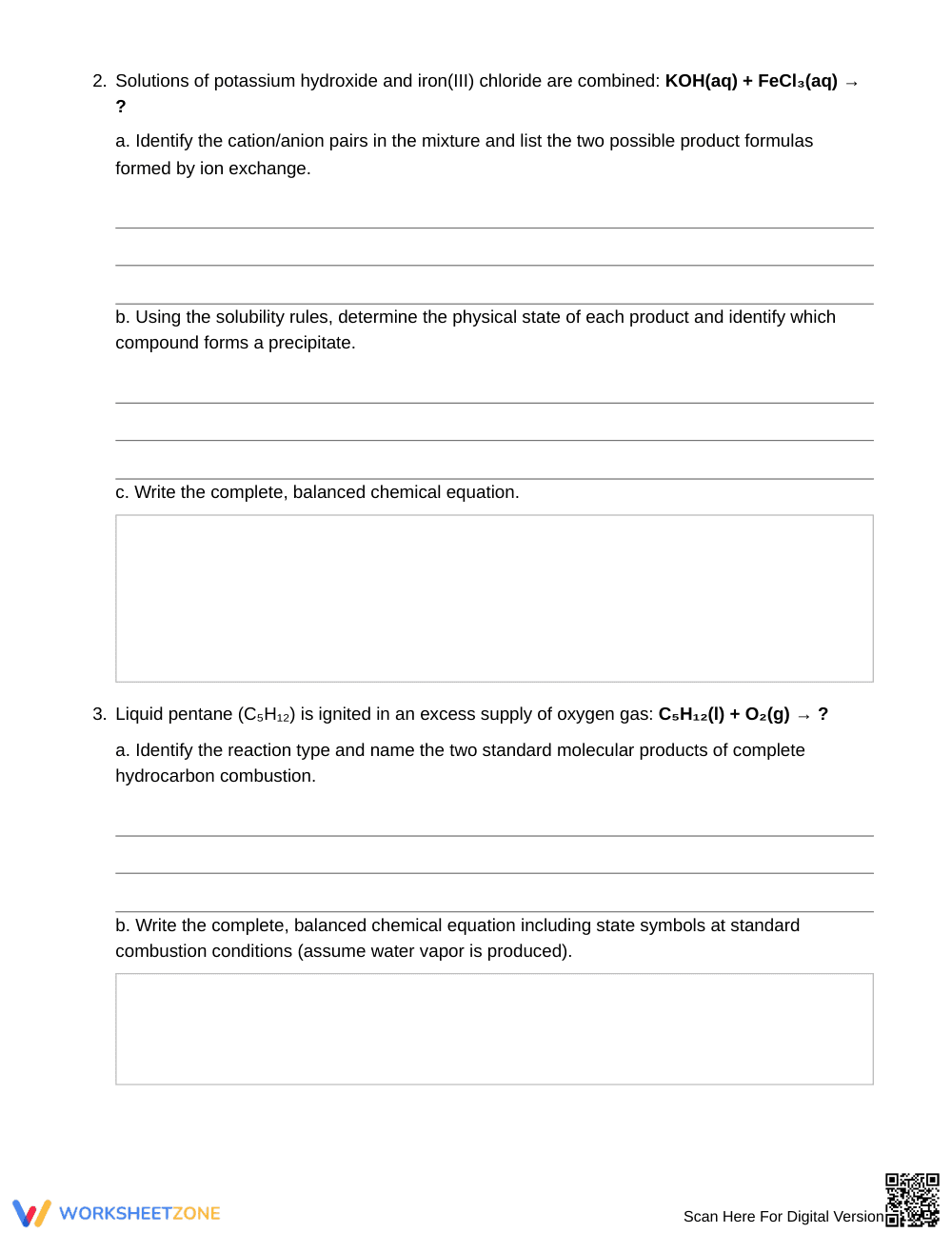
- Guided practice: Part A presents 3 scaffolded problems with targeted prompts guiding students through activity displacement, ion exchange, and combustion balancing.
- Supported practice: Part B provides 5 independent problems where students assess feasibility, assign physical states, and balance complete molecular equations.
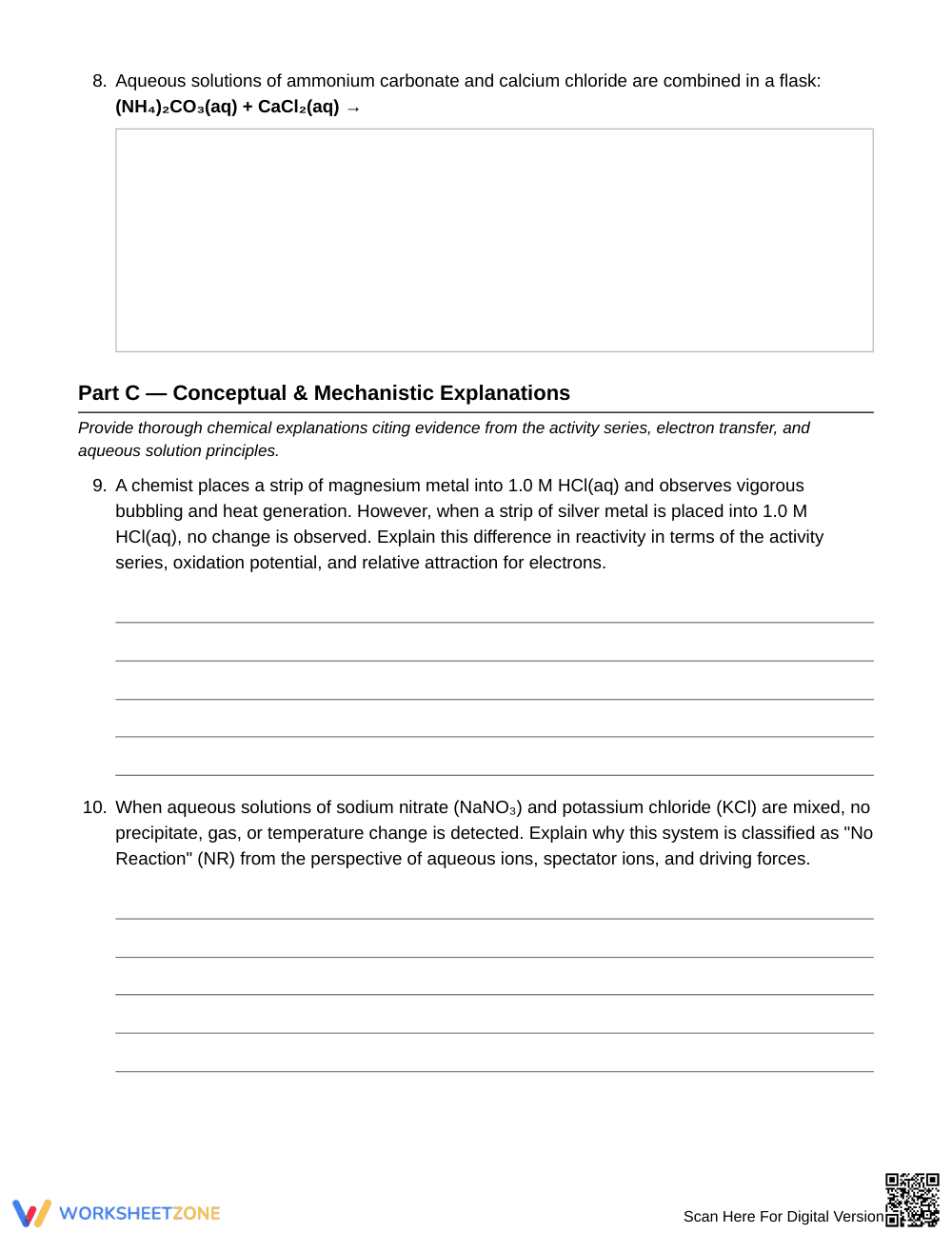
- Independent practice: Part C challenges students with 2 conceptual synthesis questions requiring written explanations of oxidation potential and aqueous driving forces.
This structure follows the gradual-release model, moving learners from guided reference usage to autonomous chemical prediction.
Standards Alignment
Aligned to core high school chemistry standards, this curriculum material prepares students to formulate balanced chemical equations, apply the law of conservation of matter, and predict the outcomes of chemical interactions using patterns in reactivity and solubility. Both standard codes can be copied directly into lesson plans, IEP goals, or district curriculum mapping tools.
How to Use It
Deploy this worksheet after direct instruction on reaction classifications, activity series, and solubility rules. First, use Part A for guided classroom practice, observing whether students verify aqueous solubility before predicting products. Next, assign Parts B and C as independent practice or partner review. Expected completion time is 45 to 60 minutes.
Who It's For
This resource is designed for Grade 11 general and honors chemistry students mastering reaction mechanics. Scaffolding supports developing learners through structured prompts and reference tables, while conceptual questions challenge advanced thinkers. Pair this worksheet directly with an aqueous precipitation laboratory or chemical reactivity demonstration.
According to Fisher & Frey (2014), implementing a structured gradual-release framework allows high school learners to transition effectively from procedural competence to autonomous scientific problem-solving. This Grade 11 chemistry resource operationalizes that evidence-based pedagogy by guiding students through predicting products under supplied conditions across synthesis, single replacement, double replacement, decomposition, and combustion reactions. By systematically moving from reference-supported guided models to independent product formulation and mechanistic explanations, the 5-page curriculum material builds robust conceptual foundations. Students do not merely memorize reaction formulas; they analyze thermodynamic feasibility, assess electron transfer potential, and evaluate precipitate formation using solubility rules. Incorporating 10 targeted problems and a 2-page complete answer key, this resource provides an authentic assessment tool that demonstrates tangible mastery of high school chemical reaction standards. Educators can confidently deploy this worksheet to reinforce chemical reasoning, improve equation-balancing accuracy, and facilitate diagnostic formative evaluation in secondary science classrooms.


