

































Complete Precise Transitions Worksheet | Grade 10 English II

Paste this activity's link or code into your existing LMS (Google Classroom, Canvas, Teams, Schoology, Moodle, etc.).
Students can open and work on the activity right away, with no student login required.
You'll still be able to track student progress and results from your teacher account.
This Grade 10 English II worksheet teaches students how to connect complex sections in informative essays using precise, domain-specific transitions. Students analyze curatorial texts on museum accessibility, plan logical linkages across competing constraints, draft cohesive paragraphs, and synthesize a complete essay with sophisticated structural transitions.
At a Glance
- Grade: 10 · Subject: English II
- Standard:
W.9-10.2— Write informative and explanatory texts to examine and convey complex ideas clearly- Skill Focus: Connect Sections with Precise Transitions
- Format: 6 pages · 8 problems · Answer key included · PDF
- Best For: Explanatory essay writing instruction and revision
- Time: 60–90 minutes
What's Inside
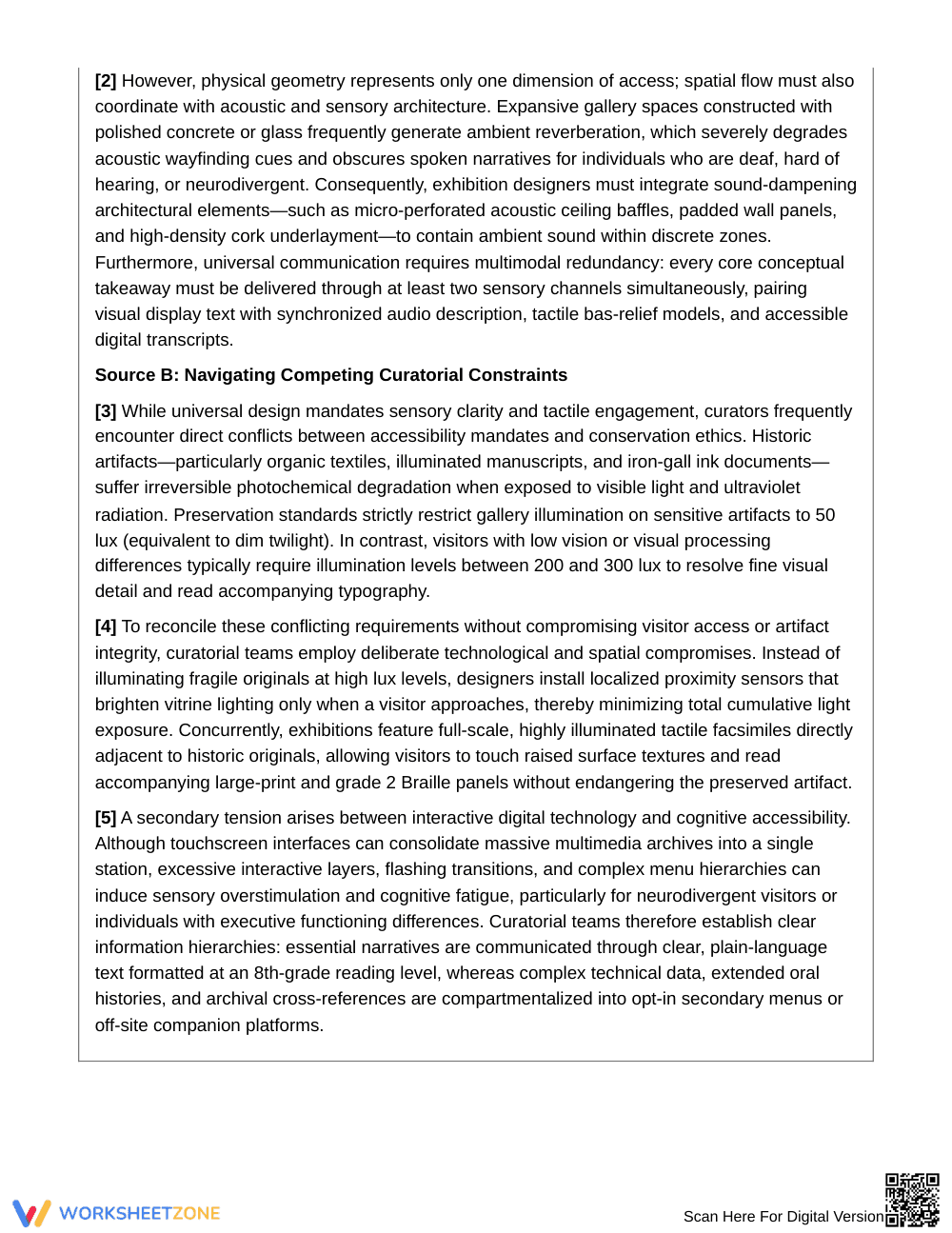
This 6-page instructional resource contains two informational source texts, an analytical planning matrix, paragraph drafting frames, a structural bridge rewrite exercise, a full essay synthesis prompt, and a diagnostic cohesion audit across 8 structured tasks. It also features a complete 6-page answer key with exemplar responses and transitional logic analyses.
Skill Progression
- Guided practice (Tasks 1–2): Students analyze source texts on universal design and map logical relationships (concession, causality, hierarchy) using a transition matrix and macro-outline.
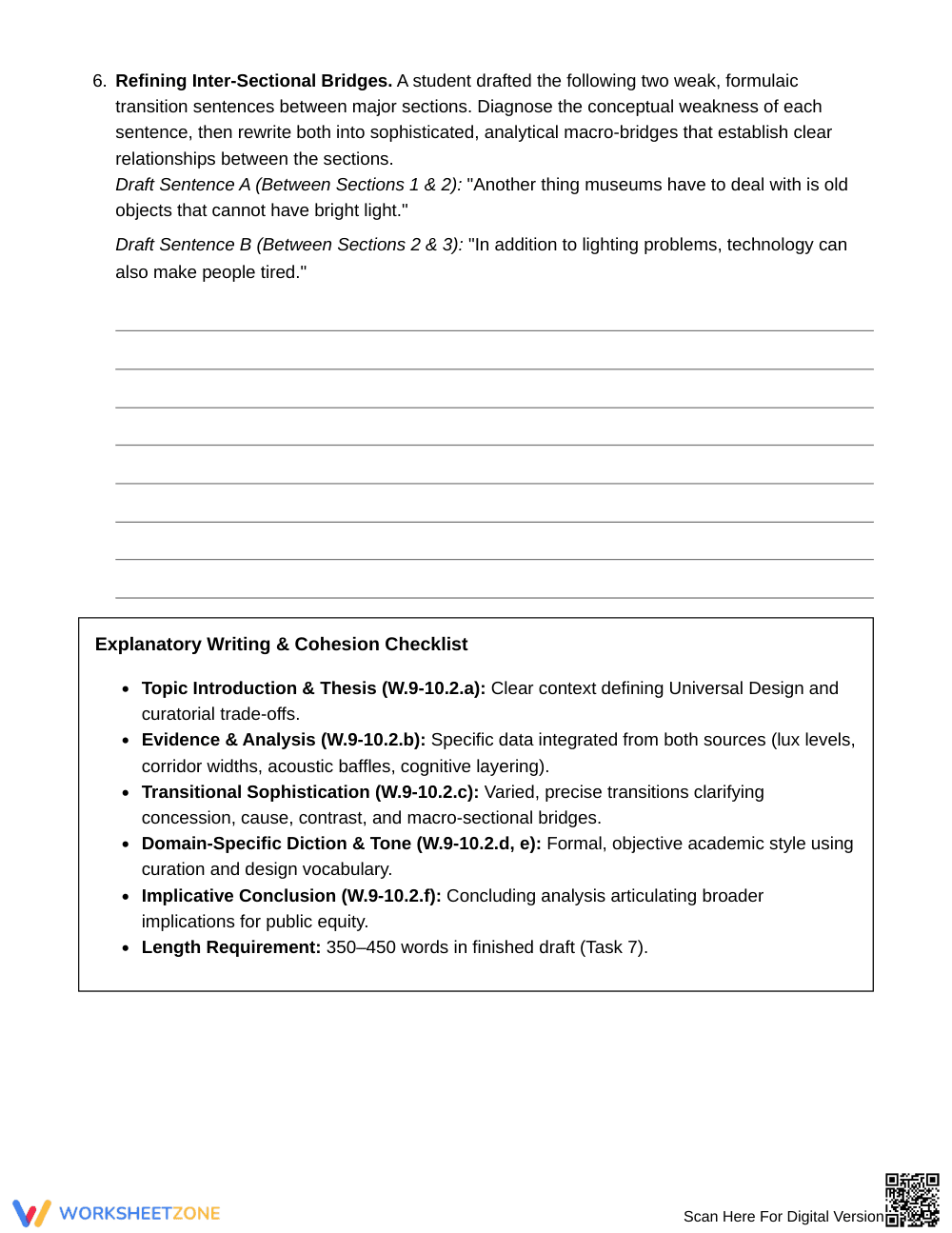
- Supported practice (Tasks 3–6): Students draft 3 targeted body paragraphs addressing specific curatorial trade-offs and rewrite weak, formulaic transition sentences into sophisticated analytical bridges.
- Independent practice (Tasks 7–8): Students compose a complete 350-to-450-word synthesis essay and conduct a diagnostic cohesion audit evaluating three distinct transitions.
This sequence implements a gradual-release model that moves students from identifying logical tensions to independently generating cohesive structural transitions.
Standards Alignment
This worksheet is aligned to Common Core standard W.9-10.2: "Write informative/explanatory texts to examine and convey complex ideas, concepts, and information clearly and accurately through the effective selection, organization, and analysis of content," with explicit focus on W.9-10.2.c to link major sections of text and clarify relationships among complex ideas. Both standard codes can be copied directly into lesson plans, IEP goals, or district curriculum mapping tools.
How to Use It
Use this resource during the drafting phase of an informative writing unit to transition students away from mechanical transitional phrases like "in addition" or "another reason." It also serves as an intensive revision lab after initial direct instruction on essay structure. As a formative assessment tip, check Task 6 bridge rewrites to ensure students articulate conceptual relationships rather than mere topic shifts. Expected completion time is 60 to 90 minutes.
Who It's For
This material is designed for Grade 10 English II students preparing for analytical and explanatory writing benchmarks. It includes structured sentence-level constraints to scaffold emerging writers and rich technical source texts to challenge advanced students. Pair this worksheet directly with mentor text analyses on architectural or museum curation models.
According to Fisher & Frey (2014), explicit instruction in transitional logic and cohesion markers enables secondary writers to organize complex domain-specific arguments and clarify multi-layered conceptual relationships. When students analyze authentic informational texts and practice contextualized sentence-combining strategies, their mastery of organizational structures increases significantly. This Grade 10 English II worksheet directly targets standard W.9-10.2 by guiding students to replace simplistic sequential cues with nuanced transitions that convey concession, causal interdependence, and hierarchical distinction across complex explanatory sections. Through 8 structured tasks spanning informational analysis, paragraph drafting, sentence refinement, and essay-level synthesis, learners develop the sophisticated structural bridges necessary for college- and career-ready exposition. The integrated audit tool further reinforces metacognitive revision, ensuring students independently evaluate how transitional choices clarify technical trade-offs.


