




























Complete Pig Investigation Worksheet | Grades 7-12 Science
Paste this activity's link or code into your existing LMS (Google Classroom, Canvas, Teams, Schoology, Moodle, etc.).
Students can open and work on the activity right away, with no student login required.
You'll still be able to track student progress and results from your teacher account.
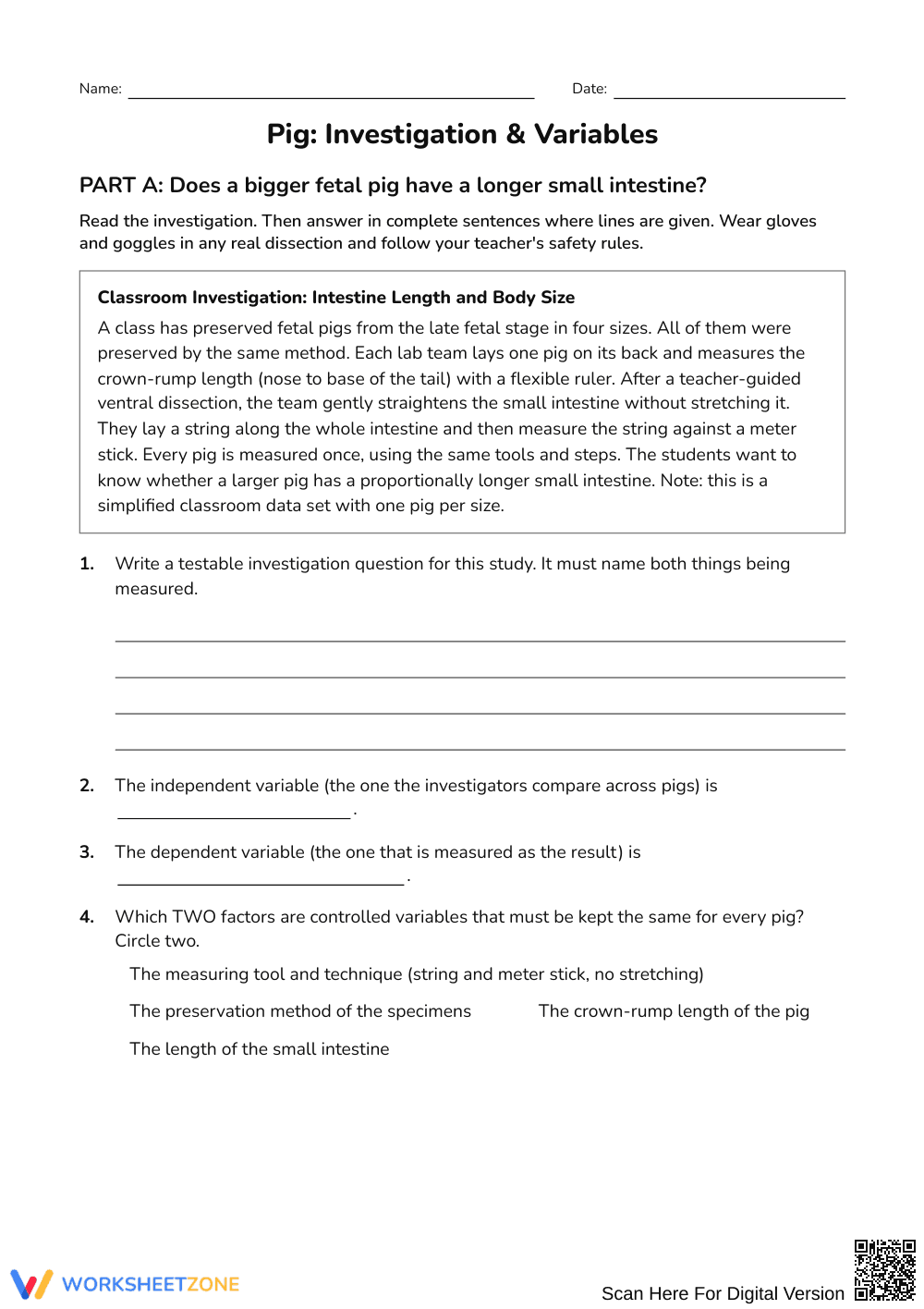
This fetal pig anatomy worksheet guides secondary biology students through experimental design, data interpretation, and physiological reasoning across 26 rigorous questions. Learners identify testable questions, isolate independent and dependent variables, control experimental factors, and predict anatomical evidence using both physical organ measurements and circulatory system thought experiments.
At a Glance
- Grade: Grades 7–12 · Subject: Science
- Standard: Science Inquiry — Identify variables, control conditions, testable questions, and empirical evidence in biological investigations
- Skill Focus: Experimental design, controls, variables, and anatomical predictions
- Format: 4 pages · 26 problems · Answer key included · PDF
- Best For: Biology dissection prep or dry-lab inquiry
- Time: 45–60 minutes
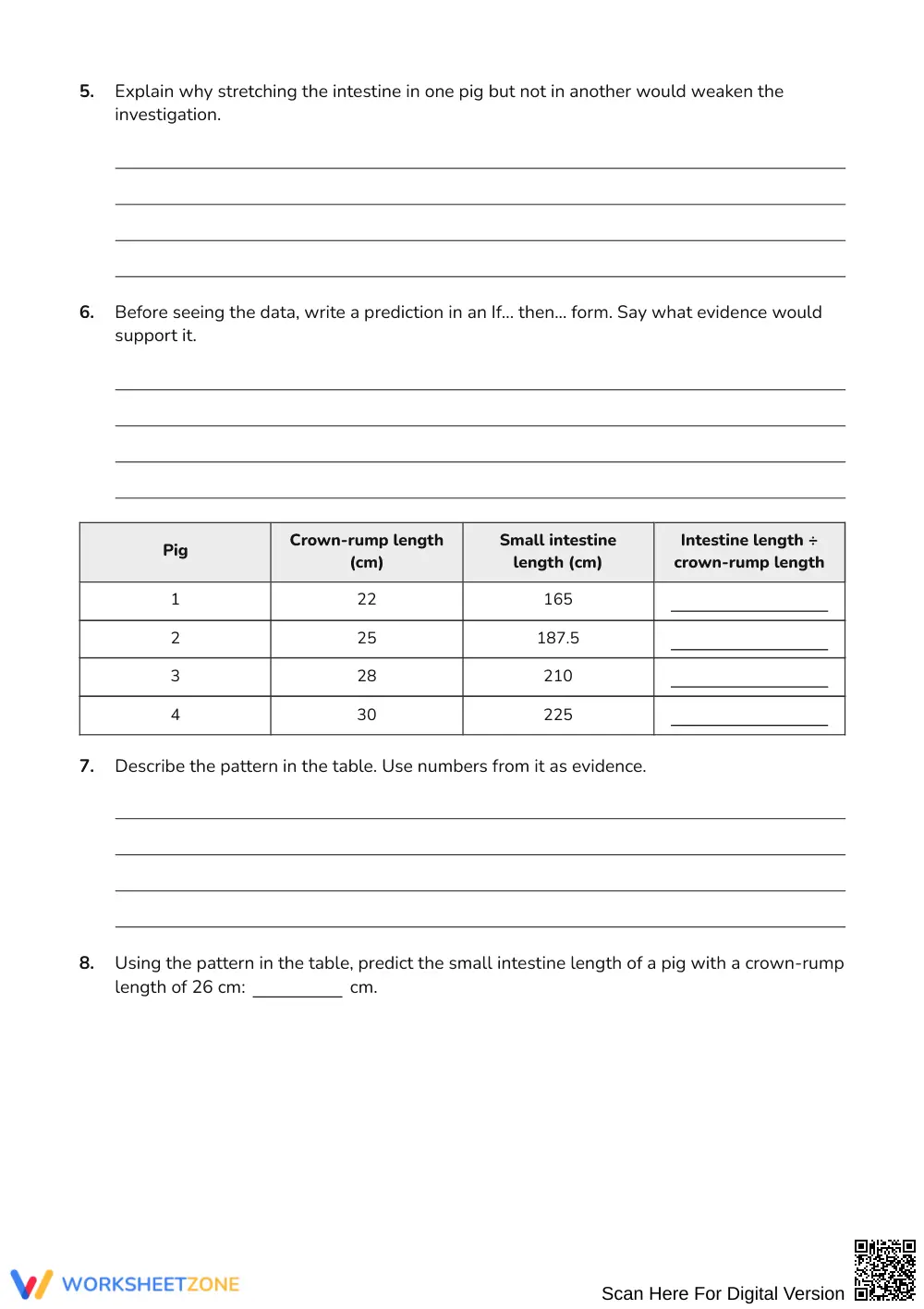
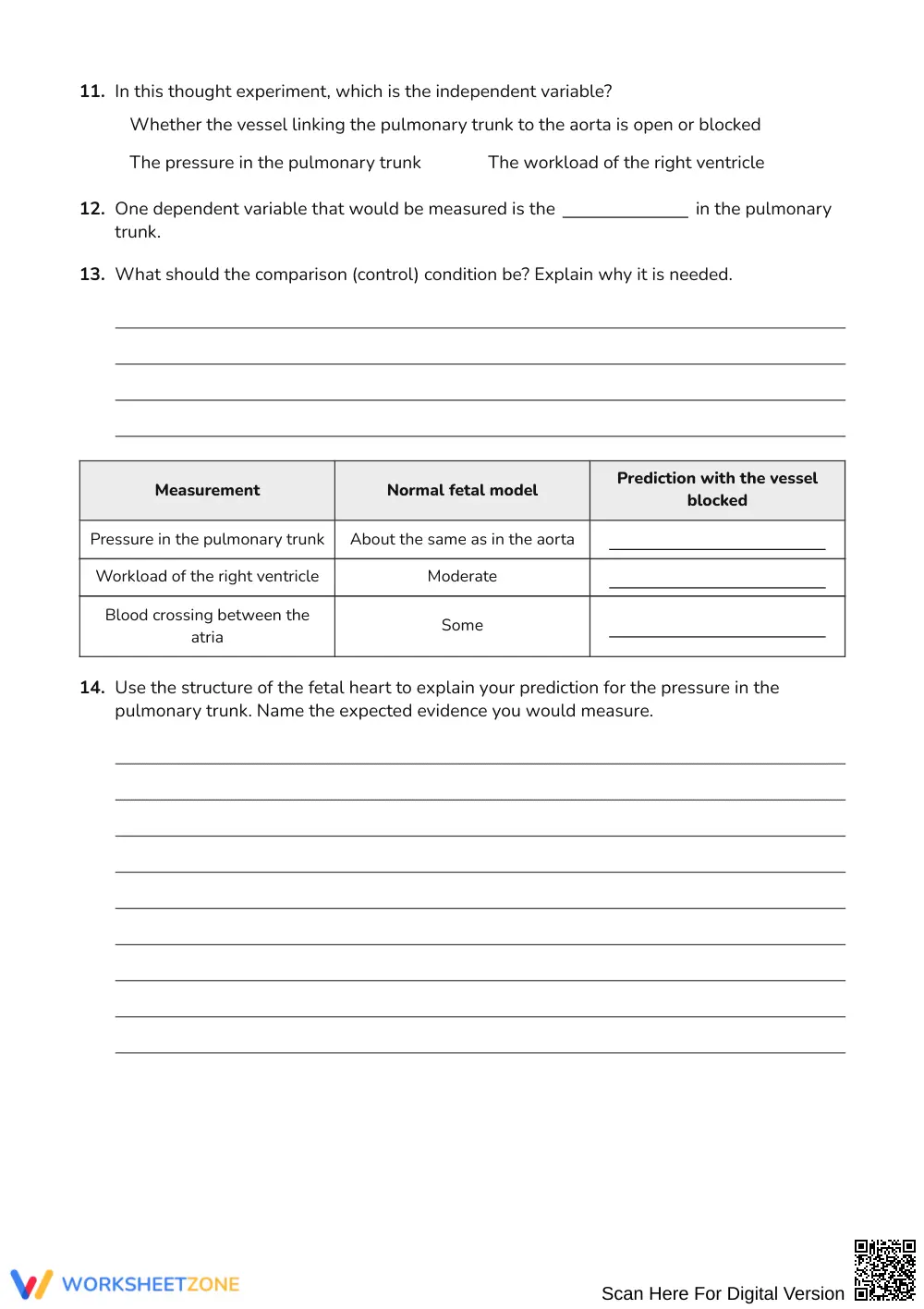
Inside this 4-page resource, students examine two distinct biological contexts. Part A features an investigation comparing crown-rump length to small intestine length across a structured four-specimen data table with ratio calculations. Part B presents an advanced circulatory thought experiment exploring fetal heart bypasses, complete with an anatomical diagram, five labeled cardiac structures, and predictive reasoning tables. A comprehensive 4-page answer key provides complete model responses for every prompt.
Skill Progression
- Guided practice (Tasks 1–6): Students define investigation questions, identify independent and dependent variables, and isolate controlled variables using explicit contextual models from dissection procedures.
- Supported practice (Tasks 7–14): Learners analyze numerical intestine data, calculate organ-to-body ratios, make mathematical predictions, and articulate structure-function relationships in the digestive tract.
- Independent practice (Tasks 15–26): Students analyze fetal circulation structures, establish comparative baseline controls, and construct mechanistic arguments predicting pulmonary pressure shifts when vascular shunts are obstructed.
This sequence follows a gradual-release framework, transitioning learners from foundational variable identification to sophisticated causal biological reasoning.
Standards Alignment
This resource aligns with national secondary science inquiry practices requiring students to formulate testable hypotheses, identify independent and dependent variables, design controlled comparative tests, and evaluate empirical evidence. The tasks bridge physical anatomical observation with mechanistic biological modeling. Standard alignment details can be copied directly into lesson plans, IEP goals, or district curriculum mapping tools.
How to Use It
Deploy this worksheet during direct instruction as a pre-lab readiness activity before conducting physical fetal pig dissections, ensuring students grasp measurement precision and variable control. Alternatively, use it as a standalone dry-lab substitute for absent learners or non-dissecting students. During completion, observe whether students confuse independent and dependent variables in Part A's ratio table. Anticipated completion time ranges from 45 to 60 minutes.
Who It's For
This activity supports middle and high school students in life science, general biology, or advanced anatomy courses. Built-in sentence models scaffold developing scientific writers, while open-ended physiological inquiries challenge advanced learners. Pair this worksheet directly with a whole-class dissection demonstration or a mammalian organ system anchor chart.
According to Fisher & Frey (2014), structured inquiry activities that scaffold experimental design through systematic variable identification significantly boost scientific literacy and cognitive independence. This Grades 7–12 science worksheet operationalizes these evidence-based principles across 26 focused tasks. By evaluating small intestine proportions and modeling fetal cardiac circulation bypasses, secondary students practice isolating independent variables, identifying constants, formulating testable predictions, and interpreting quantitative biological evidence. Rather than treating anatomical study as rote memorization of organ labels, the scaffolded gradual-release progression requires learners to connect physical structures directly to physiological functions and systemic blood flow mechanics. Teachers can reliably evaluate student mastery of core scientific practices, using structured tabular data and comparative thought experiments to build durable conceptual models of mammalian anatomy and rigorous experimental controls. The complete four-page answer key provides clear benchmarks for formative progress monitoring.


