





























Complete Pig Error Analysis Worksheet | Grades 7-12 Science
Paste this activity's link or code into your existing LMS (Google Classroom, Canvas, Teams, Schoology, Moodle, etc.).
Students can open and work on the activity right away, with no student login required.
You'll still be able to track student progress and results from your teacher account.
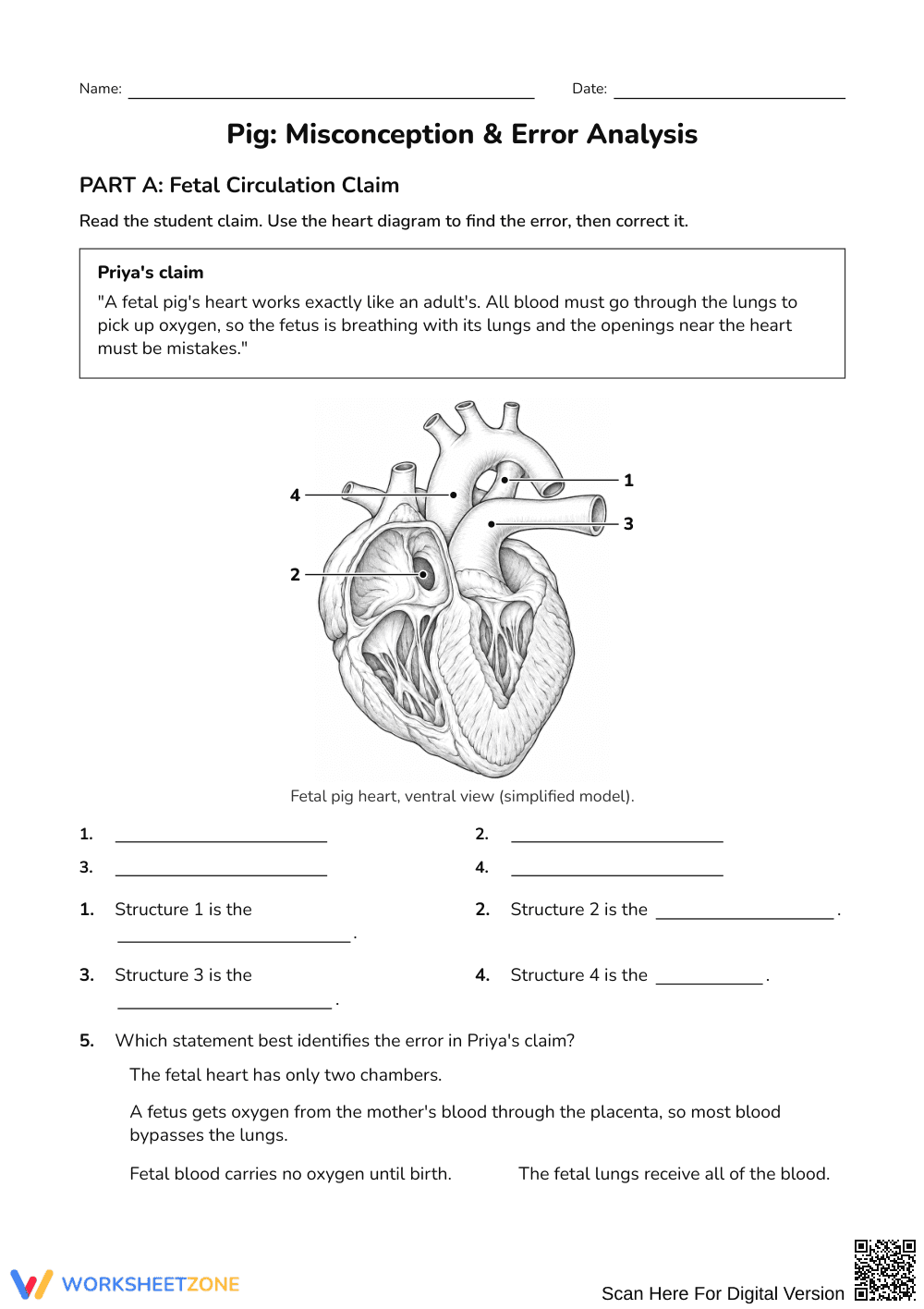
This pig anatomy error analysis worksheet targets common student misconceptions in mammalian anatomy across 30 focused tasks. Students evaluate peer claims about fetal circulation, urogenital structures, and body cavities to replace flawed logic with evidence-based biological explanations. The 4-page activity builds rigorous analytical reasoning directly from anatomical models.
At a Glance
- Grade: Grades 7–12 · Subject: Science
- Standard: Life Science Structure and Function — Evaluate anatomical evidence to critique and correct flawed biological claims
- Skill Focus: Misconception & Error Analysis
- Format: 4 pages · 30 problems · Answer key included · PDF
- Best For: Dissection follow-up and error analysis
- Time: 45–60 minutes
What's Inside
This four-page resource organizes thirty analytical tasks across four parts. Students analyze labeled heart diagrams showing fetal shunts, evaluate comparative anatomy tables for sex identification, and interpret body cavity boundaries around the diaphragm. A complete four-page answer key provides model corrections and detailed anatomical justifications.
Skill Progression
- Guided practice (Tasks 1–10): Students identify circulation errors using a labeled heart diagram and rewrite peer claims with teacher modeling.
- Supported practice (Tasks 11–22): Students use data tables and boundary clues to correct flawed claims regarding sex determination and body cavities.
- Independent practice (Tasks 23–30): Students synthesize knowledge by predicting ductus venosus function and explaining multi-system interactions without scaffolds.
This structure follows a gradual-release framework from guided identification to independent synthesis.
Standards Alignment
This worksheet aligns with secondary life science standards on structure and function, focusing on how circulatory adaptations bypass nonfunctional fetal organs. Supporting standards address organ system interactions, specifically connecting circulatory delivery to placental gas exchange. Both standard codes can be copied directly into lesson plans, IEP goals, or district curriculum mapping tools.
How to Use It
Deploy this activity after direct instruction or dissection labs to consolidate observational learning. During independent practice, observe how students analyze Part C; many confuse physical proximity to the diaphragm with compartmental placement. The 30 tasks require 45 to 60 minutes to complete.
Who It's For
This activity serves life science and biology students in grades 7 through 12 learning vertebrate anatomy. Diagram labels and reference tables support struggling readers, while open-ended application tasks challenge advanced learners. Pair this worksheet with a labeled dissection guide or anatomical poster for optimal reference.
Structured misconception and error analysis in secondary life science improves conceptual understanding by prompting learners to confront flawed biological assumptions rather than passively reviewing anatomical structures. According to Fisher & Frey (2014), gradual-release instructional designs that incorporate explicit error correction enable students to move successfully from guided identification to independent cognitive transfer. This four-page science worksheet delivers thirty systematic tasks requiring students in grades 7 through 12 to evaluate peer claims regarding fetal circulation, internal body cavities, and urogenital anatomy. By grounding analytical prompts in labeled heart diagrams, organ comparison tables, and physiological reasoning, the resource systematically guides learners to identify factual errors, rewrite inaccurate claims, and justify conclusions using anatomical evidence. Incorporating targeted misconception analysis deepens conceptual retention, ensuring students understand not merely where organs reside, but how structure governs function across interconnected mammalian systems.


