




























Complete Pig Anatomy Worksheet | Grades 7-12 Science
Paste this activity's link or code into your existing LMS (Google Classroom, Canvas, Teams, Schoology, Moodle, etc.).
Students can open and work on the activity right away, with no student login required.
You'll still be able to track student progress and results from your teacher account.
This 4-page pig anatomy worksheet guides secondary science students through 27 structured tasks exploring internal mammalian structures, fetal circulation, and physiological relationships. Students identify visceral organs, trace circulatory shunts, compare pig and human anatomy, and analyze oxygenation data to explain system interactions across vertebrate body systems.
At a Glance
- Grade: Grades 7–12 · Subject: Science
- Standard: Life Science — Model structure-function relationships and body system interactions in multicellular organisms
- Skill Focus: Mammalian anatomy, fetal circulation, and structure-function relationships
- Format: 4 pages · 27 problems · Answer key included · PDF
- Best For: Dissection pre-lab or biology lab replacement
- Time: 45–60 minutes
What's Inside
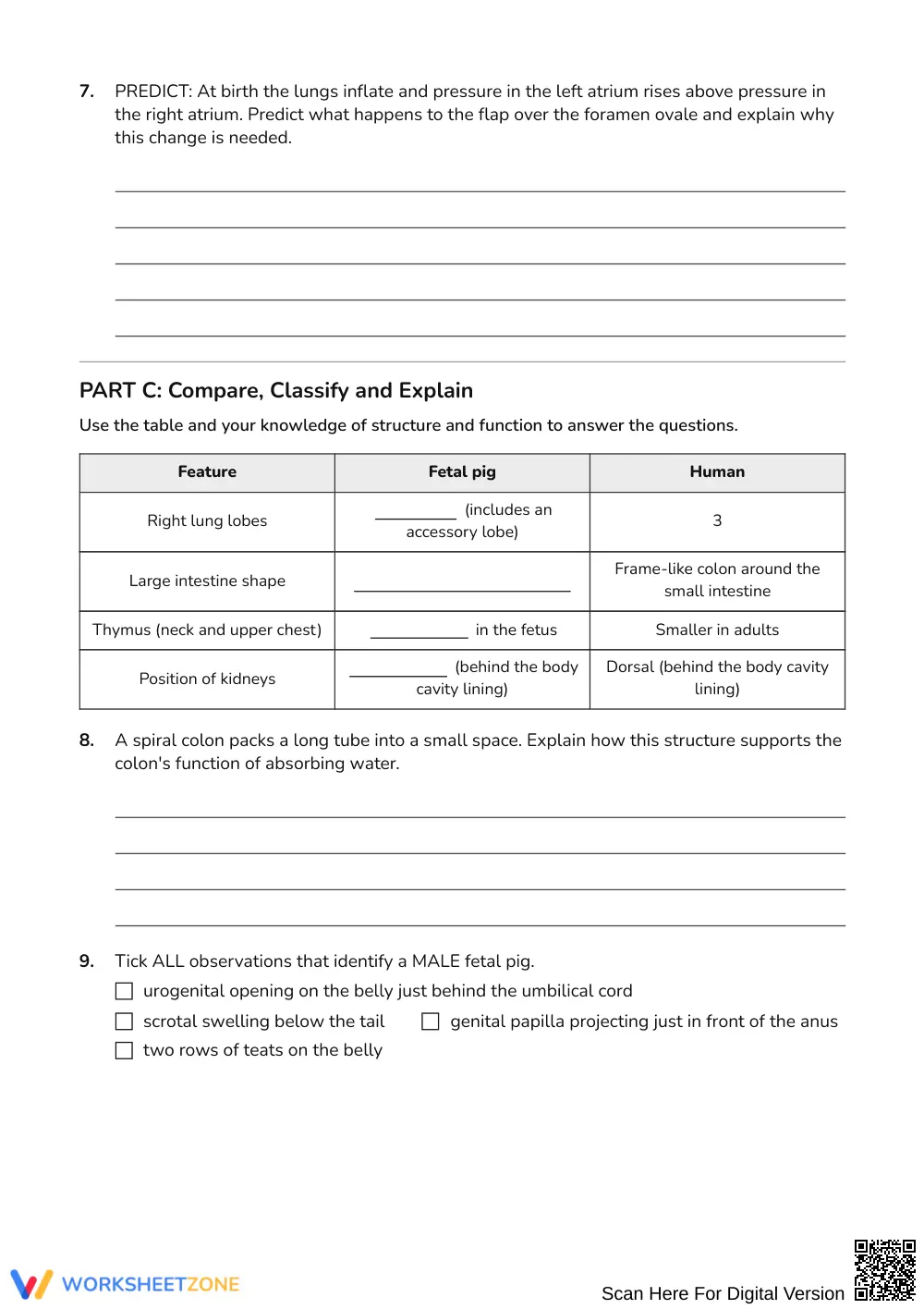
This resource features four sections combining dissection diagrams, flowcharts, comparative tables, and data questions across 4 pages. An anatomical word bank supports organ identification in thoracic and abdominal cavities, while comparative tables contrast fetal pig and human structures. A 4-page answer key provides complete labels and sample explanations.
Skill Progression
- Guided practice: Students use a word bank to label major visceral organs and identify cavity boundaries across 8 foundational items.
- Supported practice: Students complete a 6-step blood flow diagram, evaluate circulatory shunts, and contrast anatomical features across 12 analytical tasks.
- Independent practice: Students analyze quantitative oxygen saturation data across 7 problems to explain placental-circulatory interactions.
This sequence follows the gradual release of responsibility model, guiding learners from structural recall to independent physiological reasoning.
Standards Alignment
This worksheet aligns with life science standards requiring students to analyze how interacting organ systems support multicellular organisms. Students model how body systems coordinate to perform nutrient distribution and gas exchange. Supporting standards address comparative anatomy and structure-function relationships. Both standard codes can be copied directly into lesson plans, IEP goals, or district curriculum mapping tools.
How to Use It
Use this worksheet during direct instruction as a pre-lab orientation before physical dissection, ensuring students locate major organs before working with specimens. Alternatively, assign it after instruction as an independent lab replacement or unit review. During class, monitor student explanations of foramen ovale pressure changes to formatively assess comprehension of neonatal circulation. Completion time is 45 to 60 minutes.
Who It's For
This resource serves middle and high school biology, life science, and introductory anatomy students. Word banks and visual flowcharts support English language learners and students with 504 plans. Pair this worksheet with an interactive torso model or virtual dissection software to reinforce spatial orientation.
According to research by Fisher & Frey (2014) on scaffolded instruction, student mastery of complex biological systems improves significantly when instruction transitions systematically from explicit spatial modeling to evidence-based analysis. Secondary life science objectives require students to analyze how multicellular organ systems interact to maintain physiological function. This worksheet operationalizes that instructional sequence across 27 targeted items. Students begin by identifying thoracic and abdominal structures using anatomical diagrams before progressing to tracing circulatory pathways through fetal shunts. By engaging in comparative mammalian anatomy and interpreting quantitative oxygen saturation data, learners move beyond rote anatomical memorization toward rigorous explanatory discourse. The structured inclusion of labeled diagrams, comparative tables, and data models ensures students build durable mental representations of structure-function relationships. This structured approach directly addresses persistent misconceptions regarding neonatal cardiovascular transitions and visceral organ boundaries in vertebrate biology.


