



























Complete Pig Anatomy Worksheet | Grade 7-12 Science
Paste this activity's link or code into your existing LMS (Google Classroom, Canvas, Teams, Schoology, Moodle, etc.).
Students can open and work on the activity right away, with no student login required.
You'll still be able to track student progress and results from your teacher account.
This comprehensive pig anatomy assessment evaluates secondary life science and biology students on anatomical structures, physiological functions, and organ system interactions. Students analyze internal cavities, trace fetal circulatory shunts, and interpret biological models. The structured exercises prepare learners to synthesize complex mammalian anatomy concepts effectively.
At a Glance
- Grade: 7–12 · Subject: Science
- Standard: Dissect and analyze mammalian organ systems and evaluate physiological structure-function adaptations
- Skill Focus: Mammalian body cavities, organ identification, fetal circulation, and evidence evaluation
- Format: 4 pages · 33 problems · Answer key included · PDF
- Best For: Unit exam or dissection lab assessment
- Time: 45–60 minutes
What's Inside
This 4-page assessment contains 33 rigorous tasks distributed across four distinct sections. Students encounter multiple-choice reasoning items, multi-select organ cavity classifications, anatomical diagram labeling of ventral viscera, circulatory pathway mapping, and evidence-based data analysis of external anatomical specimens. A complete 4-page answer key provides full explanations and sample constructed responses.
Skill Progression
- Guided Practice (Part A): Foundational multiple-choice and multi-select prompts assess structural identification of the diaphragm, umbilical vessels, digestive adaptations, and thoracic organs.
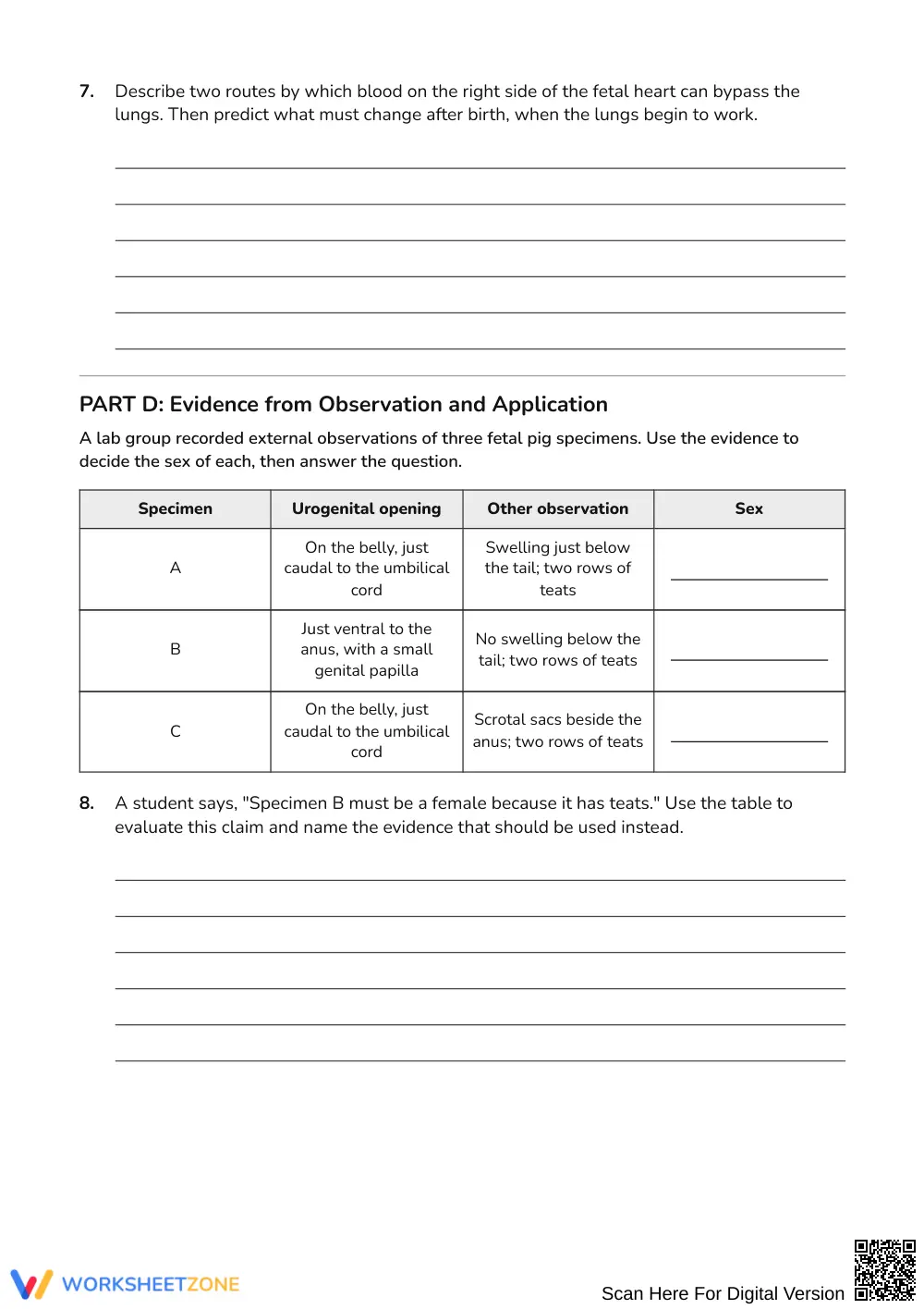
- Supported Practice (Parts B & C): Diagram-based labeling and structured short-response questions require students to trace nutrient absorption across systems and explain fetal shunts, including the ductus arteriosus and foramen ovale.
- Independent Application (Part D): High-level data analysis asks students to evaluate external specimen observations, determine specimen sex, and critique flawed scientific claims.
This sequence follows a gradual-release framework, advancing students from foundational recall to complex physiological reasoning.
Standards Alignment
This worksheet directly reinforces state and national life science benchmarks addressing how organ systems interact to carry out essential life functions and how anatomical structures reflect functional adaptations. Curricular expectations emphasize using physical models to explain circulatory adjustments before and after birth. Both standard competencies can be copied directly into lesson plans, IEP goals, or district curriculum mapping tools.
How to Use It
Administer this worksheet as a summative post-dissection exam or as a formal review packet following direct instruction on mammalian body systems. During completion, monitor how students articulate systemic collaboration between the digestive and circulatory pathways in Part B to identify gaps in physiological reasoning. Expect students to finish the 33 tasks within 45 to 60 minutes.
Who It's For
Designed for middle and high school biology, anatomy, and life science classrooms. It supports general education learners while offering structured data tables that aid developing readers. Pair this assessment with a physical fetal pig dissection or a 3D virtual anatomy model to anchor student understanding.
Secondary science curricula require students to bridge macroscopic anatomical observation with microscopic physiological function. According to findings from EdReports 2024, standards-aligned science tasks that integrate visual models and analytical writing significantly enhance long-term retention of biological principles compared to rote vocabulary memorization. This 33-question assessment operationalizes those principles by requiring students to label anatomical structures, trace specialized fetal cardiovascular pathways such as the ductus arteriosus, and construct evidence-based arguments regarding external morphology. By integrating diagrammatic labeling with analytical explanations of organ interactions, the resource ensures students demonstrate authentic comprehension of mammalian systems rather than isolated factual recall. Teachers can utilize the included multi-page scoring guide to quickly identify whether students require targeted intervention on organ system interconnectedness prior to advanced physiological coursework.


