



























Complete Piecewise Continuity Worksheet | Grade 12 Calculus
Paste this activity's link or code into your existing LMS (Google Classroom, Canvas, Teams, Schoology, Moodle, etc.).
Students can open and work on the activity right away, with no student login required.
You'll still be able to track student progress and results from your teacher account.
This Grade 12 calculus worksheet provides focused practice on modeling continuity in piecewise situations. Students evaluate one-sided limits, solve algebraic systems to eliminate discontinuities, and satisfy engineering constraints. By working through applied contexts, learners master the formal limit definition of continuity needed for advanced calculus coursework.
At a Glance
- Grade: 12 · Subject: Calculus
- Standard: Limits & Continuity — Verify continuity at boundary points using formal one-sided limits and functional values
- Skill Focus: Model Continuity in a Piecewise Situation
- Format: 4 pages · 10 problems · Answer key included · PDF
- Best For: Piecewise limit practice and exam preparation
- Time: 45–60 minutes
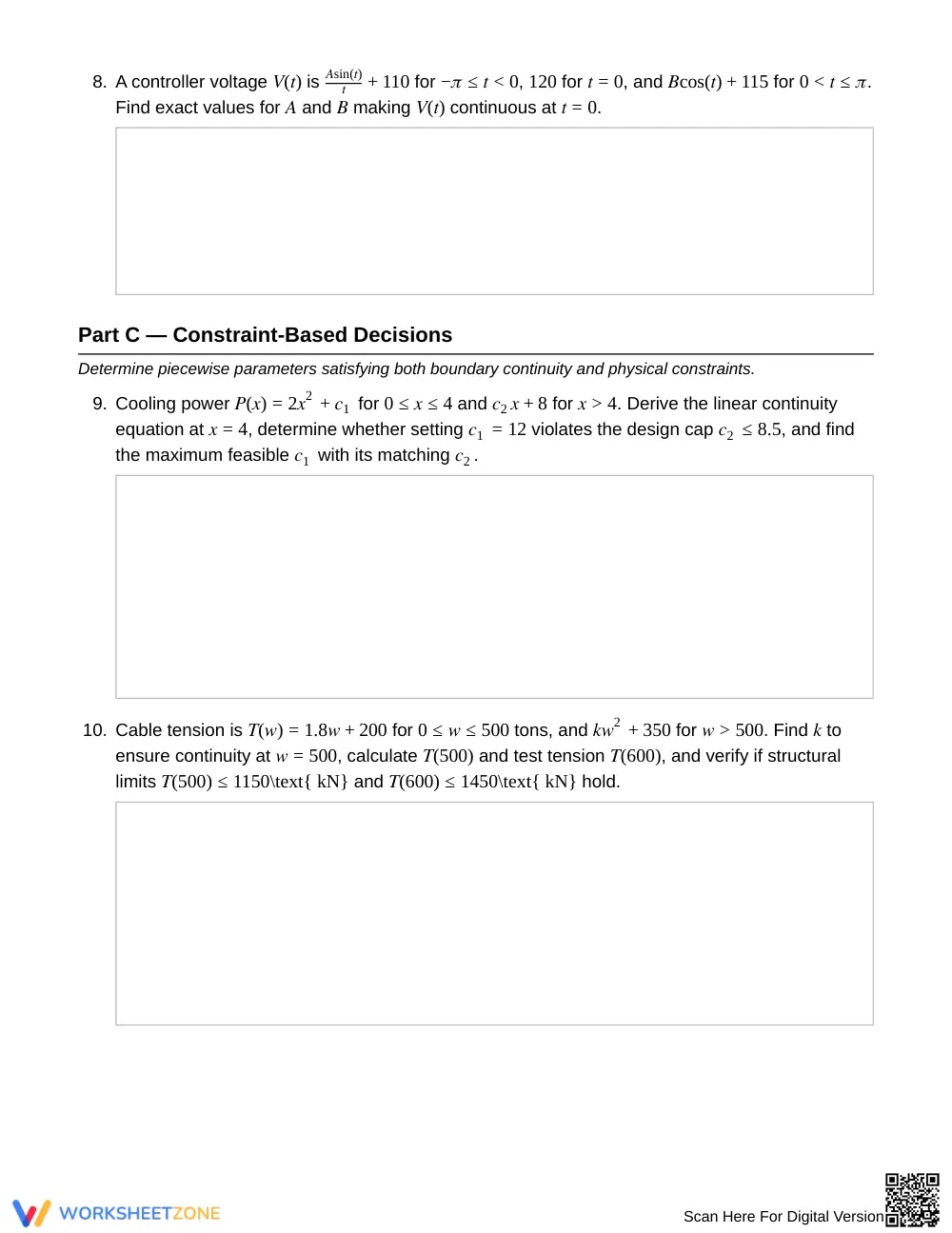
The 4-page worksheet includes 10 rigorous modeling tasks and a complete 3-page worked answer key. A foundational reference box states the formal three-condition continuity test alongside a fully solved autoclave temperature model. The problems feature realistic applications such as municipal water rates, drone thrust profiles, traffic velocity, chemical yields, and structural cable tension.
Skill Progression
- Guided practice (Part A, Problems 1–2): Single-variable boundary problems where students equate left and right limits to solve for one constant.
- Supported practice (Part B, Problems 3–8): Multi-step tasks requiring systems of equations across two transition points, indeterminate limits, and discontinuity classification.
- Independent practice (Part C, Problems 9–10): Unscaffolded modeling items demanding simultaneous boundary continuity and physical constraint verification.
This structure reflects a gradual-release progression, guiding students from introductory limit matching to autonomous multi-constraint problem-solving.
Standards Alignment
This resource aligns with calculus curricular benchmarks in Limits and Continuity. Students use limit notation to verify whether functions are continuous across piecewise transitions and classify discontinuities. Educators can incorporate these targeted objectives directly into lesson plans and curriculum mapping guides for advanced high school mathematics.
How to Use It
Assign this worksheet following direct instruction on piecewise functions during a 50-minute class period. Have students complete Parts A and B in pairs while checking that limit setups are written out completely rather than solved through informal arithmetic. Use Part C as an independent exit assessment or homework task.
Who It's For
This resource serves Grade 12 students in AP Calculus AB/BC or Honors Calculus preparing for rigorous limit evaluations. Differentiate by providing the worked example box for struggling learners while assigning Part C constraint tasks to advanced students. Pair this worksheet with an introductory graphical continuity exercise.
Research by Fisher & Frey (2014) emphasizes that mathematics mastery accelerates when guided instructional models transition into systematic independent practice. This Grade 12 calculus worksheet applies that gradual-release framework to the skill of modeling continuity in piecewise situations across 10 structured applied tasks. By opening with a formal limit definition and a worked heating transition model, the material reduces initial cognitive load before challenging students with multi-parameter systems and structural engineering constraints. Fisher & Frey (2014) confirm that pairing explicit structural scaffolds with authentic contextual challenges helps learners internalize complex procedures, including evaluating indeterminate forms and setting up one-sided limits. Consequently, students develop the mathematical precision and analytical stamina required for mastery on college-level calculus assessments. Educators can deploy this resource to bridge foundational limit concepts with rigorous multi-step analytical problem-solving in senior mathematics classrooms.


