































Complete Parallel Circuits Worksheet | Grades 8-12 Science

Paste this activity's link or code into your existing LMS (Google Classroom, Canvas, Teams, Schoology, Moodle, etc.).
Students can open and work on the activity right away, with no student login required.
You'll still be able to track student progress and results from your teacher account.
This circuit analysis worksheet guides students to compare and contrast series and parallel circuits through quantitative calculations and conceptual models. Working through 31 structured questions, learners calculate voltage, current, and equivalent resistance, examine graphical patterns, and explain real-world electrical systems using physical laws and evidence-based scientific reasoning.
At a Glance
- Grade: Grades 8–12 · Subject: Science
- Standard: Electric Circuits — Compare current, voltage, and resistance in series and parallel circuits
- Skill Focus: Compare and contrast circuit behaviors
- Format: 4 pages · 31 problems · Answer key included · PDF
- Best For: High school physics or physical science
- Time: 45–60 minutes
What's Inside
The four-page worksheet contains five focused sections. Students complete a side-by-side calculation table supported by an Ohm's law formula box, a structured organizer, conceptual multiple-choice items, a branch-current data graph, and a light-string troubleshooting scenario. A complete four-page answer key provides worked calculations and sample explanations for fast grading.
Skill Progression
- Guided practice (Parts A & B): Students complete 12 table and organizer cells with formula prompts to compare voltage, current, and equivalent resistance.
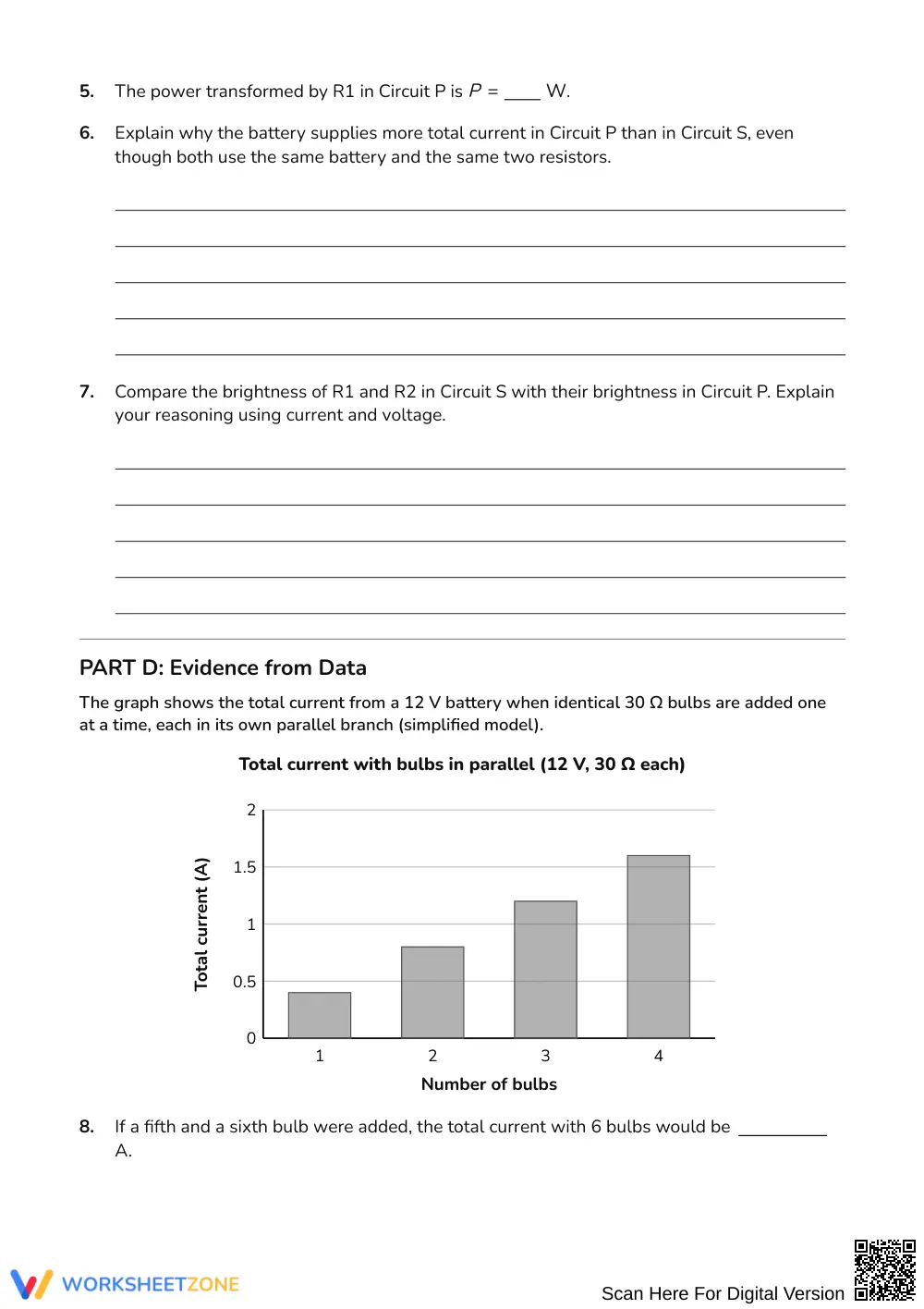
- Supported practice (Parts C & D): Students solve 11 analytical tasks, determining bulb brightness and interpreting a branch-current graph to deduce resistance trends.
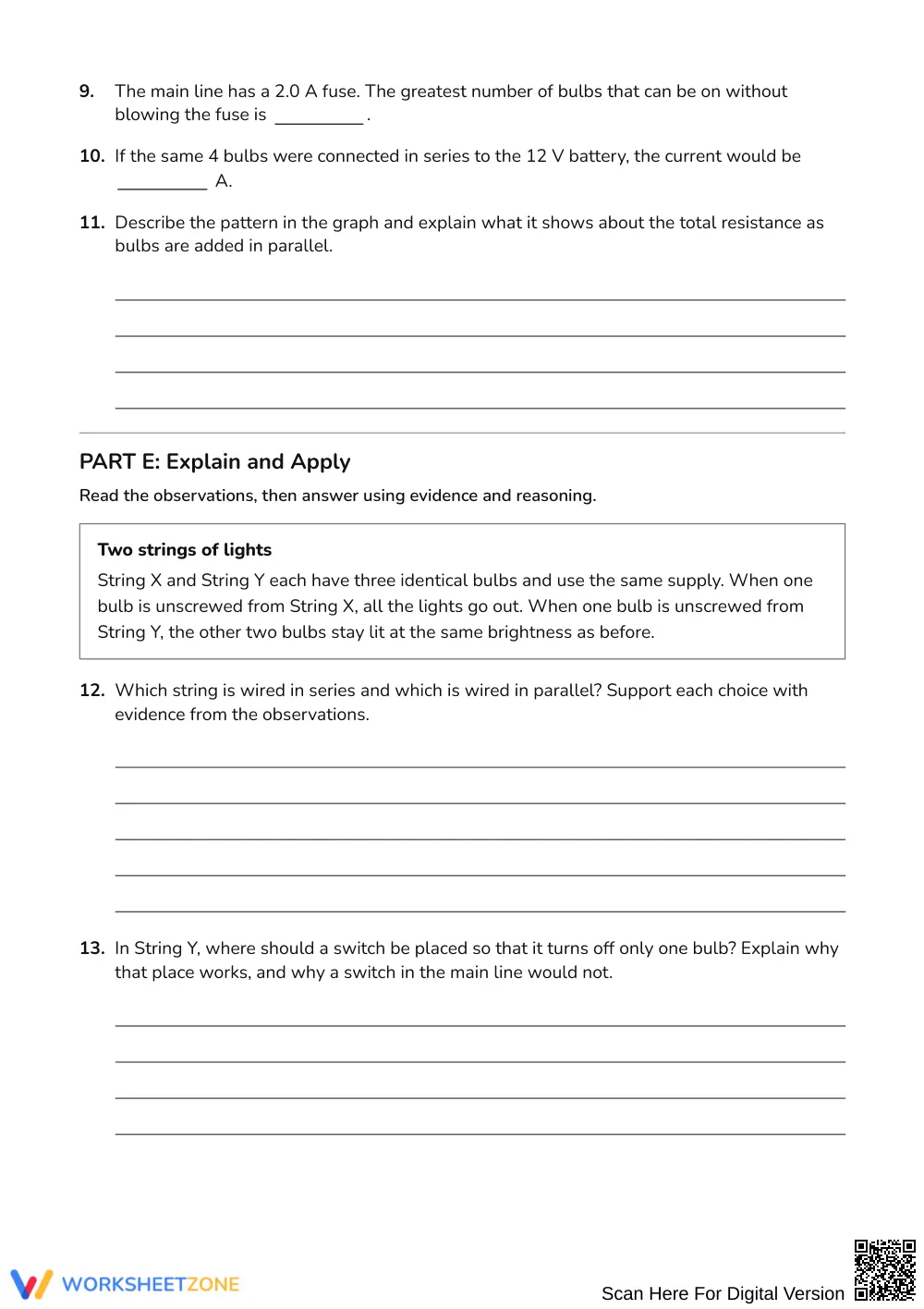
- Independent practice (Part E): Students complete 8 diagnostic questions, troubleshooting holiday light strings and justifying switch placement with written evidence.
This gradual-release sequence moves learners from scaffolded calculations to autonomous circuit diagnosis and argumentation.
Standards Alignment
This activity aligns with high school physical science standards requiring students to analyze and model how electric circuits transfer energy and conserve charge. Students investigate mathematical representations of Ohm's law, verify that total current depends on network geometry, and contrast potential differences across series and parallel loads. Both standard codes can be copied directly into lesson plans, IEP goals, or district curriculum mapping tools.
How to Use It
Deploy this worksheet after direct instruction on Ohm's law. Have student pairs complete Parts A and B during collaborative practice before working independently through Parts C, D, and E. For formative assessment, check Part C to verify students understand why parallel branches reduce equivalent resistance. Expected completion time is 45 to 60 minutes.
Who It's For
This resource supports Grades 8–12 physical science and physics students studying electric circuits. Formula scaffolds assist emerging problem solvers, while graph extrapolation and circuit design challenge advanced learners. Pair this worksheet with hands-on breadboard kits or an interactive circuit simulation.
According to Fisher & Frey (2014), structured comparative analysis enables secondary science students to resolve persistent misconceptions regarding electrical potential difference and current conservation. This four-page circuit investigation provides 31 targeted analytical tasks that guide learners to compare and contrast series and parallel circuits through quantitative modeling and qualitative reasoning. Rather than memorizing formulas in isolation, students evaluate how voltage drops, branch currents, and equivalent resistance shift when identical components are rearranged. By coordinating numerical Ohm's law calculations with data graph interpretation and real-world light string troubleshooting, learners establish coherent mental models of electrical systems. The gradual-release structure supports students in translating physical laws into rigorous scientific arguments backed by empirical data, reinforcing analytical thinking across introductory physics and high school physical science courses. This explicit framework equips students to justify circuit behavior using mathematical relationships, establishing essential problem-solving habits for advanced STEM coursework.


