

































Complete Parallel Circuits Worksheet | Grade 8-12 Science

Paste this activity's link or code into your existing LMS (Google Classroom, Canvas, Teams, Schoology, Moodle, etc.).
Students can open and work on the activity right away, with no student login required.
You'll still be able to track student progress and results from your teacher account.
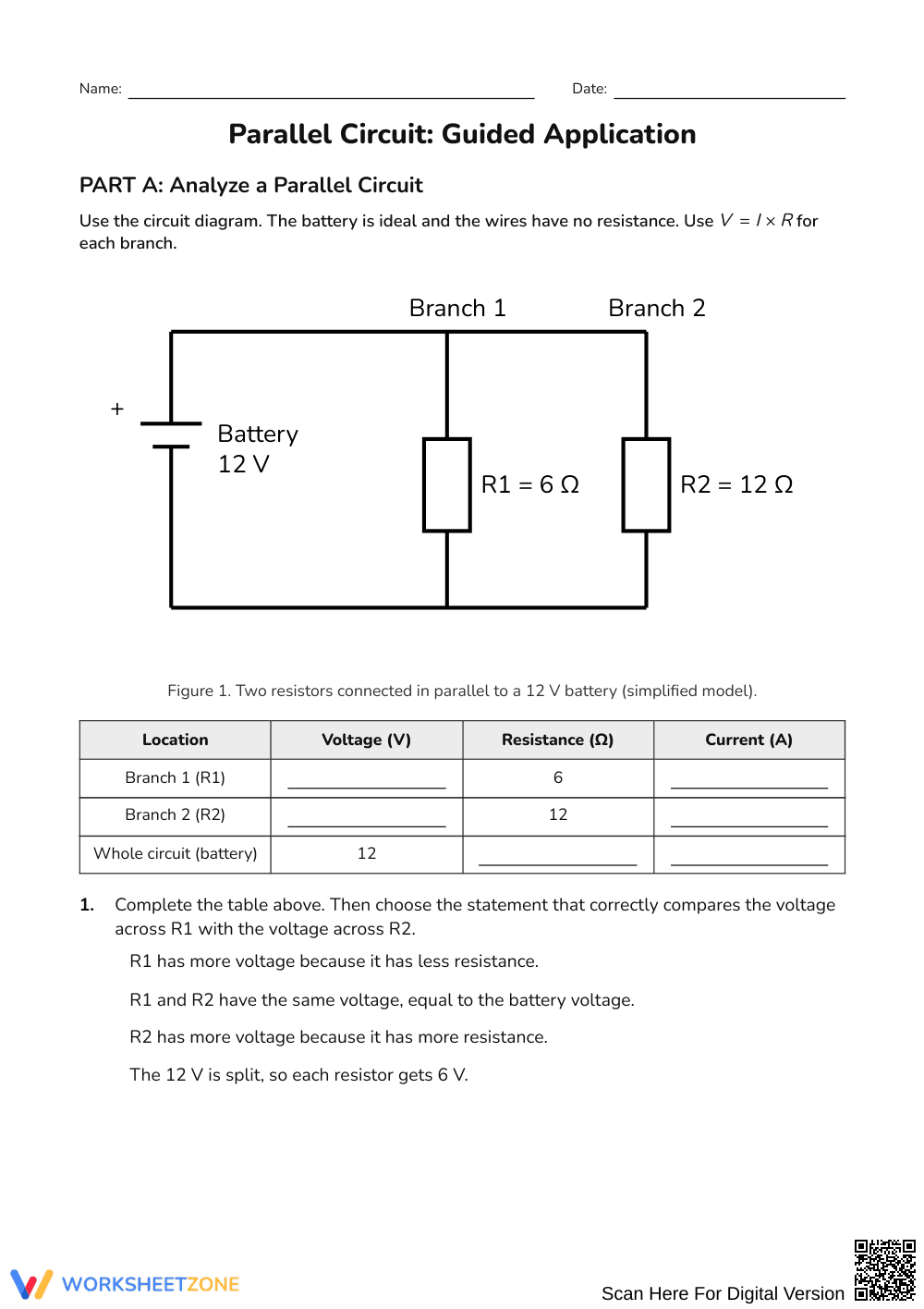
Mastering parallel circuits requires students to connect mathematical calculations with physical concepts of voltage, current, and equivalent resistance. This 4-page science worksheet guides physics students through 26 targeted problems, analyzing current flow, predicting branch changes, graphing circuit data, and calculating household electrical power safety limits.
At a Glance
- Grade: 8–12 · Subject: Science / Physics
- Standard: Core Physical Science — Analyze electric circuits using Ohm's law and energy conservation
- Skill Focus: Parallel Circuit Analysis and Guided Application
- Format: 4 pages · 26 problems · Answer key included · PDF
- Best For: High school physics practice and review
- Time: 45–60 minutes
This 4-page worksheet contains 26 structured tasks across four parts: analyzing circuit schematics, predicting branch changes, graphing experimental current data, and applying electrical concepts to household safety. The resource includes resistor data tables, ammeter graphing grids, multiple-choice conceptual items, and short-answer prompts, supported by a full 4-page teacher answer key with worked calculations.
Skill Progression
- Guided Practice: Part A guides students through a parallel circuit schematic to calculate branch currents using Ohm's law and verify that total resistance decreases as branches are added.
- Supported Practice: Parts B and C prompt students to predict circuit outcomes when branches open, plot current versus branch count, and evaluate fuse thresholds.
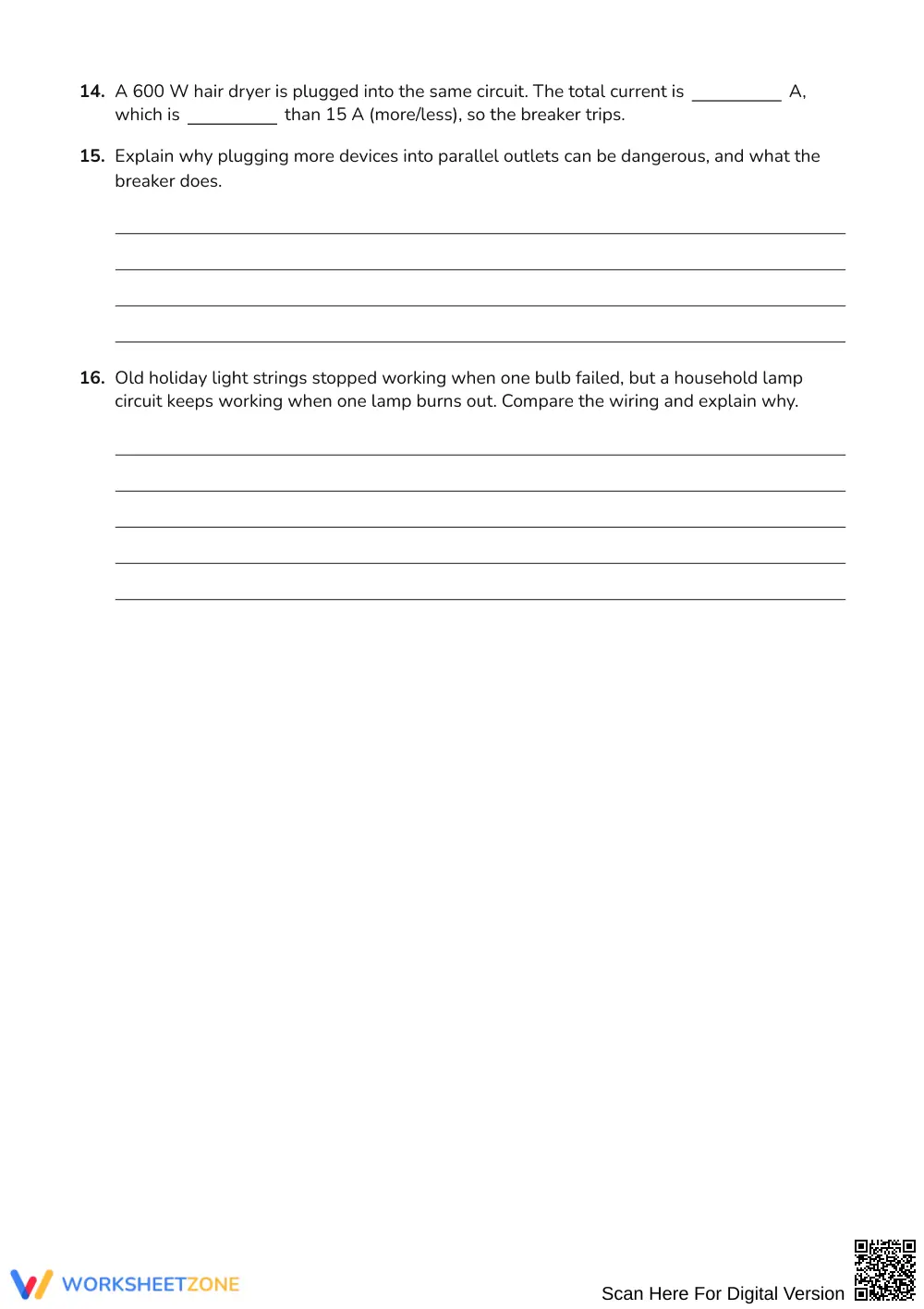
- Independent Practice: Part D challenges learners to independently calculate electrical power using P = I × V, analyze kitchen circuit breaker loads, and contrast parallel household wiring with series holiday lights.
This sequence follows an intentional gradual-release model, moving from structured schematic calculation to independent real-world engineering evaluation.
Standards Alignment
This worksheet supports physical science standards focusing on electric circuits, Ohm's law, and conservation of energy. Students demonstrate how voltage remains uniform across parallel branches while current divides inversely with resistance. Both standard concepts can be copied directly into lesson plans, IEP goals, or district curriculum mapping tools.
How to Use It
Deploy this worksheet after direct instruction on Ohm's law and parallel circuits. For guided practice, walk through Part A together before students complete Parts B and C with a partner. Use Part D as an exit ticket to assess whether students understand that adding appliances increases total current. Expected completion time is 45 to 60 minutes.
Who It's For
This activity is designed for Grades 8–12 physical science and introductory physics classrooms. Built-in scaffolding supports emerging learners through labeled tables, while real-world circuit breaker scenarios extend learning for advanced students. Pair this resource with a hands-on circuit lab or virtual PhET simulation for maximum conceptual retention.
According to Fisher & Frey (2014), structured cognitive progressions that transition students from scaffolded schematic analysis to independent authentic problem-solving significantly increase conceptual mastery in secondary science. This 26-task parallel circuit resource reinforces core physical science principles by demanding that learners apply Ohm's law, evaluate equivalent resistance across independent branches, and predict current loads in real-world household systems. By integrating numerical calculation with conceptual explanation and data graphing, students build both procedural fluency and qualitative understanding. Educational research documented by Fisher & Frey demonstrates that pairing worked branch calculations with student-generated explanations prevents persistent misconceptions regarding voltage drops across parallel paths. Consequently, secondary physics educators can utilize this structured practice set to prepare students for advanced electrical engineering tasks, quantitative laboratory investigations, and standardized physical science assessments while fostering durable scientific reasoning.


