





























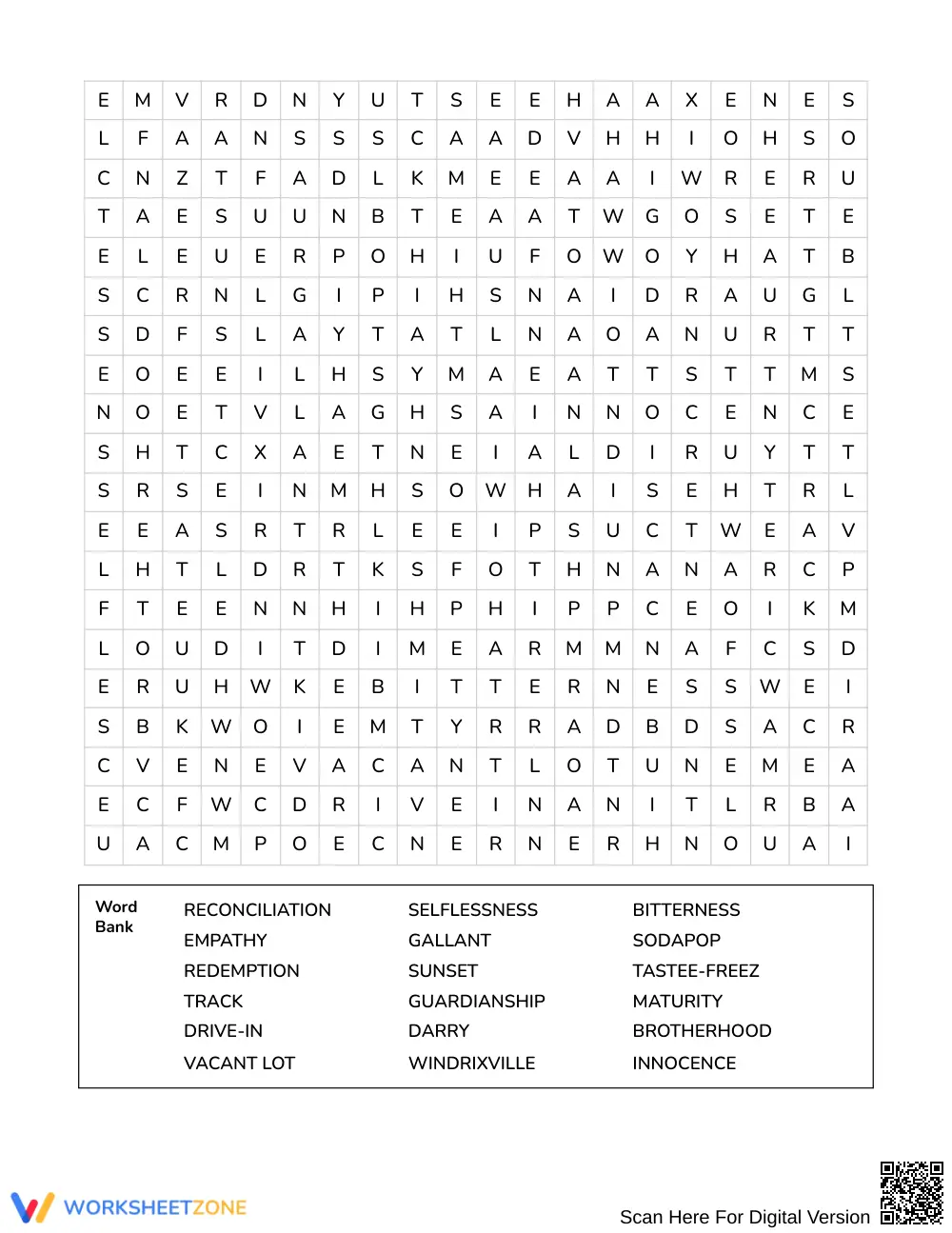


Complete Outsiders Characters Word Search | Grades 7–8 ELA

Paste this activity's link or code into your existing LMS (Google Classroom, Canvas, Teams, Schoology, Moodle, etc.).
Students can open and work on the activity right away, with no student login required.
You'll still be able to track student progress and results from your teacher account.
This The Outsiders word search reinforces student understanding of characters, motivations, and thematic changes across S. E. Hinton's classic novel. Middle school learners analyze 18 key character terms and story concepts, using detailed narrative clues to locate vocabulary embedded in the puzzle. It serves as an engaging cumulative review for Grades 7–8 English Language Arts.
At a Glance
- Grade: Grades 7–8 · Subject: English Language Arts
- Standard: Not standards-assessed — vocabulary enrichment
- Skill Focus: Character motivations and changes
- Format: 3 pages · 18 words · Answer key included · PDF
- Best For: Novel review and sub plans
- Time: 25–35 minutes
What's Inside
The activity package spans 3 student pages accompanied by a comprehensive 4-page answer key. Students explore an 18-item vocabulary list featuring central figures like Darry and Sodapop, pivotal settings including Windrixville and the vacant lot, and core thematic concepts such as redemption, empathy, and gallant sacrifice. Each vocabulary term connects to a concise story clue summarizing critical character developments.
Puzzle Mechanics
The puzzle features a dense 20-by-20 letter grid containing 18 hidden vocabulary terms. Words run in all 8 directions: north, northeast, east, southeast, south, southwest, west, and northwest, providing a rigorous visual challenge. Students reference a shuffled word bank alongside contextual definitions that prompt close recall of character motives, relationships, and symbolic transformations before hunting for terms in the grid.
Standards Alignment
This activity provides dedicated vocabulary enrichment and thematic reinforcement rather than standards-based assessment. While not aligned to a formal state standard, the clues prompt students to reflect on character relationships, moral choices, and internal character changes across the narrative arc of the novel.
How to Use It
Use this word search as an end-of-unit review activity after completing the novel to reinforce key character trajectories before an analytical essay or unit exam. Alternatively, deploy it as a no-prep emergency sub plan during an ongoing literature study. During independent work, circulate to observe whether learners recognize which characters exemplify abstract terms like gallant or bitterness, intervening with targeted textual reminders as needed. Expected completion time ranges from 25 to 35 minutes.
Who It's For
This resource is designed for Grades 7–8 English Language Arts students engaged in whole-class novel studies, literature circles, or remediation groups. Pair this vocabulary puzzle directly with character tracking graphic organizers, chapter reading quizzes, or S. E. Hinton's original text to deepen recall of character actions and major plot milestones.
Literary vocabulary acquisition and character comprehension require multiple exposures to key narrative terms across varied instructional contexts. While not standards-assessed, this Grades 7–8 cumulative review word search develops students' ability to analyze character motivations and changes by pairing 18 high-utility thematic vocabulary terms with explicit story clues from S. E. Hinton's The Outsiders. According to Fisher & Frey (2014), intentional integration of novel-specific vocabulary alongside contextual definitions reinforces textual memory, deepens conceptual associations, and actively supports reading comprehension during middle school literature studies. Engaging adolescent learners in structured puzzle activities allows them to revisit abstract character dynamics—including maturity, reconciliation, selflessness, and empathy—in a low-stress format that strengthens long-term semantic retention. The accompanying four-page solution grid enables rapid teacher verification or structured student self-correction, supporting vocabulary mastery and character analysis prior to formal summative assessments.


