




























Complete Oral-Care Objects Word Search | Grades 4–5 ELA
Paste this activity's link or code into your existing LMS (Google Classroom, Canvas, Teams, Schoology, Moodle, etc.).
Students can open and work on the activity right away, with no student login required.
You'll still be able to track student progress and results from your teacher account.
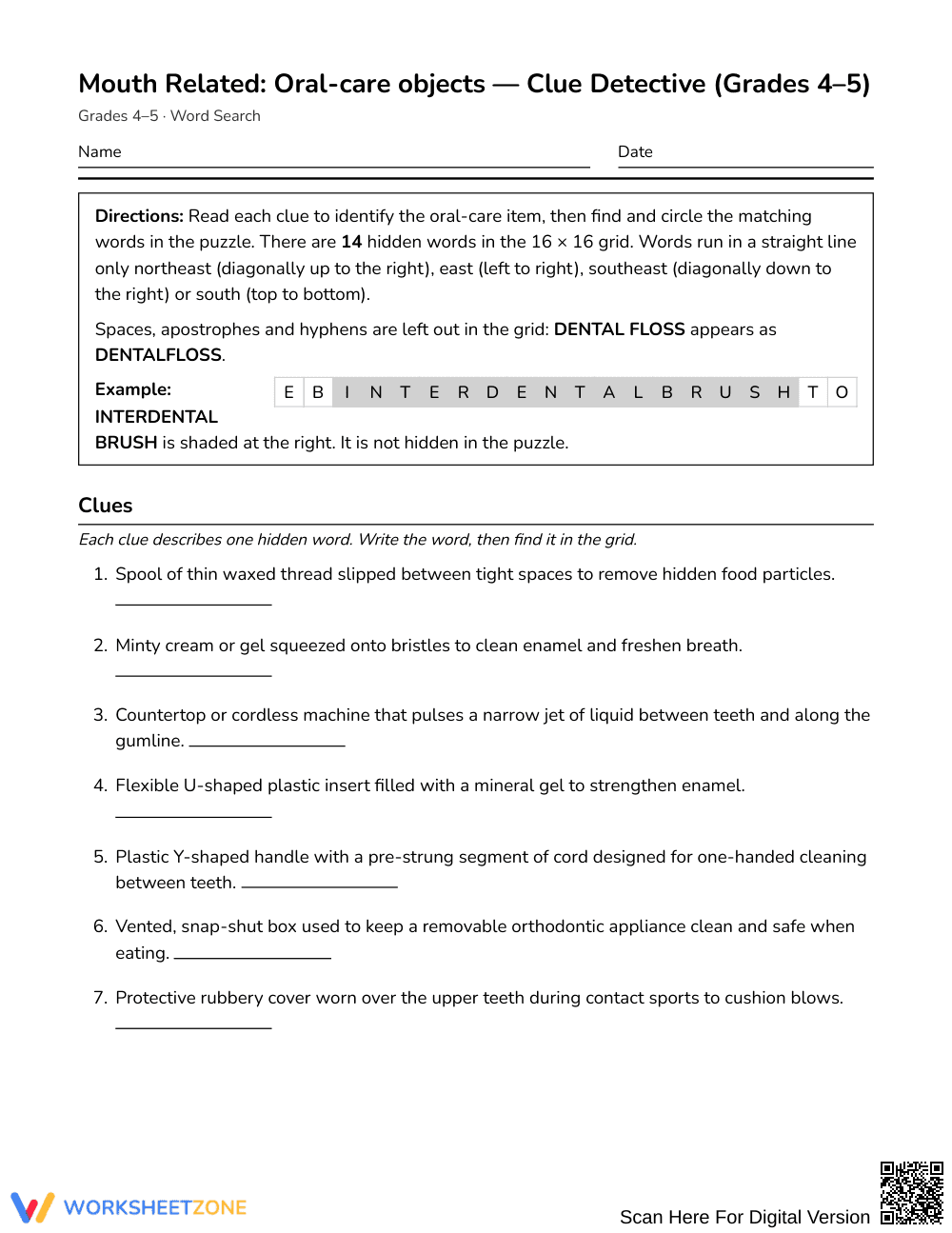
This oral-care objects word search strengthens upper-elementary health and domain-specific language through contextual clue solving. Students in Grades 4–5 read descriptive definitions to identify fourteen dental hygiene items before searching for each hidden term. The activity pairs critical reading comprehension with pattern recognition, building active dental vocabulary and functional wellness knowledge.
At a Glance
- Grade: Grades 4–5 · Subject: English Language Arts (ELA)
- Standard: Not standards-assessed — vocabulary enrichment
- Skill Focus: Oral-care objects and hygiene vocabulary
- Format: 3 pages · 14 words · Answer key included · PDF
- Best For: Health vocabulary stations or morning work
- Time: 20–30 minutes
The printable packet spans three pages, providing an organized layout that includes fourteen clue-driven vocabulary tasks and full answer keys. Rather than relying on a passive word bank, students analyze functional definitions for each item—ranging from protective mouthguards to orthodontic dental wax—reinforcing conceptual understanding before scanning the letter field.
Puzzle Mechanics
The word search is built on a 16 × 16 letter grid designed to challenge intermediate elementary learners without causing visual fatigue. Target terms are hidden across four distinct vector paths: northeast, east, southeast, and south. Students decipher the descriptive text clues to deduce the target phrase, then track letter sequences across horizontal, vertical, and diagonal orientations.
Standards Alignment
This resource serves as targeted vocabulary enrichment rather than formal standards-based testing material. It supports cross-curricular literacy by connecting informational reading skills to personal health topics, helping learners internalize specialized terminology without the pressure of standardized test formatting.
How to Use It
Integrate this word search during an upper-elementary health unit or as an independent literacy center after direct vocabulary instruction. For formative assessment, observe whether students deduce the dental terms from the clues independently or require peer discussion to clarify technical words like orthodontic appliances. Most fourth and fifth graders finish the puzzle within 20 to 30 minutes.
Who It's For
This activity is designed for fourth- and fifth-grade learners expanding their technical lexicons. English language learners benefit from pairing concrete hygiene routines with precise English definitions, while early finishers gain purposeful word study. Pair this puzzle with an informational passage on oral microbiology or an anchor chart illustrating daily dental care habits.
Vocabulary acquisition in the intermediate grades relies heavily on multiple meaningful exposures to domain-specific terminology across varied modalities. According to research synthesized by Fisher & Frey (2014), intentional word-learning experiences that combine definitional reasoning with active visual processing support deeper semantic encoding and retention than rote memorization lists alone. This clue-based word search operationalizes that instructional principle by requiring students to decode context-rich descriptions of oral-care tools before locating the hidden terms. Integrating health-related vocabulary into intermediate English language arts practice strengthens cross-curricular schema while reinforcing functional reading comprehension. Because the activity requires learners to connect functional descriptions to precise terminology, it bridges everyday hygiene habits with academic language development. Consequently, structured vocabulary enrichment tools provide educators with an efficient mechanism for sustaining student engagement, solidifying conceptual knowledge, and fostering persistent lexical retrieval across content areas.


