































Complete Nonstandard Coefficients Worksheet | Grade 8 Math

Paste this activity's link or code into your existing LMS (Google Classroom, Canvas, Teams, Schoology, Moodle, etc.).
Students can open and work on the activity right away, with no student login required.
You'll still be able to track student progress and results from your teacher account.
This Grade 8 math worksheet helps students master scientific notation by diagnosing and correcting nonstandard coefficients. Through targeted error analysis, learners evaluate flawed conversions, explain the underlying mathematical misconceptions regarding exponent adjustment, and compute accurate representations for large astronomical distances and microscopic measurements.
At a Glance
- Grade: 8 · Subject: Math
- Standard: Express numbers in standard scientific notation with proper coefficients
- Skill Focus: Correct Nonstandard Coefficients
- Format: 5 pages · 10 problems · Answer key included · PDF
- Best For: Conceptual practice and error analysis
- Time: 30–45 minutes
What's Inside
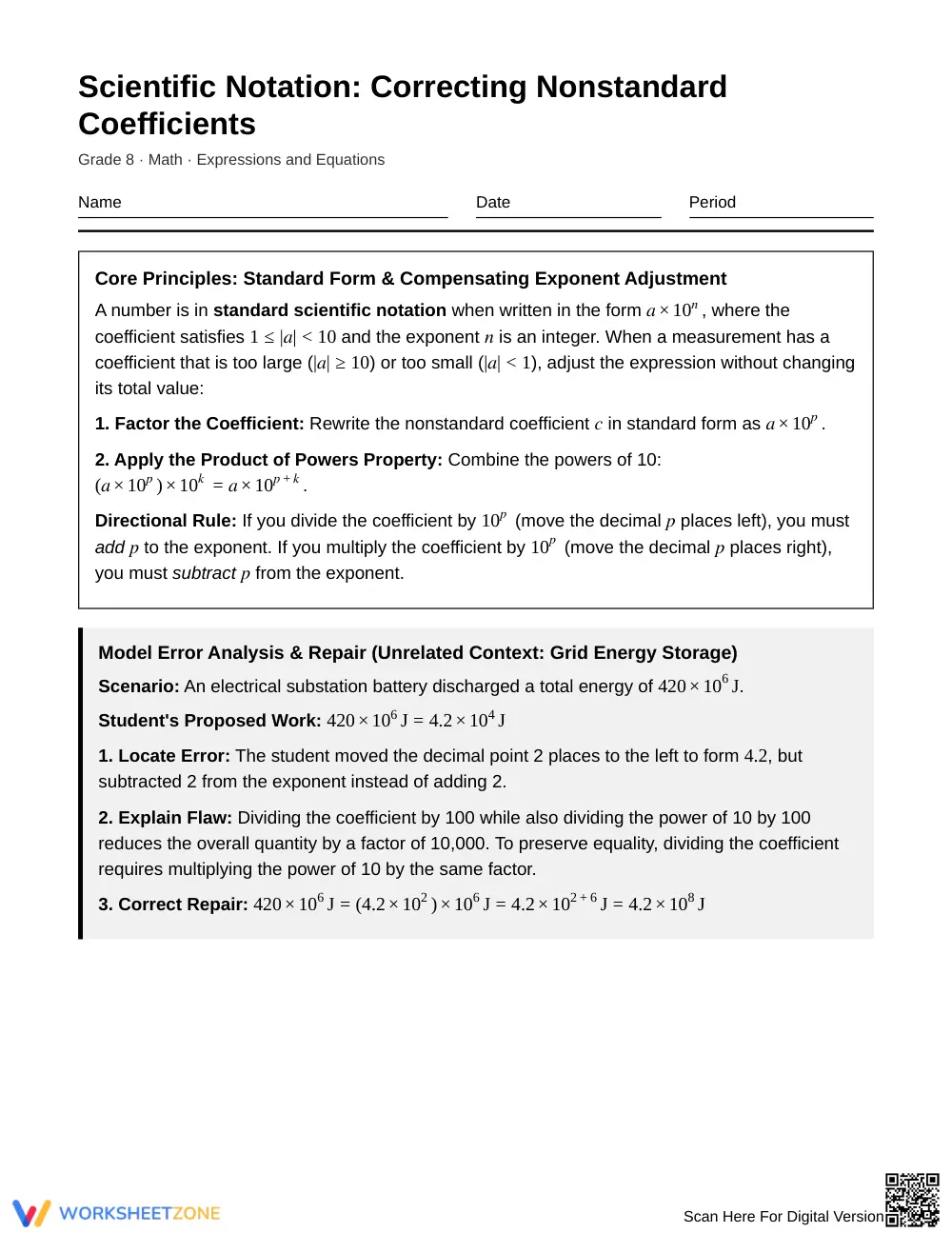
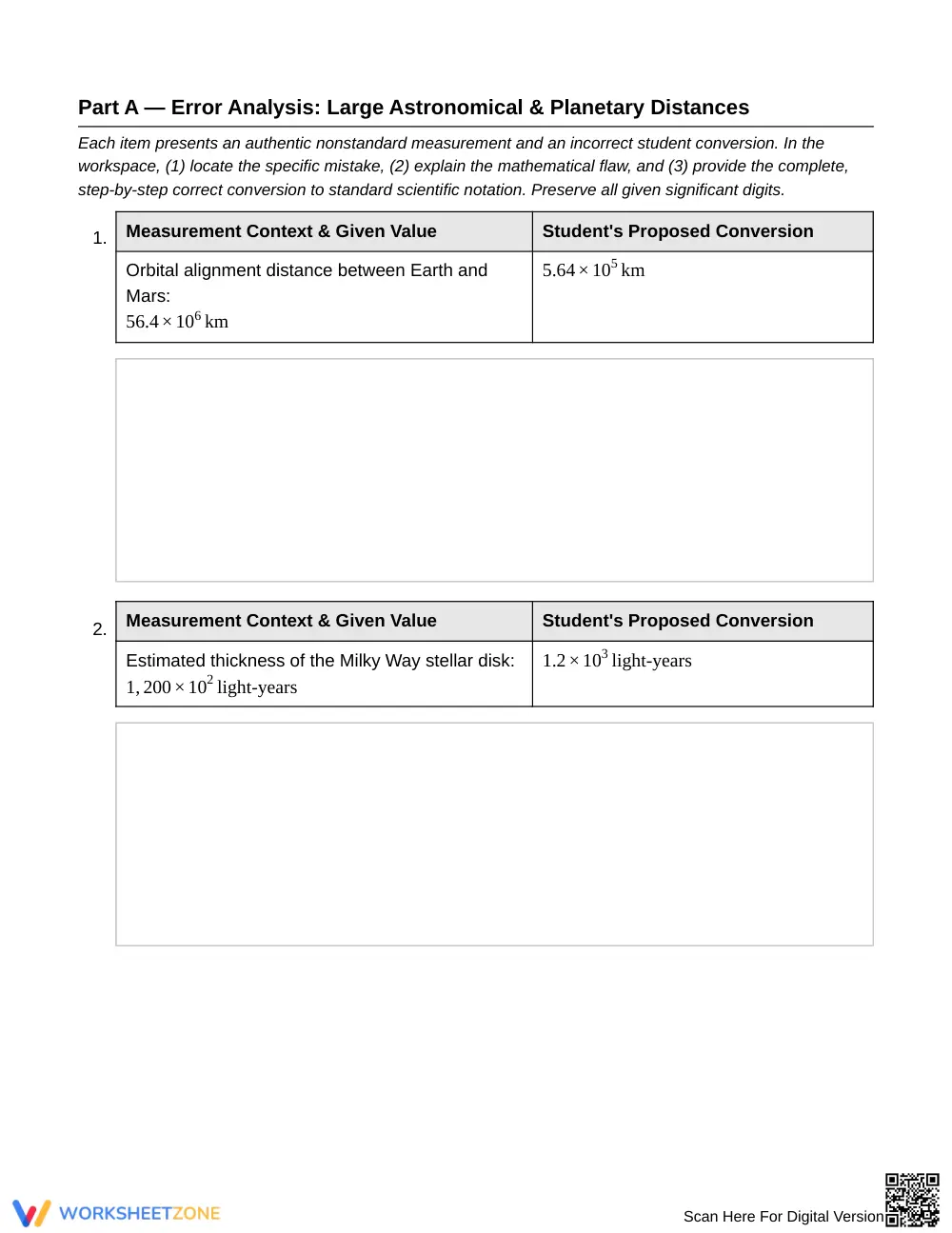
The resource contains 10 rigorous error-analysis tasks spread across 5 printable pages, supported by an extensive 4-page answer key with worked explanations. Students engage with a detailed reference rule box covering the Product of Powers Property and directional exponent adjustments, followed by a fully worked model repair. Part A provides 5 problems set in real-world astronomical contexts with coefficients greater than 10, while Part B delivers 5 nanoscale problems with coefficients less than 1.
Skill Progression
- Guided Practice: A complete model problem breaks down how to identify exponent adjustment errors, articulate the mathematical flaw, and write the corrected form using step-by-step factoring.
- Supported Practice: Part A challenges learners to analyze 5 macroscopic distance problems, using real astronomical quantities to apply positive exponent adjustments.
- Independent Practice: Part B presents 5 microscopic measurement tasks requiring students to manipulate negative powers of ten and small decimal coefficients independently.
This structured progression reflects the gradual release of responsibility model, guiding students from direct procedural modeling to independent analytical evaluation.
Standards Alignment
This activity reinforces middle school expressions and equations standards centered on writing and interpreting numbers in scientific notation. Students ensure coefficients adhere to standard form while maintaining total numeric value through properties of integer exponents. Both standard concepts can be copied directly into lesson plans, IEP goals, or district curriculum mapping tools.
How to Use It
Use this worksheet after direct instruction on scientific notation rules as an in-class collaborative activity or homework assignment. During partner error-analysis routines, circulate and listen for whether students understand why moving a decimal to the left requires adding to the exponent to preserve equivalence. Students typically complete these 10 tasks in 30 to 45 minutes.
Who It's For
This worksheet is designed for Grade 8 mathematics, Pre-Algebra, and introductory physical science students. It provides built-in scaffolds for struggling learners through the directional reference rule box while challenging advanced students to articulate written mathematical reasoning. Pair this resource with an exponent properties anchor chart or a lesson on scientific notation operations.
Fisher & Frey (2014) emphasize that structured error analysis deepens conceptual understanding by requiring students to justify mathematical reasoning rather than merely memorizing algorithmic steps. This 5-page Grade 8 math worksheet engages students in evaluating and correcting nonstandard scientific notation coefficients across 10 multi-step real-world problems. By examining flawed decimal shifts and compensating integer exponents in both macroscopic and nanoscale contexts, learners internalize the Product of Powers Property and coefficient constraints. The resource includes explicit reference guidelines, a worked model problem, and a comprehensive 4-page answer key detailing every calculation step. Grounded in research-backed pedagogical frameworks, these targeted exercises foster durable number sense, precise mathematical communication, and procedural fluency when expressing very large and very small physical quantities.


