































Complete Net Ionic Equation Worksheet | Grades 9-12 Science

Paste this activity's link or code into your existing LMS (Google Classroom, Canvas, Teams, Schoology, Moodle, etc.).
Students can open and work on the activity right away, with no student login required.
You'll still be able to track student progress and results from your teacher account.
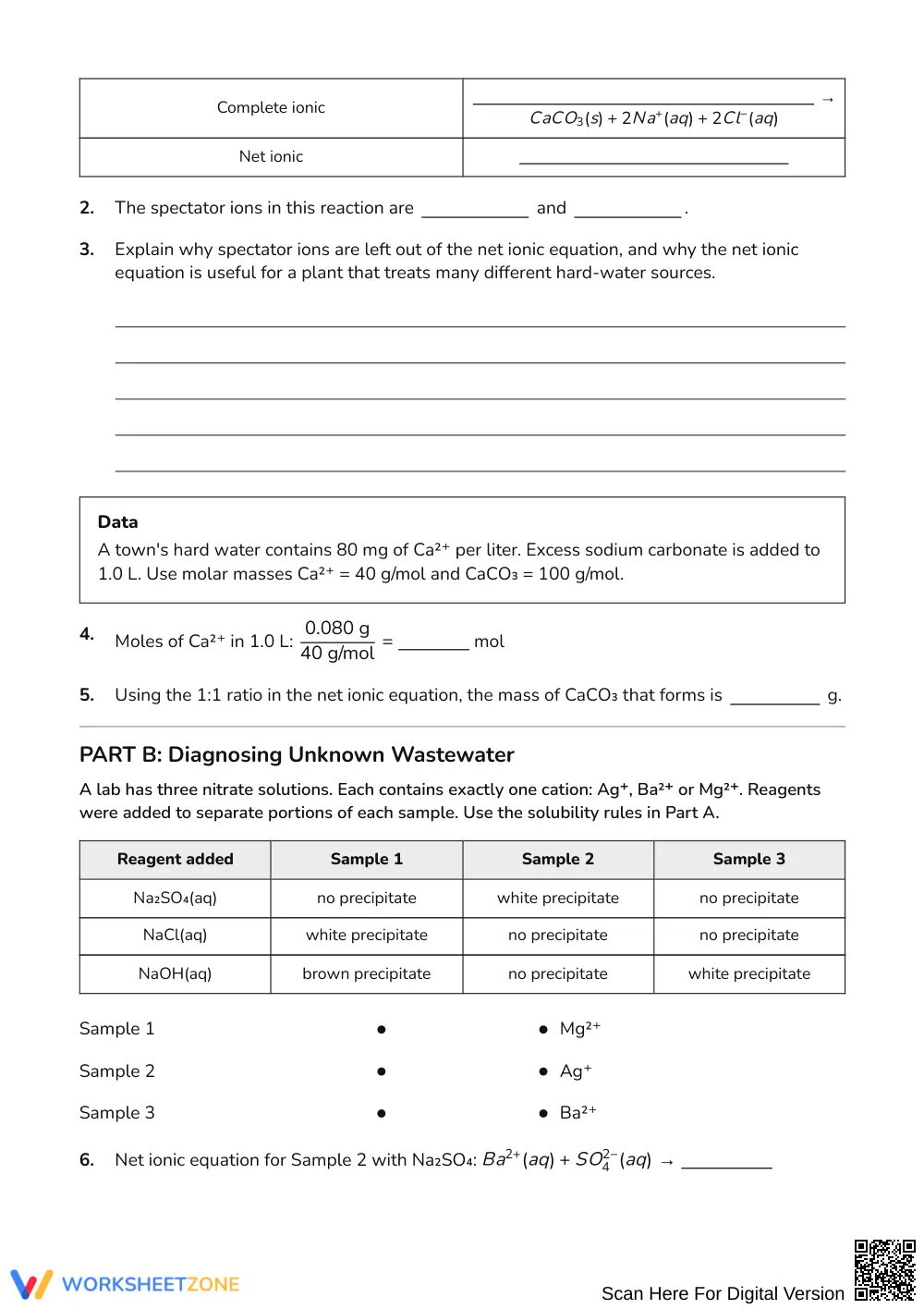
This 4-page chemistry worksheet trains high school students to analyze precipitation reactions and write balanced net ionic equations across realistic environmental engineering contexts. Working through 25 structured items, learners connect particle-level interactions to water softening, qualitative cation diagnosis, and industrial lead removal while tracking stoichiometry and thermochemical changes.
At a Glance
- Grade: Grades 9–12 · Subject: Science
- Standard: High School Physical Science — Write net ionic equations for precipitation reactions and predict product solubility
- Skill Focus: Net ionic equations and real-world precipitation applications
- Format: 4 pages · 25 problems · Answer key included · PDF
- Best For: High school chemistry reaction stoichiometry review
- Time: 45–60 minutes
What's Inside
This resource features a complete reference table of aqueous solubility rules, particulate diagrams, and laboratory reaction data sets. Students complete molecular, complete ionic, and net ionic equations, interpret unknown precipitation test tables, analyze precipitate mass graphs, and calculate reaction enthalpy changes across 4 structured pages with a full 4-page teacher answer key.
Skill Progression
- Guided practice (Part A, 7 items): Students use solubility rules and particle models to complete molecular, complete ionic, and net ionic equations for hard water softening.
- Supported practice (Part B, 6 items): Learners interpret qualitative precipitation tests to identify unknown metal cations and write equations with decreasing instructional prompts.
- Independent practice (Part C, 12 items): Students evaluate lead removal data, determine limiting reactants, interpret solubility plateaus, and calculate solution calorimetry values.
This scaffolded sequence reflects gradual-release instruction, moving students smoothly from visual scaffolding toward independent quantitative analysis.
Standards Alignment
Aligned with high school physical science core ideas on chemical reactions, this resource requires students to formulate complete and net ionic equations, evaluate matter conservation in aqueous solutions, and apply solubility principles to real-world engineering problems. These performance expectations can be copied directly into lesson plans, IEP goals, or district curriculum mapping tools.
How to Use It
Deploy this worksheet after direct instruction on solubility guidelines and double-replacement reactions. Use Part A for collaborative guided practice, Part B as a mid-period check for understanding, and Part C for independent summative evaluation. During instruction, observe whether students identify spectator ions correctly or mistakenly keep them in final equations. Expect completion within 45 to 60 minutes.
Who It's For
This worksheet serves general chemistry, honors chemistry, and introductory Advanced Placement chemistry classes. For students needing support, the embedded solubility reference table and particle diagrams reinforce conceptual understanding before symbolic manipulation. Pair this activity directly with a hands-on precipitation microscale laboratory or an introductory aqueous solution lecture.
Grounded in the instructional architecture described by Fisher & Frey (2014), this chemistry resource leverages structured cognitive modeling and guided release to build student competency in writing net ionic equations for aqueous precipitation reactions. Beginning with explicit particle diagrams and tabular solubility guidelines, the activity anchors symbolic notation in concrete physical phenomena before tasking learners with unassisted multi-step diagnostic reasoning. High school chemistry students frequently struggle to differentiate spectator ions from actively precipitating species; providing visual particulate scaffolding alongside molecular equations directly remedies this persistent conceptual hurdle. As learners transition across the 25 analytical tasks—from municipal water softening to toxic heavy metal remediation—they incrementally internalize reaction stoichiometry, limiting reactant logic, and thermochemical calculation. Fisher & Frey (2014) emphasize that purposeful shifts from structured scaffolds to independent evidence evaluation secure higher retention of abstract scientific representations, preparing students for rigorous post-secondary chemical inquiry.


