































Complete Multiply by 6 Strategies Worksheet | Grade 3 Math

Paste this activity's link or code into your existing LMS (Google Classroom, Canvas, Teams, Schoology, Moodle, etc.).
Students can open and work on the activity right away, with no student login required.
You'll still be able to track student progress and results from your teacher account.
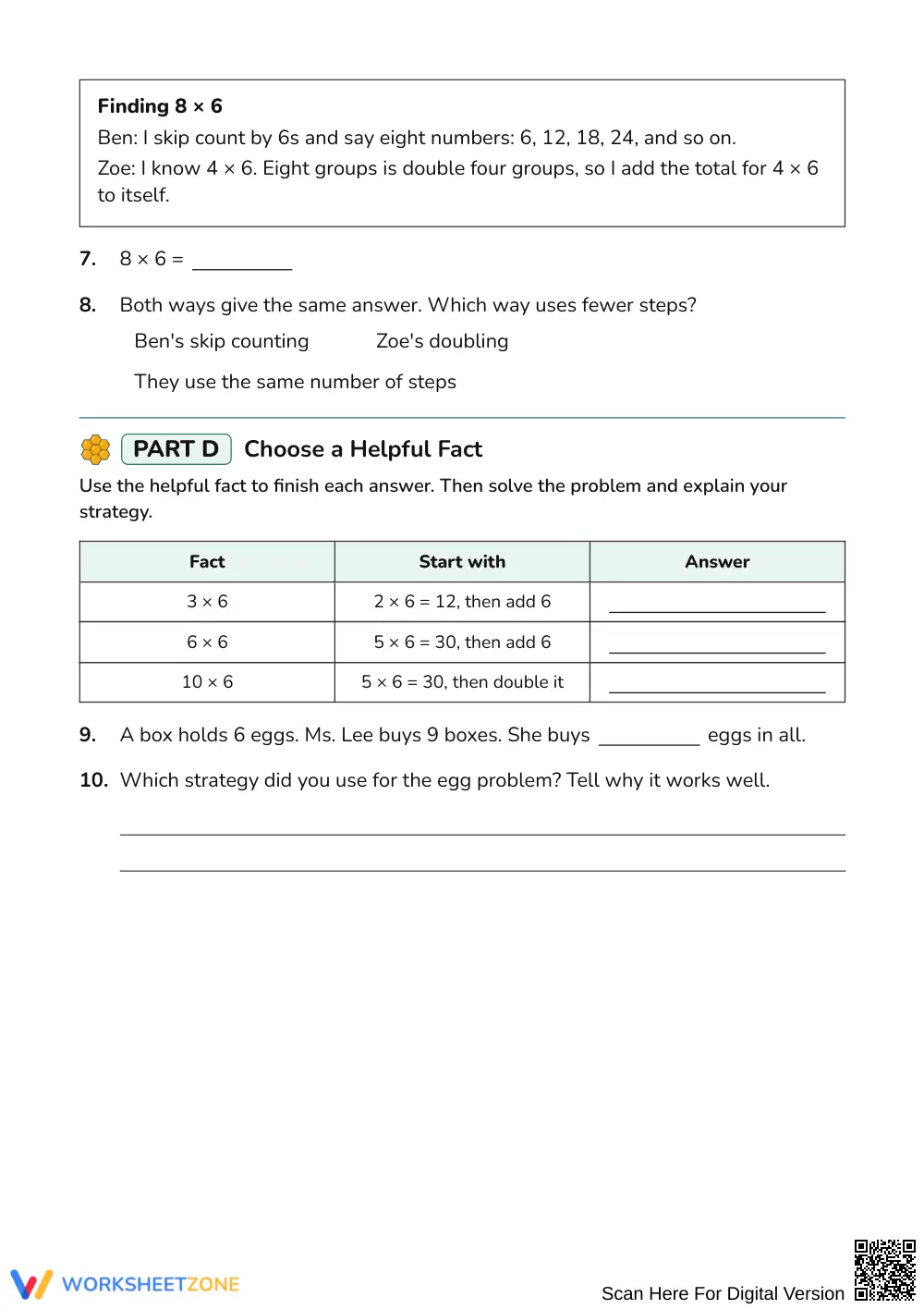
This Grade 3 math worksheet builds operational reasoning by guiding students to evaluate and compare strategies for multiplying by 6. Learners explore visual arrays, skip counting, known facts, and doubling methods to identify the most efficient solution paths for multiplication equations.
At a Glance
- Grade: 3 · Subject: Math
- Standard:
3.OA.B.5— Apply properties of operations as strategies to multiply and divide factors fluently- Skill Focus: Comparing multiplication strategy efficiency, visual representations, and student reasoning
- Format: 3 pages · 14 problems · Full answer key included · Printable PDF
- Best For: Guided practice and peer math discussions
- Time: 25–35 instructional minutes
What's Inside
Across 3 pages, students complete 14 problems analyzing multiplication by 6. Features include dot arrays, number line models, student dialogue speech boxes, and comparison tables. A 3-page answer key provides complete solutions, error analyses, and sample student explanations.
Skill Progression
- Guided Practice (Part A, 4 problems): Students compare dot arrays with skip counting, determining when adding one group of 6 is faster than counting.
- Supported Practice (Parts B and C, 6 problems): Learners analyze two student responses to spot calculation errors, then compare skip counting against doubling on a number line.
- Independent Practice (Part D, 4 problems): Students apply benchmark facts to solve new equations and justify their strategy for an egg carton word problem.
This progression follows the gradual release of responsibility model, moving students from guided visual analysis to independent strategy justification.
Standards Alignment
This worksheet aligns directly with 3.OA.B.5: Apply properties of operations as strategies to multiply and divide. Students use the distributive property to break products into manageable facts, such as decomposing 7 × 6 into (5 × 6) + (2 × 6). Supporting standard 3.OA.A.3 is integrated as learners solve equal-group word problems. Both standard codes can be copied directly into lesson plans, IEP goals, or district curriculum mapping tools.
How to Use It
Facilitate Parts A and B during direct instruction as a collaborative math talk comparing efficiency. Assign Parts C and D after instruction for paired practice. During work time, observe whether students recount by ones or apply benchmark facts like 5 × 6. Expected completion time is 25 to 35 minutes.
Who It's For
This resource serves Grade 3 students mastering multiplication strategies and Grade 4 students needing intervention on the distributive property. Visual models support English learners and students with math accommodations. Pair this worksheet directly with a lesson or anchor chart on benchmark multiplication facts.
Aligned to standard 3.OA.B.5, this instructional resource develops conceptual fluency by prompting students to compare multiplication strategy efficiency, evaluate representations, and critique peer reasoning when multiplying by 6. Grounded in research by Fisher & Frey (2014) on the gradual release of responsibility, the worksheet transitions third-grade mathematicians from scaffolded visual dot arrays and number lines to autonomous strategy selection and written justification. Rather than emphasizing rote memorization alone, the 14 structured tasks prompt learners to decompose difficult facts into known benchmarks, such as applying 5 × 6 to efficiently solve 7 × 6. Research confirms that evaluating contrasting mathematical strategies builds robust operational flexibility and conceptual understanding. This analytical comparison deepens algebraic thinking, equipping elementary students to articulate why decomposing factors and doubling known products outperforms inefficient unit counting during multi-step problem solving.


