































Complete Mountain Research Word Search | Grade 6 ELA

Paste this activity's link or code into your existing LMS (Google Classroom, Canvas, Teams, Schoology, Moodle, etc.).
Students can open and work on the activity right away, with no student login required.
You'll still be able to track student progress and results from your teacher account.
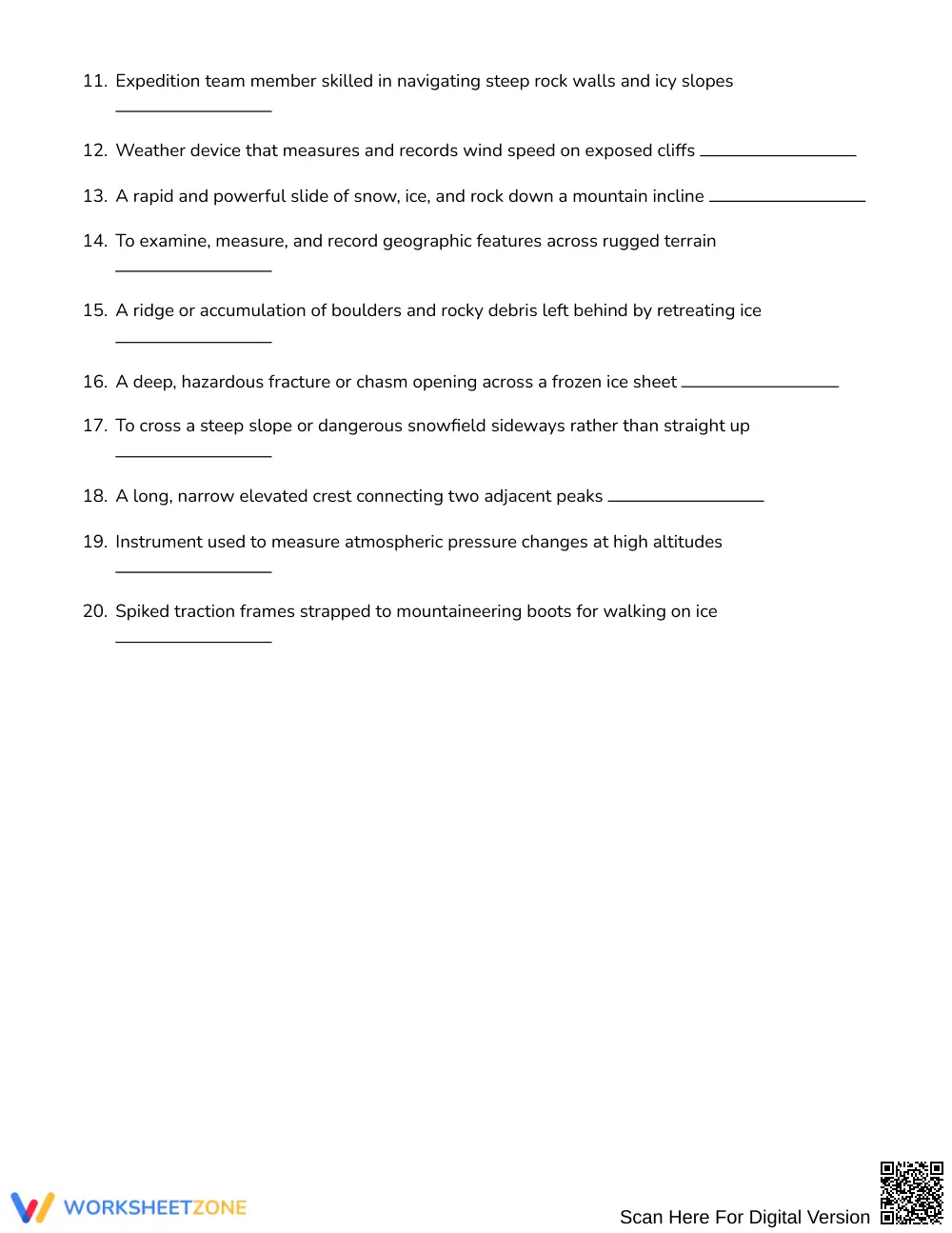
This Grade 6 mountain research camp word search builds domain-specific science vocabulary through clue-based puzzle solving. Students analyze 20 descriptive clues about alpine research, glaciology, and mountaineering tools to identify and locate target terms. This print-and-go activity strengthens informational text comprehension and scientific literacy during independent practice or interdisciplinary units.
At a Glance
- Grade: Grade 6 · Subject: English Language Arts (ELA) Vocabulary
- Standard: Not standards-assessed — vocabulary enrichment and content-area terminology
- Skill Focus: Mountain research camp domain-specific terminology
- Format: 3 pages · 20 words · Full answer key included · PDF
- Best For: Vocabulary enrichment, cross-curricular earth science connections, and purposeful fast finishers
- Time: 25–35 minutes
What's Inside
The 3-page printable activity features 20 words embedded within an alpine exploration theme. Rather than simply scanning for letters, students read scientific clues defining specialized equipment, environmental features, and expedition roles like glaciologist, barometer, and permafrost. The resource includes a shuffled word bank for flexible reference and 3 full-page answer keys showing exact grid coordinates for rapid checking.
Puzzle Mechanics and Structure
This clue detective activity is constructed on a 20 x 20 letter grid containing 20 hidden vocabulary terms. Words run in four specific orientations: northeast, east, southeast, and south. Learners inspect detailed clues for each entry, solve for the corresponding academic term, and locate the matching letter sequences within the scrambled letter matrix using the shuffled word bank as an optional reference guide.
Standards Alignment
This word search serves strictly as vocabulary enrichment and is not aligned to a standard. It supports domain-specific language acquisition in middle school ELA and earth science by immersing students in authentic technical terms related to alpine geography, meteorology, and scientific field expeditions.
How to Use It
This activity functions effectively during two distinct instructional moments. First, assign it after direct instruction on informational text features as an engaging application of contextual clue deciphering. Second, deploy it before an earth science unit on glaciers to activate background knowledge. As students search, circulate formatively to observe whether they deduce words from clues directly or rely heavily on the letter bank. Completion typically requires 25 to 35 minutes.
Who It's For
This resource is tailored for Grade 6 general education classrooms, cross-curricular science literacy blocks, and enrichment groups. Differentiate support by highlighting first letters for striving readers or encouraging advanced students to define terms without looking at the word bank. Pair this activity naturally with an informational reading passage describing high-altitude field research expeditions in the Himalayas or Rocky Mountains.
Designed for Grade 6 learners, this mountain research camp word search emphasizes domain-specific vocabulary acquisition and contextual deduction across 20 specialized scientific terms. Although not aligned to an assessed state standard, this enrichment resource reinforces high-utility disciplinary language including glaciology and expedition terminology. Grounded in research by Fisher & Frey (2014) regarding intentional vocabulary instruction, purposeful word-learning tasks that require learners to connect descriptive definitions with orthographic letter patterns support long-term memory retention and conceptual understanding. The puzzle format challenges middle school students to synthesize geological concepts while locating vocabulary oriented in four distinct spatial directions. By pairing comprehensive clues with independent spatial analysis, educators can reinforce content-area literacy without extra preparation. The completed activity provides tangible evidence of morphological recognition and scientific literacy, confirming that students can identify, interpret, and contextualize specialized environmental vocabulary across diverse academic reading contexts.


