





























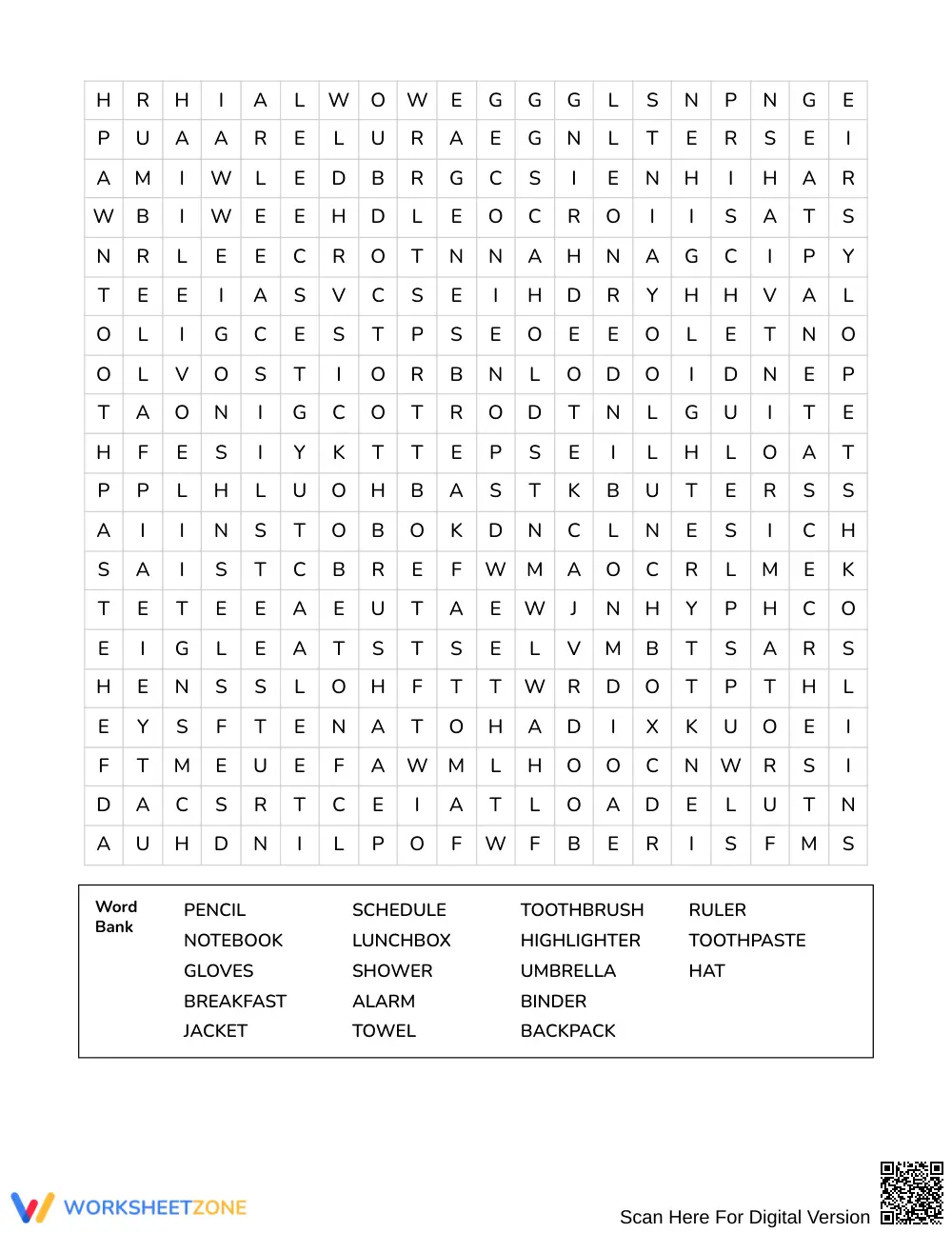


Complete Morning Routine Word Search | Grades 7–8 ELA

Paste this activity's link or code into your existing LMS (Google Classroom, Canvas, Teams, Schoology, Moodle, etc.).
Students can open and work on the activity right away, with no student login required.
You'll still be able to track student progress and results from your teacher account.
This Grades 7–8 vocabulary word search builds lexical familiarity with functional morning routine terminology, school readiness habits, and personal responsibilities. Students examine definitional clues to locate 18 theme-related terms hidden across the grid, reinforcing spelling patterns, active recall, and contextual connections without requiring extended teacher delivery.
At a Glance
- Grade: Grades 7–8 · Subject: English Language Arts (ELA)
- Standard: Not standards-assessed — vocabulary enrichment
- Skill Focus: Objects actions and responsibilities
- Format: 3 pages · 18 words · Answer key included · PDF
- Best For: Bell ringer, homeroom, or vocabulary review
- Time: 15–25 minutes
What's Inside
This 3-page printable activity delivers a substantial letter puzzle accompanied by a definitional clue sheet and a comprehensive 3-page answer key showing all circled targets. Rather than a simple surface-level matching task, students read functional clues describing daily preparation tools and duties—ranging from personal hygiene items to academic supplies—to identify each vocabulary item before finding it.
Puzzle Mechanics & Design
The activity is built on a dense 20 × 20 letter grid containing 18 embedded vocabulary words. Word entries run in all 8 directions: north, northeast, east, southeast, south, southwest, west, and northwest, providing an engaging cognitive search challenge for secondary learners. Students use a shuffled word bank supported by functional sentence clues that define items like binders, schedules, and hygiene essentials, fostering active orthographic scanning and contextual word recognition.
Standards Alignment
This activity is designed purely for vocabulary enrichment and language reinforcement and is not aligned to a formal academic standard. It supports foundational literacy and executive functioning awareness by prompting students to connect daily practical responsibilities with their precise written forms.
How to Use It
Deploy this word search as an engaging morning bell ringer during homeroom advisory or as a calm transition activity following direct instruction on functional life skills and organizational routines. During independent seatwork, circulate to note whether students rely on the descriptive clues to determine target words or default to raw letter scanning; prompt struggling decoders to underline clue keywords first. Most middle school learners will finish within 15 to 25 minutes.
Who It's For
This resource serves general education classrooms, English language learners developing everyday school vocabulary, and special education students practicing independent task initiation. It pairs naturally with executive functioning mini-lessons, daily planner setup units, or practical life-skills anchor charts.
Vocabulary acquisition research emphasized by Fisher & Frey (2014) demonstrates that structured encounters with domain-specific and practical words strengthen reading comprehension, orthographic memory, and language processing. Integrating definition-driven word searches enables secondary learners to consolidate semantic associations through active visual engagement. As students scan the 20 × 20 grid across multiple orientations, they repeatedly process orthographic letter strings while linking target vocabulary to personal responsibilities and daily morning routines. This sustained exposure develops rapid word recognition and reinforces key executive habits, ensuring that students internalize functional school-readiness terminology in an accessible, low-anxiety instructional format that directly supports independent academic literacy.


