

































Complete Momentum & Impulse Worksheet | Grades 8-12 Science

Paste this activity's link or code into your existing LMS (Google Classroom, Canvas, Teams, Schoology, Moodle, etc.).
Students can open and work on the activity right away, with no student login required.
You'll still be able to track student progress and results from your teacher account.
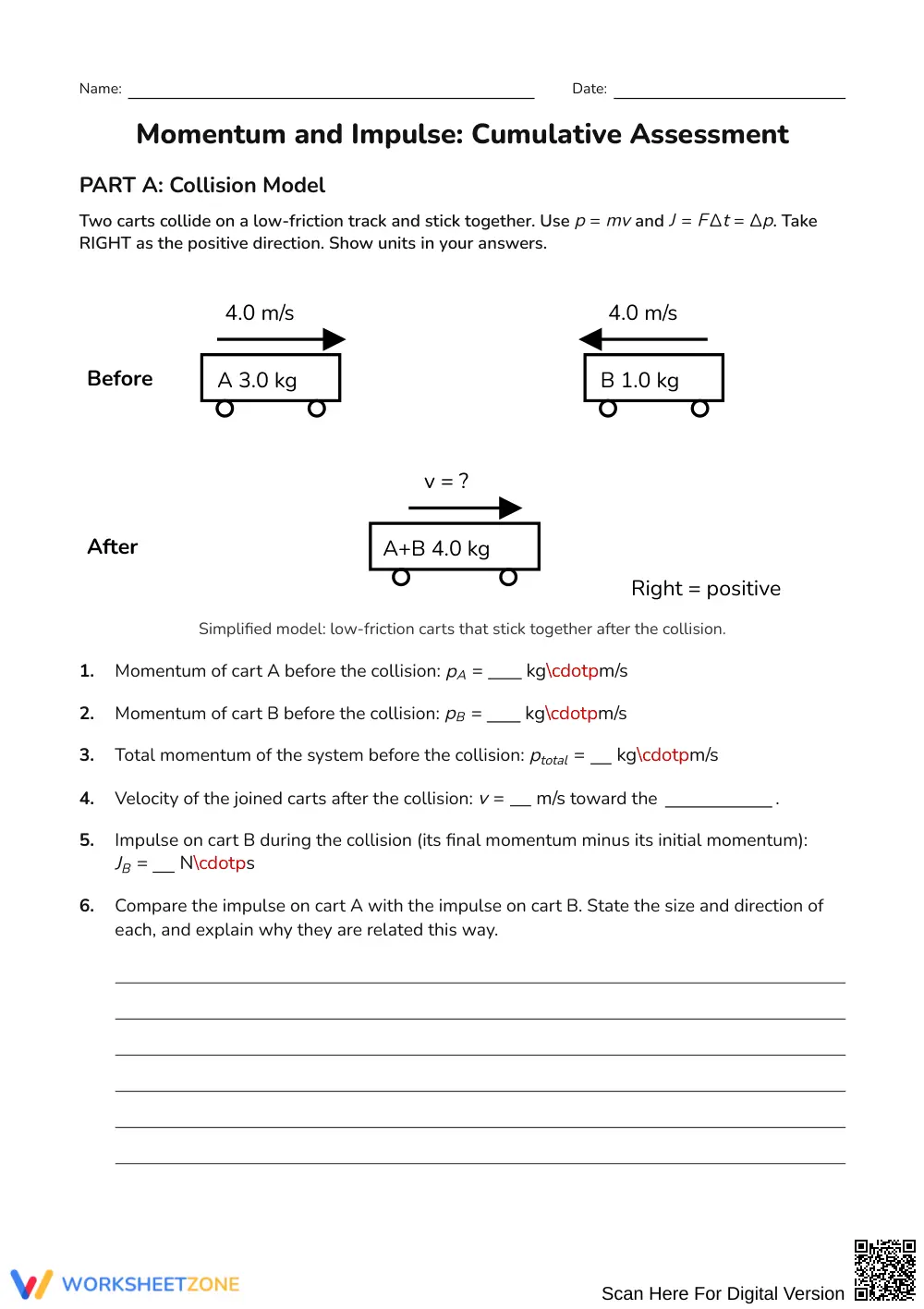
This comprehensive physical science worksheet guides secondary students through quantitative momentum conservation, impulse-momentum relationships, force-time graph analysis, and vehicle safety engineering. Students examine multi-step collision models, calculate area under curves to determine impulse, evaluate conceptual misconceptions using data tables, and apply force-time trade-offs to automotive safety designs.
At a Glance
- Grade: 8–12 · Subject: Science
- Standard: Apply physical laws to predict motion changes and analyze impulse-momentum relationships during collisions
- Skill Focus: Momentum conservation, impulse calculation, and safety applications
- Format: 4 pages · 21 problems · Answer key included · PDF
- Best For: Cumulative physics review and assessment
- Time: 45–60 minutes
What's Inside
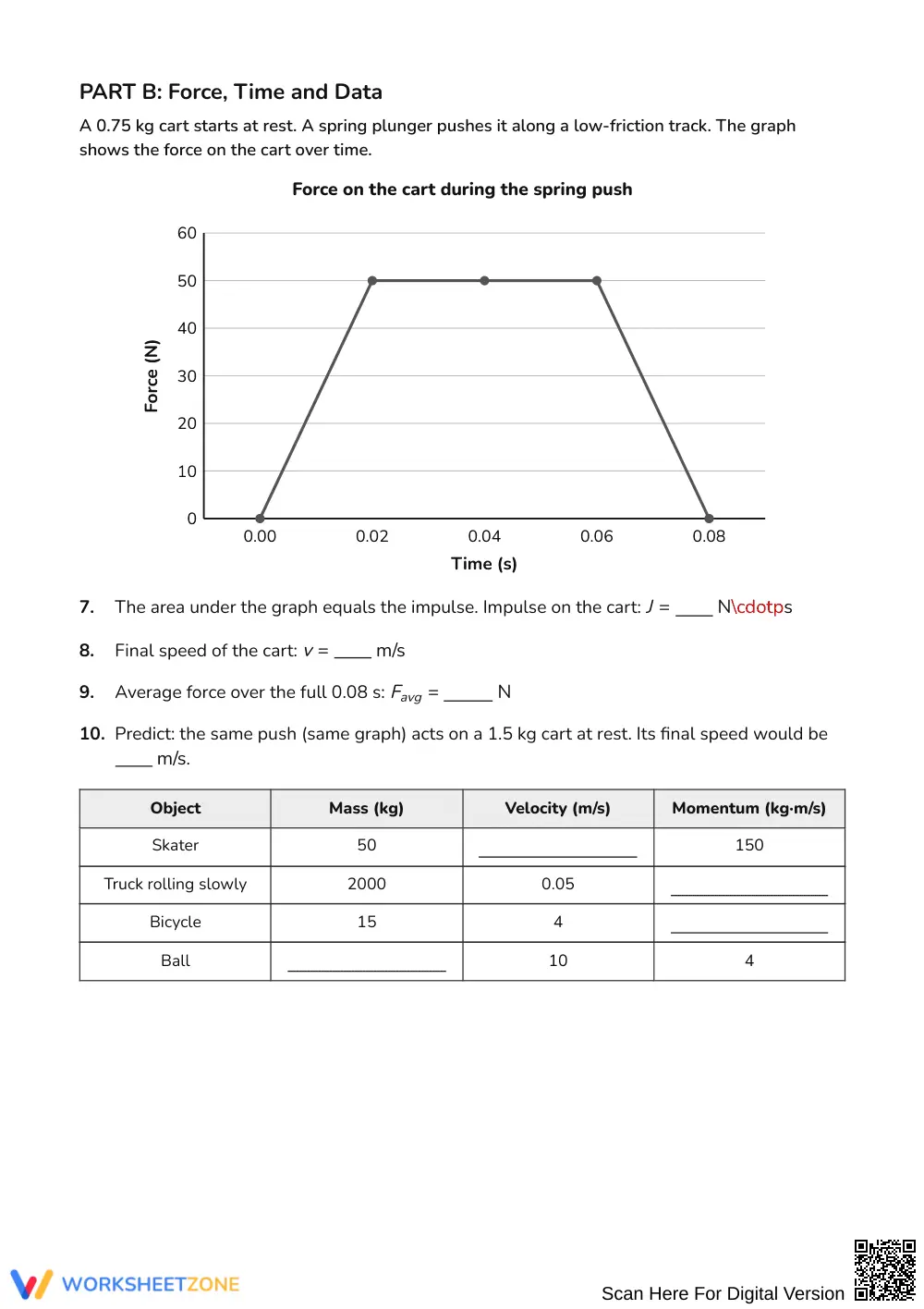
This 4-page assessment features 21 targeted tasks organized into three distinct parts: a mathematical collision system, a force-time graph interpretation with data analysis, and qualitative engineering design applications. The resource includes explicit equation headers (p = mv and J = FΔt = Δp), coordinate-based graph values, comparative data sets, and a complete 4-page teacher answer key displaying full numerical solutions and conceptual explanations.
Skill Progression
- Guided Practice: Tasks 1–7 establish foundational mathematical relationships using an inelastic cart collision model on a low-friction track, prompting students to calculate individual momentum, system momentum, and vector impulses.
- Supported Practice: Tasks 8–14 transition to graphical and tabular analysis, requiring learners to calculate area under a force-time graph, derive final velocity, compute average force, and refute common mass-momentum misconceptions using comparative data.
- Independent Practice: Tasks 15–21 challenge students to synthesize physical principles by comparing vehicle crash test designs, calculating collision impact forces, identifying safety mechanisms that extend stopping time, and explaining physiological impacts during athletic landings.
This sequence mirrors the gradual-release framework, scaffolding from formulaic calculation to conceptual justification and engineering evaluation.
Standards Alignment
This worksheet addresses secondary physical science standards focused on Newton's third law of motion, the impulse-momentum theorem, and the design of solutions that minimize collision forces. Students synthesize mathematical modeling with real-world technological design. Both standard codes can be copied directly into lesson plans, IEP goals, or district curriculum mapping tools.
How to Use It
Administer this worksheet after direct instruction on linear momentum and Newton's laws. It functions effectively as a paired problem-solving activity during class or as a summative unit assessment. During the activity, check whether students account for directional signs in Part A and correctly interpret the area under the force-time curve in Part B. Expected student completion time ranges from 45 to 60 minutes.
Who It's For
Designed for introductory physical science and high school physics classrooms, this resource supports diverse learners through structured data tables and defined formulas. Pair this assessment with an interactive dynamic cart collision laboratory or automotive crash-test demonstration.
According to Fisher & Frey (2014), structured instructional progressions that transition from visual-quantitative models to real-world evaluative writing significantly deepen conceptual retention in STEM domains. This worksheet operationalizes that research by leading students through 21 carefully sequenced tasks covering momentum conservation, impulse calculation, graphical data synthesis, and vehicle crumple zone mechanics. Rather than presenting isolated computational drills, the resource integrates Newton's third law with empirical force-time graphs and authentic impact scenarios. By requiring learners to analyze how extended collision durations reduce average impact forces, the material bridges mathematical calculation and physical intuition. The self-contained 4-page format and matching answer key provide educators with an authentic instrument to gauge student mastery of impulse and momentum dynamics.


