
































Complete Momentum & Impulse Worksheet | Grade 8-12 Science

Paste this activity's link or code into your existing LMS (Google Classroom, Canvas, Teams, Schoology, Moodle, etc.).
Students can open and work on the activity right away, with no student login required.
You'll still be able to track student progress and results from your teacher account.
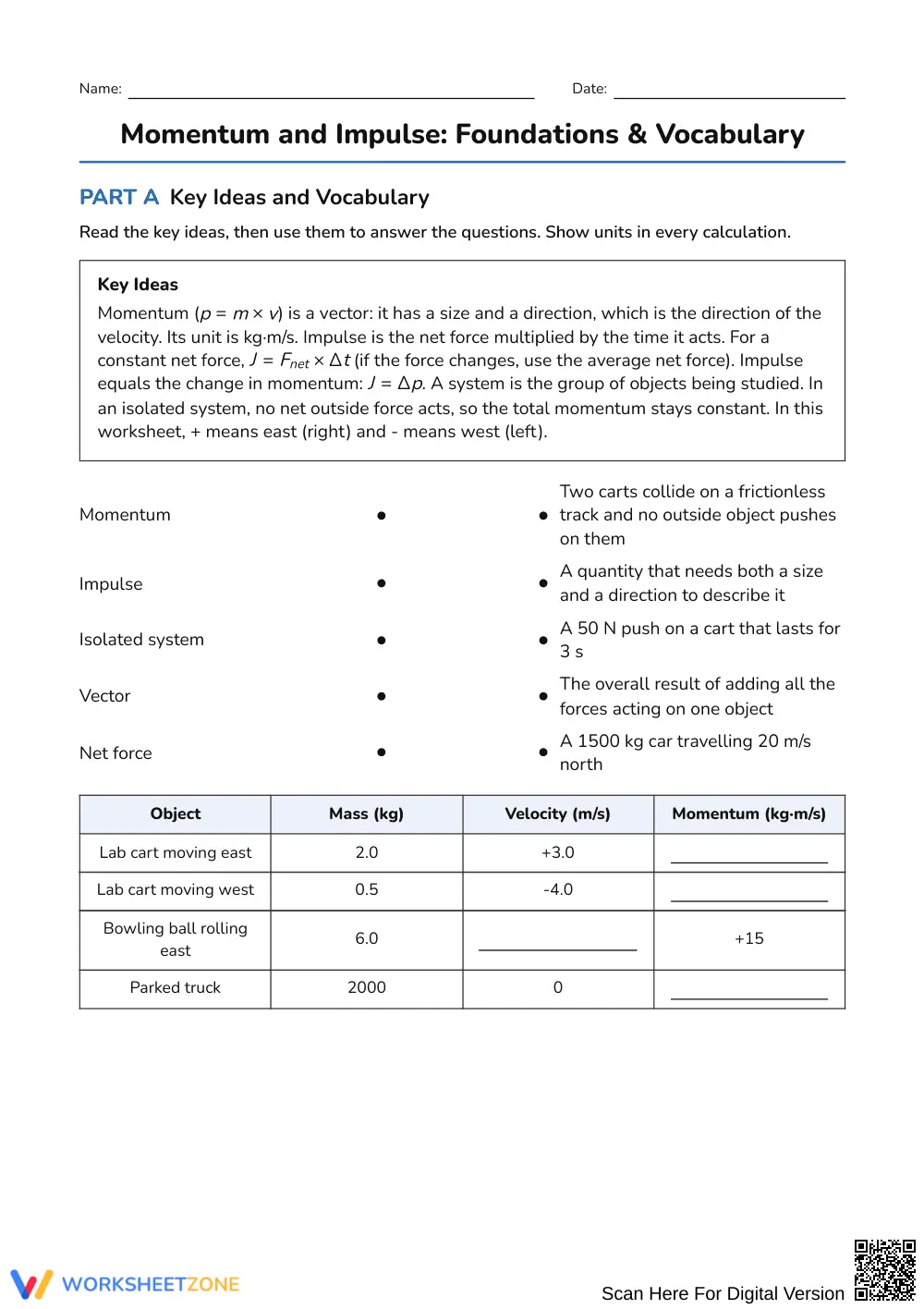
This momentum and impulse worksheet provides students with targeted practice defining key physics vocabulary, calculating linear momentum, and evaluating common conceptual misconceptions. Through structured scenarios, learners calculate vector quantities, interpret collision models, and relate applied net force and contact time to momentum changes across real-world physical systems.
At a Glance
- Grade: Grades 8–12 · Subject: Science
- Standard: Physical Science — Calculate momentum and impulse, analyze simple collision models, and address velocity misconceptions
- Skill Focus: Momentum and impulse foundations and vocabulary
- Format: 3 pages · 20 problems · Answer key included · PDF
- Best For: Physics introductory practice and misconception checks
- Time: 40–50 minutes
What's Inside
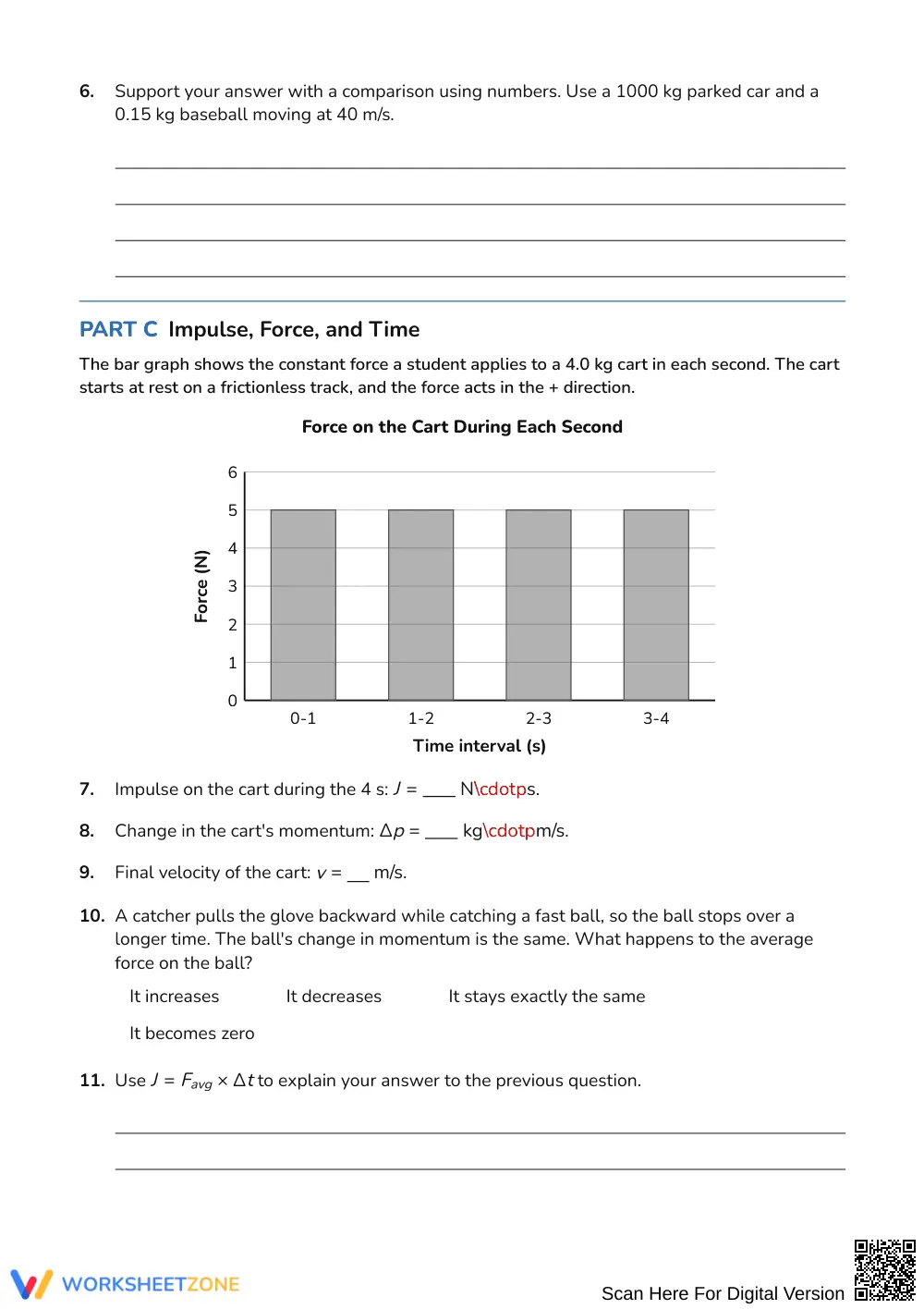
This 3-page printable resource features 20 focused items across three distinct learning sections. Students review core definitions with an embedded reference box, populate a momentum data table, evaluate collision scenarios on frictionless tracks, and examine force-time relationships using bar graphs. A matching 3-page answer key provides complete calculations, proper vector directions, and exemplar conceptual explanations.
Skill Progression
The worksheet follows a structured gradual-release sequence across three scaffolded sections:
- Guided practice (Part A): Students use clear definitions and sign conventions to define terms and complete 8 foundational table entries calculating momentum via mass and velocity.
- Supported practice (Part B): Students interpret isolated collision models and resolve common misconceptions through 6 structured tasks comparing moving objects to stationary high-mass objects.
- Independent practice (Part C): Students solve 6 analytical problems connecting force, contact time, and impulse graphs to stopping mechanics.
This intentional sequence moves from teacher-guided definitions to autonomous conceptual transfer, reinforcing the I Do, We Do, You Do instructional framework.
Standards Alignment
This resource aligns with physical science standards for forces and motion, requiring students to calculate momentum changes in isolated systems. Supporting standards address Newton's third law and force-time interactions. Both standard codes can be copied directly into lesson plans, IEP goals, or district curriculum mapping tools.
How to Use It
Deploy this worksheet immediately following direct instruction on Newton's laws to clarify the distinction between inertia and momentum. During individual or partner work, circulate to check Part B and verify that students do not equate mass alone with momentum. The resource functions effectively as an in-class assignment requiring 40 to 50 minutes.
Who It's For
This activity supports secondary physical science and physics students developing quantitative mechanics skills. Directional sign keys and graphic models support developing problem solvers. Pair this printable with an interactive collision simulation to provide visual confirmation of momentum conservation before students complete written explanations.
Physical science standards require secondary students to understand linear momentum, impulse, and conservation laws through qualitative reasoning and quantitative calculation. This 20-item foundational worksheet systematically guides learners through momentum formulas, vector directions, and force-time interactions to dispel persistent mechanical misconceptions. Grounded in the instructional framework outlined by Fisher & Frey (2014), the resource scaffolds conceptual progression from explicit reference definitions to collision analysis and independent impulse problem-solving. By structuring tasks that require learners to contrast high-mass stationary objects with low-mass moving projectiles, the resource targets the common intuitive error that mass alone determines momentum. Complete calculation steps and written explanations within the 3-page answer key enable accurate formative evaluation, peer review, and targeted remediation. Consequently, educators receive an efficient, standards-focused tool that solidifies mechanics vocabulary, bridges proportional reasoning with physical phenomena, and prepares students for advanced collision dynamics.


