































Complete Momentum Conservation Worksheet | Grade 12 Physics

Paste this activity's link or code into your existing LMS (Google Classroom, Canvas, Teams, Schoology, Moodle, etc.).
Students can open and work on the activity right away, with no student login required.
You'll still be able to track student progress and results from your teacher account.
This Grade 12 physics worksheet provides rigorous practice in analyzing momentum conservation, impulse, and one-dimensional collisions. Students calculate total system momentum, determine post-collision velocities for elastic and inelastic interactions, evaluate kinetic energy dissipation, and interpret force-time graphs. The multi-step problems prepare advanced learners for AP Physics Mechanics exams and university-level kinematics coursework.
At a Glance
- Grade: 12 · Subject: Physics
- Standard: Mechanics — Apply conservation of linear momentum and impulse-momentum relations in collisions
- Skill Focus: Solve a Momentum-Conservation Problem
- Format: 5 pages · 10 problems · Answer key included · PDF
- Best For: Advanced mechanics practice and exam review
- Time: 45–60 minutes
What's Inside
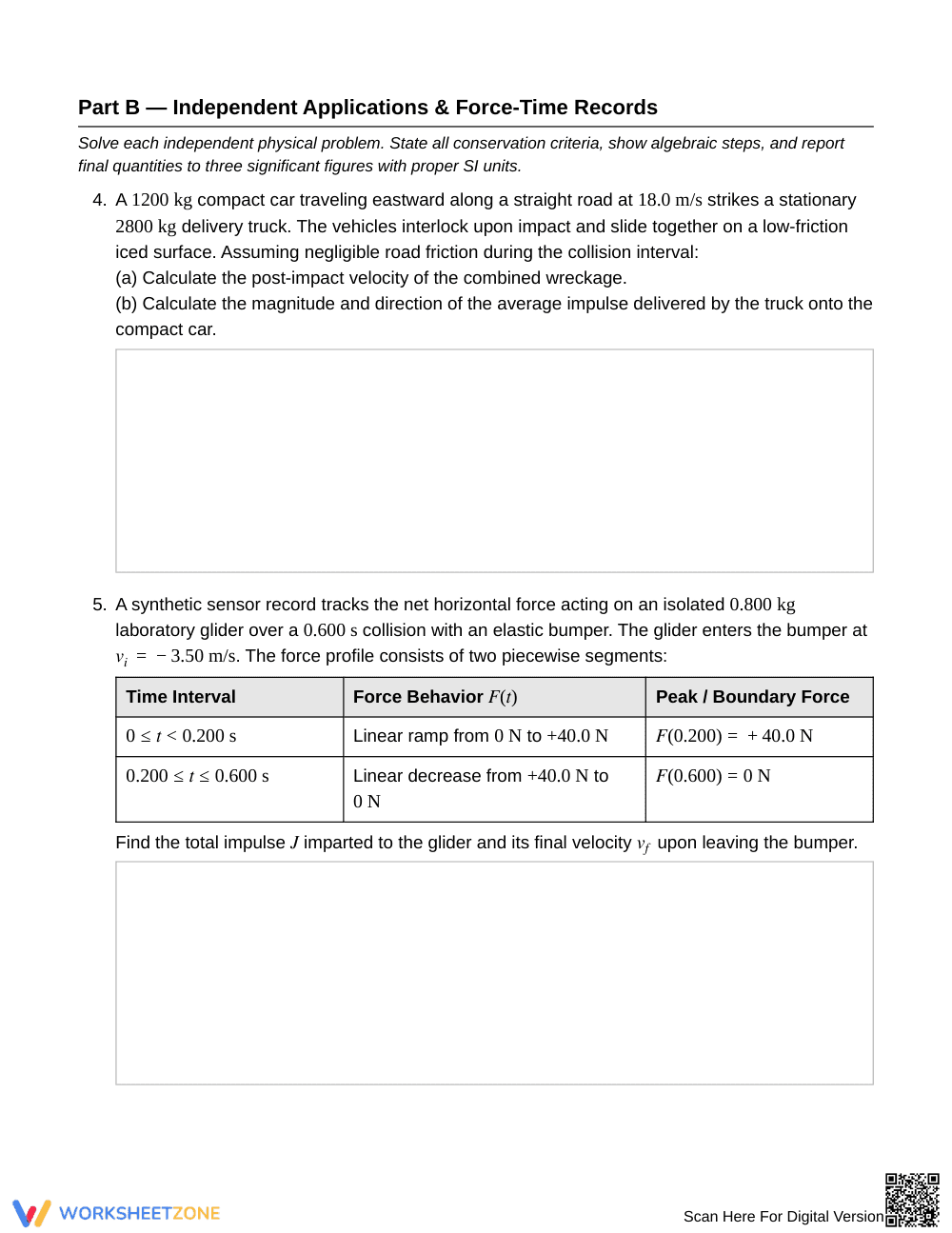
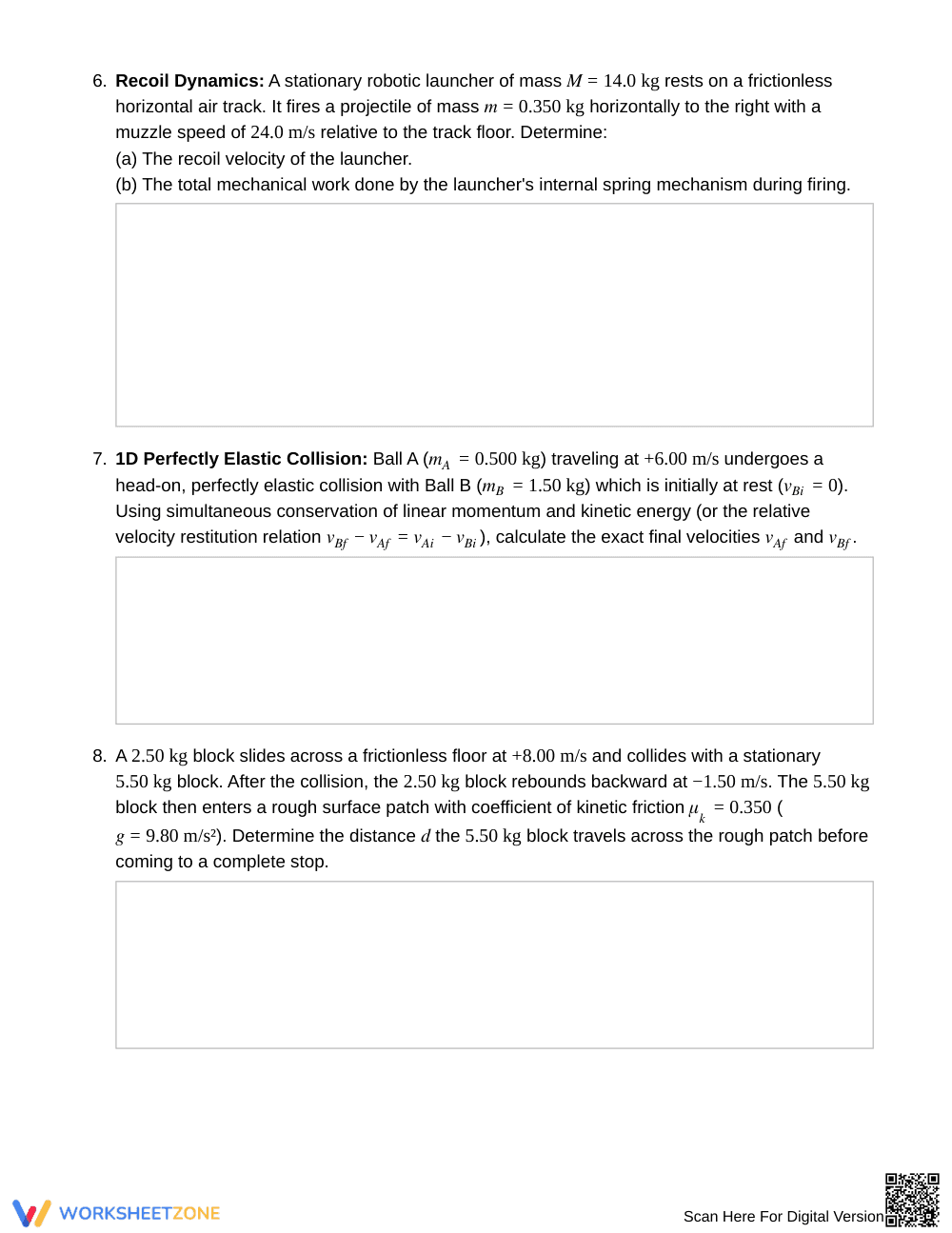
This 5-page printable PDF features 10 structured physics tasks paired with a comprehensive 3-page worked answer key. The resource opens with governing equations and two complete reference models. Students complete a 3-step scaffolded collision analysis, tackle 5 multi-step computational problems involving recoil dynamics and force-time integrals, and write 2 conceptual arguments evaluating vehicle safety and internal forces.
Skill Progression
- Guided practice: Students review governing formulas and 2 fully worked models demonstrating inelastic collisions and triangular force-pulse impulse calculations.
- Supported practice: Part A provides a 3-step scaffolded sequence where students compute initial momentum, solve for coupled velocities, and quantify kinetic energy loss.
- Independent practice: Parts B and C deliver 7 rigorous multi-part problems covering elastic collisions, spring recoil, friction deceleration, and conceptual critique.
This sequence implements a gradual-release architecture, transitioning students systematically from guided model analysis to independent algebraic derivation.
Standards Alignment
This worksheet aligns directly with high school physics and AP Mechanics standards for linear momentum and impulse. Students calculate vector momentum conservation in isolated systems, relate impulse integrals to momentum changes, and contrast mechanical energy dissipation in inelastic collisions. Both standard descriptions can be copied directly into lesson plans, IEP goals, or district curriculum mapping tools.
How to Use It
Deploy this worksheet immediately after direct instruction on the impulse-momentum theorem or as an intensive AP Physics exam review packet. For formative assessment during independent work, observe how students assign directional vector signs in Part A; sign errors when summing velocities in opposite directions indicate a need for immediate intervention. The full assignment requires 45 to 60 minutes of focused analytical work.
Who It's For
This resource is designed for Grade 12 physics and AP Physics C students preparing for calculus- and algebra-based mechanics assessments. It offers built-in scaffolding for students refining their sign conventions while providing rigorous friction and recoil challenges for advanced learners. Pair this printable with a frictionless air-track laboratory investigation or a dynamic digital cart simulation.
According to research by Fisher & Frey (2014) on the gradual release of responsibility model, structured transitions from worked reference examples to independent problem-solving significantly boost student mastery in complex STEM disciplines. When Grade 12 physics learners solve momentum-conservation problems, beginning with explicit governing equations and modeled inelastic collisions reduces cognitive load before they encounter piecewise force-time functions, recoil mechanics, and multi-variable elastic collision systems. Scaffolded steps that prompt students to calculate initial momentum, determine coupled final velocities, and evaluate kinetic energy dissipation bridge conceptual reasoning with quantitative computation. Furthermore, requiring written critiques of common misconceptions regarding internal forces reinforces genuine conceptual mastery alongside mathematical execution. This balanced instructional progression ensures high school physics students develop durable problem-solving strategies, accurate vector sign handling, and analytical fluency required for advanced mechanics coursework and standardized college-preparatory assessments.


