































Complete Molar Mass Worksheet | Grades 9-12 Science

Paste this activity's link or code into your existing LMS (Google Classroom, Canvas, Teams, Schoology, Moodle, etc.).
Students can open and work on the activity right away, with no student login required.
You'll still be able to track student progress and results from your teacher account.
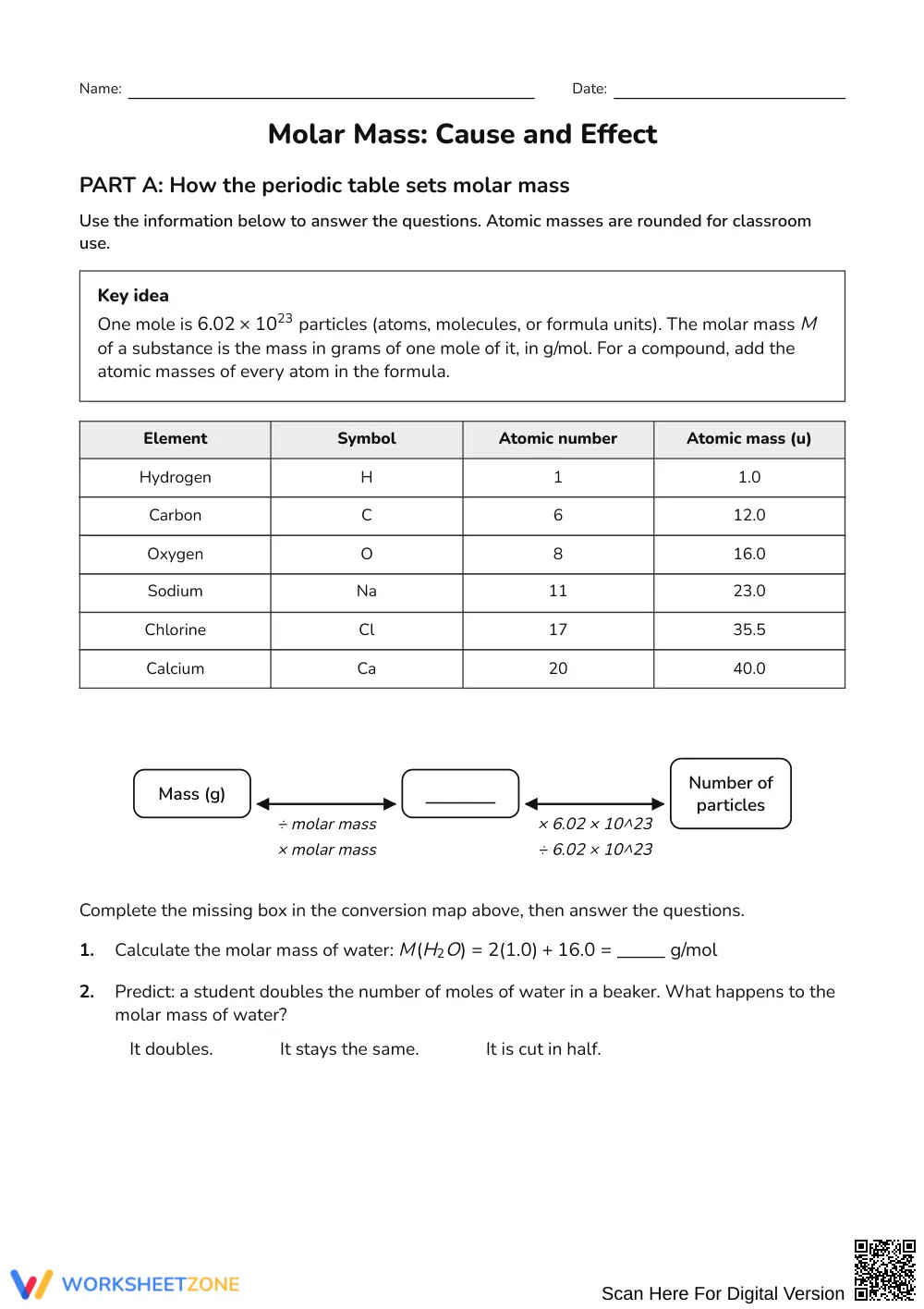
This comprehensive chemistry worksheet guides high school students through calculating molar mass, interpreting particle models, and applying quantitative cause-and-effect reasoning. Students connect atomic mass data from the periodic table to macroscopic masses, analyze molar mass graphically as a physical slope, and verify conservation of matter during chemical reactions.
At a Glance
- Grade: Grades 9–12 · Subject: Chemistry / Physical Science
- Standard: Calculate formula mass and convert between mass, moles, and particles
- Skill Focus: Molar mass calculations and cause-and-effect modeling
- Format: 4 pages · 20 problems · Answer key included · PDF
- Best For: Quantitative stoichiometry introduction and guided practice
- Time: 45–60 minutes
What's Inside
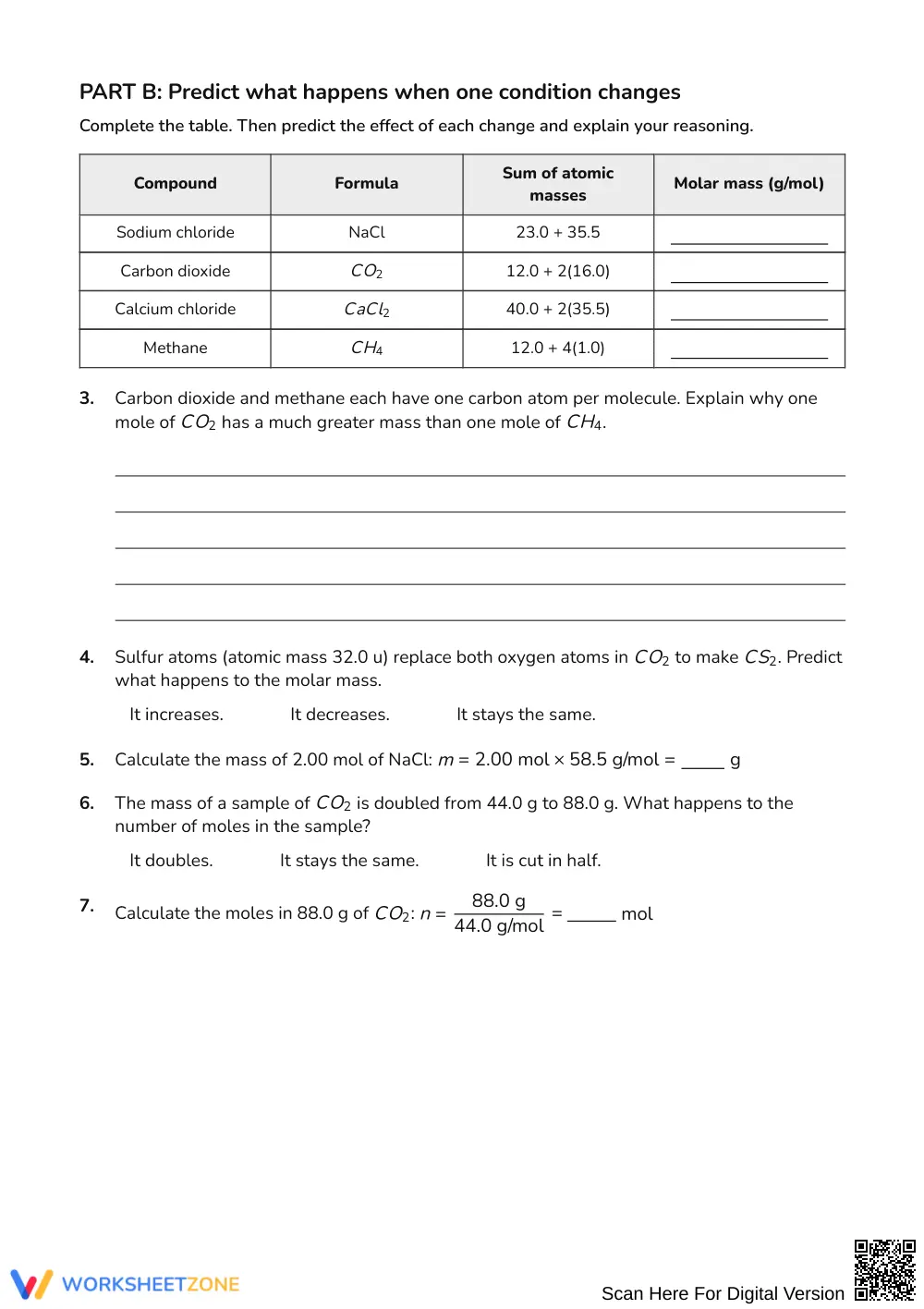
Across 4 structured pages, this resource delivers 20 targeted tasks featuring an element data reference table, formula calculation grids, linear mass-versus-amount graphs, and combustion reaction scenarios. An identical 4-page answer key provides step-by-step arithmetic setups and conceptual explanations to support rapid grading.
Skill Progression
- Guided practice: Tasks 1–5 provide an element mass table and conversion diagram, walking students through atomic mass summation and basic definitions of Avogadro's number.
- Supported practice: Tasks 6–13 prompt students to predict how altering formula composition or sample mass affects total grams and molar quantities across compounds like NaCl, CO₂, and CaCl₂.
- Independent practice: Tasks 14–20 require learners to interpret graphic slope as molar mass, critique misconceptions regarding sample mass versus particle count, and explain mass conservation in combustion.
This sequence embodies the gradual-release framework, moving learners smoothly from basic atomic mass addition to rigorous conceptual analysis.
Standards Alignment
This worksheet aligns with high school physical science standards addressing chemical quantities and conservation of matter. Students use mathematical representations of chemical formulas to calculate molar masses, convert between mass and mole units, and demonstrate that atoms are neither created nor destroyed during chemical rearrangements. Both standard descriptions can be copied directly into lesson plans, IEP goals, or district curriculum mapping tools.
How to Use It
Deploy this resource immediately after direct instruction on the mole concept and periodic table masses. During guided group work, observe student responses on Part C to catch the frequent misconception that heavier molar masses contain more particles. Expect the full 20-problem sequence to take between 45 and 60 minutes.
Who It's For
Designed for general chemistry, honors chemistry, and introductory physical science classes. Scaffolded arithmetic grids support emerging math learners, while the graphical slope analysis challenges advanced thinkers. Pair this printable with a laboratory balance demonstration measuring 1-mole samples of common elements.
According to Fisher & Frey (2014), structured scaffolds that pair mathematical problem-solving with qualitative explanations significantly deepen conceptual retention in secondary science. This 4-page worksheet systematically reinforces the principle that molar mass functions as a characteristic physical conversion factor rather than an arbitrary tally. By demanding that students reconcile numerical calculations with particle-level models, the resource helps high school chemists distinguish clearly between individual atomic mass and macroscopic sample mass. The scaffolded progression from isolated formula calculations to graphical slope interpretation ensures students build robust mental models before tackling multi-step stoichiometric equations in advanced chemistry coursework.


