































Complete Molar Mass Errors Worksheet | Grades 9-12 Science

Paste this activity's link or code into your existing LMS (Google Classroom, Canvas, Teams, Schoology, Moodle, etc.).
Students can open and work on the activity right away, with no student login required.
You'll still be able to track student progress and results from your teacher account.
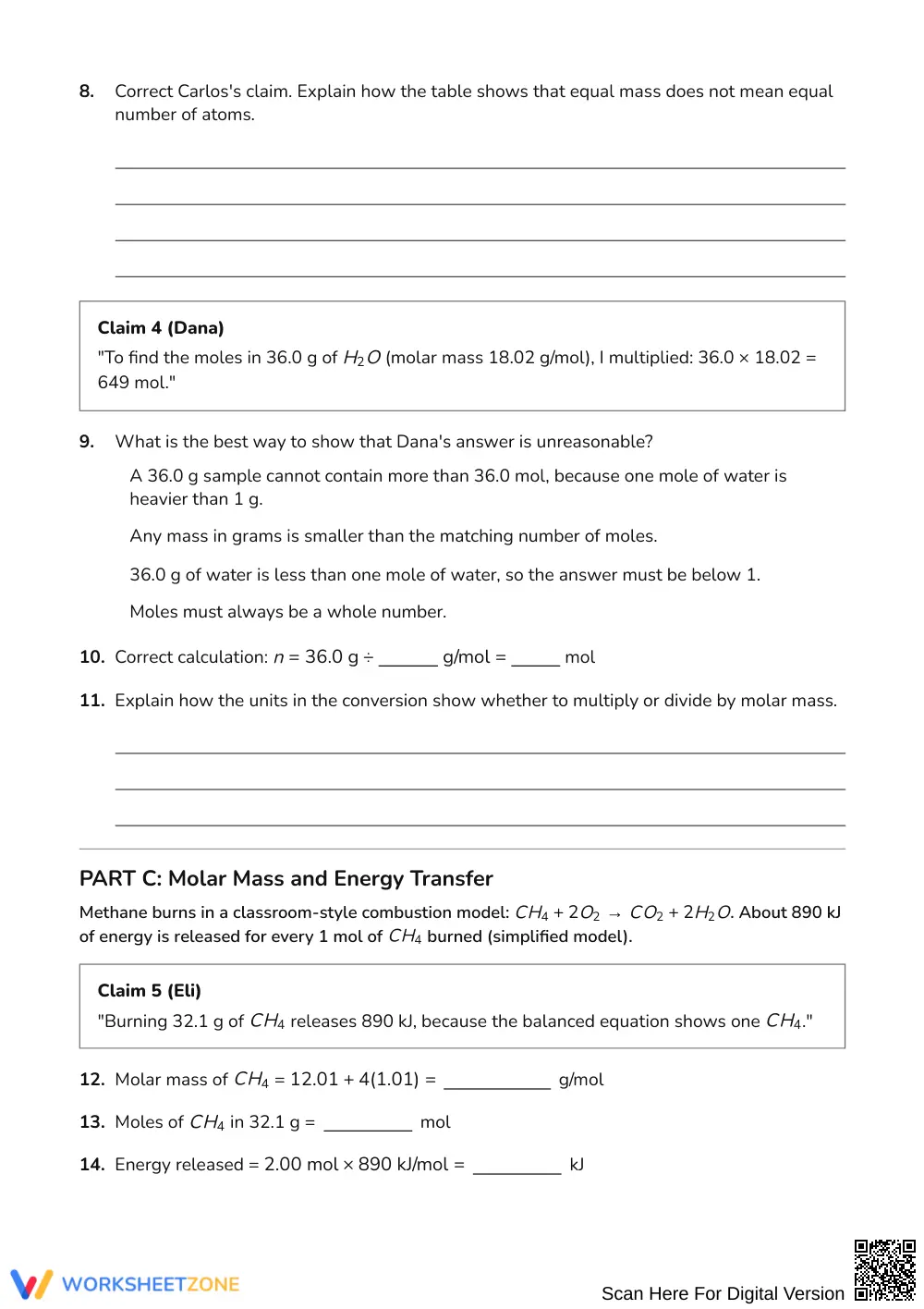
This molar mass error analysis worksheet develops high school chemistry students' quantitative literacy by diagnosing formula and conversion misconceptions. Students evaluate peer claims, calculate molar masses from periodic table data, and justify their reasoning using particulate models, connecting mechanical computations to conceptual mastery.
At a Glance
- Grade: Grades 9–12 · Subject: Science (Chemistry)
- Standard: Physical Science — Calculate molar mass and analyze student claims using mole conversions
- Skill Focus: Misconception analysis in molar mass
- Format: 4 pages · 28 problems · Complete answer key included · Printable PDF
- Best For: High school chemistry misconception remediation
- Time: 45–60 minutes
What's Inside
This 4-page worksheet guides students through 28 tasks targeting common stoichiometric errors. Students reference an atomic mass data table, answer multiple-choice error identification questions, and complete atom-counting calculation charts. The resource includes particulate explanation prompts, a self-regulation checklist, and a full 4-page answer key with step-by-step solutions.
Skill Progression
- Guided Practice (Part A, 10 tasks): Students identify formula errors involving subscripts and parentheses using structured atom-count charts.
- Supported Practice (Part B, 10 tasks): Learners evaluate claims equating mass to mole quantities using formula n = m/M and unit analysis.
- Independent Practice (Part C, 8 tasks): High schoolers independently analyze a thermochemical claim and synthesize an error-prevention checklist.
This gradual-release sequence scaffolds student reasoning from error identification to independent formula verification.
Standards Alignment
This resource aligns with high school physical science standards requiring mathematical representations to support matter conservation during chemical reactions. Students apply mole concepts and molar mass calculations to evaluate quantitative claims. Both standard codes can be copied directly into lesson plans, IEP goals, or district curriculum mapping tools.
How to Use It
Deploy this worksheet after direct instruction on molar mass and gram-mole conversions. Have students work in pairs to debate the five peer claims during class. As a formative check, observe whether students distribute subscripts across parentheses in Ca(OH)₂. Expected completion time is 45 to 60 minutes.
Who It's For
This activity supports high school chemistry students in general or honors tracks. Struggling learners benefit from explicit atom-count tables, while advanced students evaluate energy stoichiometry. Pair this worksheet with a periodic table and a lesson on mole conversions.
High school chemistry standards emphasize quantitative reasoning, requiring students to calculate molar mass, convert between grams and moles, and justify particulate relationships. According to Fisher & Frey (2014), engaging learners in structured error analysis fosters robust metacognition and deeper conceptual understanding than repetitive computation alone. This 4-page worksheet addresses pervasive chemistry misconceptions regarding chemical subscripts, parentheses distribution, and mass-versus-mole equivalence through 28 carefully sequenced tasks. By analyzing flawed student claims and defending correct solutions, learners synthesize particulate models with mathematical algorithms. The gradual progression moves from identifying subscript mistakes to troubleshooting dimensional analysis units and calculating reaction energy. When paired with explicit modeling and guided reflection, this structured error analysis provides secondary educators with high-leverage formative data, ensuring students achieve rigorous conceptual mastery before advancing into multi-step stoichiometry and limiting reactant problem sets.


