



























Complete Metric System: Multiple Representations
Paste this activity's link or code into your existing LMS (Google Classroom, Canvas, Teams, Schoology, Moodle, etc.).
Students can open and work on the activity right away, with no student login required.
You'll still be able to track student progress and results from your teacher account.
This Grade 4 math worksheet builds metric conversion fluency by guiding students through multiple mathematical representations. Learners translate between prefixes, equations, two-column tables, bar graphs, and centimeter rulers to master unit sizes. Across 26 structured tasks, students connect visual models to arithmetic steps.
At a Glance
- Grade: Grade 4 · Subject: Math
- Standard:
4.MD.A.1— Convert larger metric measurement units into equivalent smaller units and record equivalents in tables- Skill Focus: Translating metric conversions across tables, bar graphs, symbols, and ruler diagrams
- Format: 3 student pages · 26 problems · 3-page answer key included · PDF
- Best For: Guided instruction and independent formative review
- Time: 35–45 minutes
What's Inside
This 3-page printable organizes metric conversion practice across four structured parts. Students reference a metric ladder prefix chart, match measurements, complete two-column conversion tables, evaluate a bar graph, and interpret centimeter ruler markings across 26 total tasks. A complete 3-page answer key provides worked equations and conceptual explanations.
Skill Progression
- Guided Practice (Part A): Students examine the metric ladder table and sample conversions before selecting correct units for mass and liquid volume.
- Supported Practice (Parts B & C): Learners complete conversion matching, write equations, fill in proportional two-column tables, and interpret ribbon bar graphs.
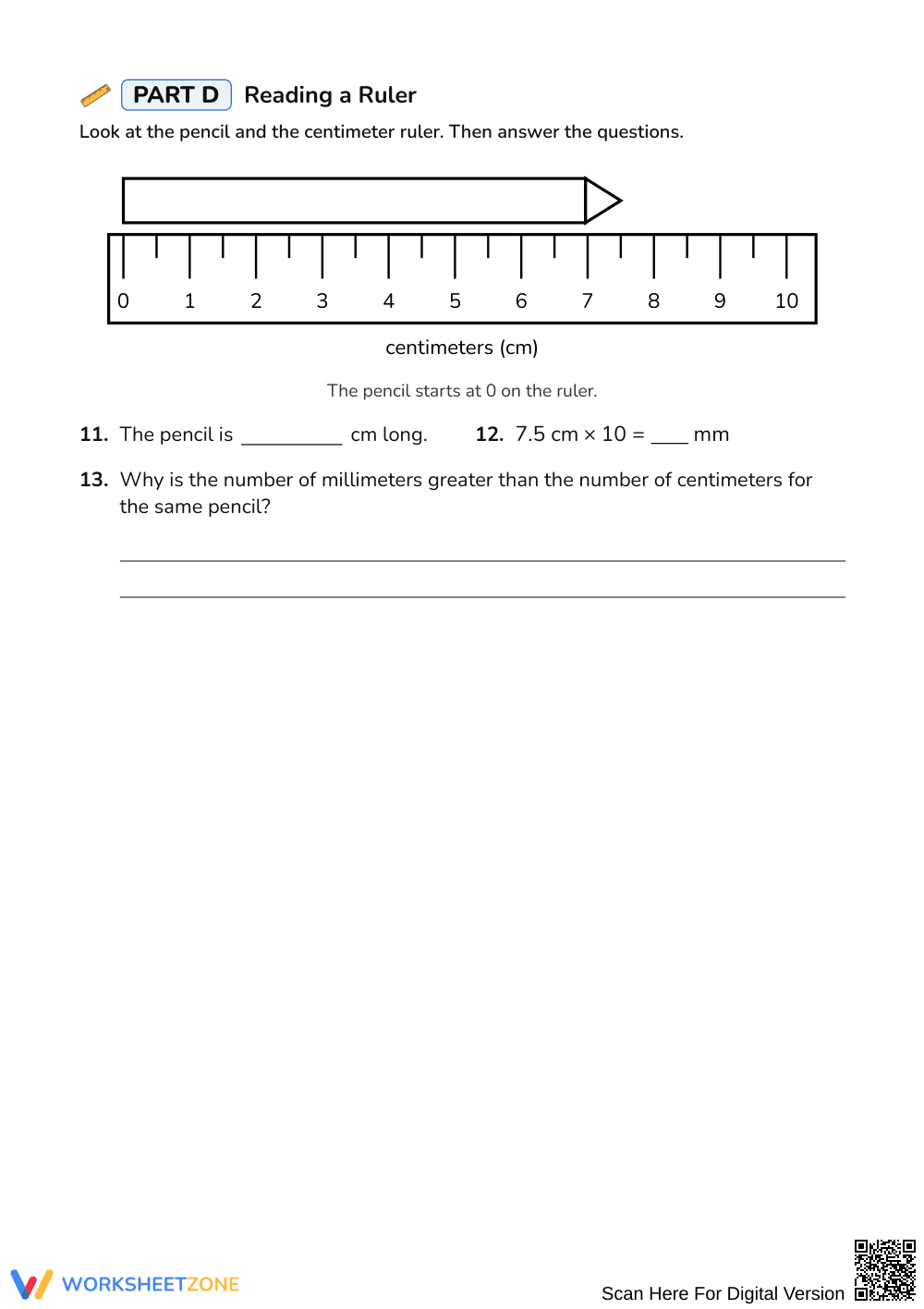
- Independent Practice (Part D): Students independently read ruler measurements in centimeters and millimeters, explaining why smaller units require larger numerical values.
This deliberate sequence follows the gradual-release model, transitioning students from scaffolded reference charts to independent conceptual reasoning.
Standards Alignment
This resource aligns directly to 4.MD.A.1: Know relative sizes of measurement units within one system of units, express measurements in a larger unit in terms of a smaller unit, and record measurement equivalents in a two-column table. It also supports 4.OA.A.1 through multiplicative comparisons. Both standard codes can be copied directly into lesson plans, IEP goals, or district curriculum mapping tools.
How to Use It
Use this worksheet during the guided practice portion of direct instruction or as a collaborative partner review. For formative assessment, examine student written justifications in Part D to verify that learners understand why smaller units yield larger counts. Expected completion time is 35 to 45 minutes.
Who It's For
This resource is tailored for fourth-grade general math classes, intervention small groups, and special education settings. English learners benefit from clear visual representations alongside mathematical symbols. Pair this printable with a classroom metric anchor chart or hands-on meter stick measurement activity.
Targeting standard 4.MD.A.1, this 3-page mathematics resource helps Grade 4 students master metric conversions by expressing larger units in terms of smaller units across multiple representations. Learners translate between unit prefix tables, arithmetic equations, ratio tables, bar graphs, and ruler diagrams across 26 targeted problems. Research from Fisher & Frey (2014) on the gradual release of responsibility underscores that pairing visual scaffolds with structured verbal explanations strengthens conceptual retention and procedural fluency in elementary mathematics. By progressing from reference ladders to independent written justification, students solidify their understanding of decimal-based measurement systems. The comprehensive answer key enables immediate feedback, supporting self-directed error correction during guided or independent practice sessions. Educators can directly cite this focused curriculum tool when documenting standards-aligned interventions for general classroom instruction, tier-two academic support, or individual education plans and progress reports.


